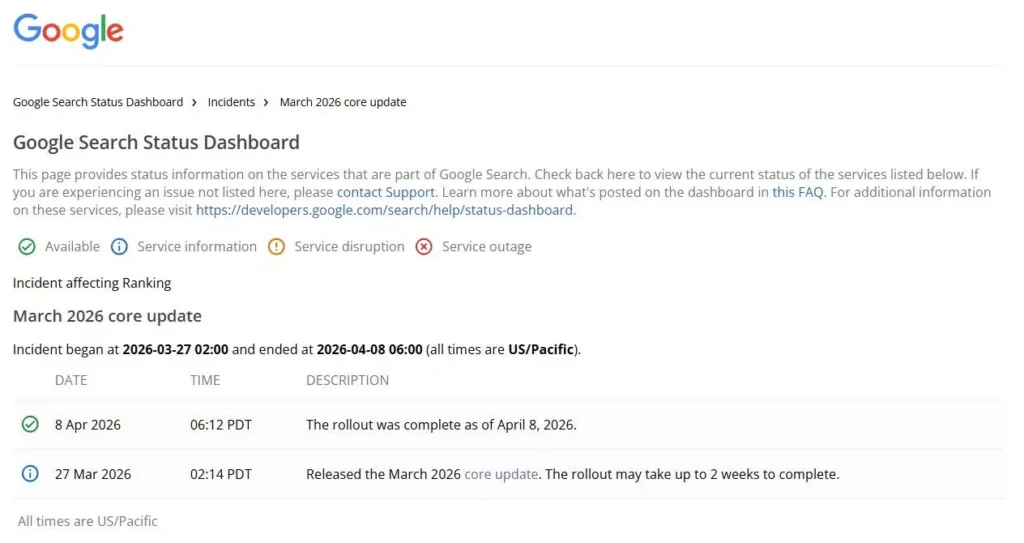
The March 2026 core update was a broad change to Google Search’s ranking systems, not a penalty aimed at specific websites. The rollout began on March 27, 2026 and finished on April 8, 2026, so what we know so far comes from a now-complete update, not early rollout noise.
Google says core updates happen several times a year and are meant to improve how Search evaluates content across the web as the web itself changes.
A core update can move strong pages up, push others down, and leave site owners guessing whether they were hit for doing something wrong, when that is often not the case.
Google’s own explanation is much simpler:
“Core updates are broad reassessments of relevance and quality, more like refreshing a ranked list than handing out punishments.”
The stakes are high because Google now sees over 5 trillion searches a year, and even a small visibility shift can affect traffic, leads, and revenue at scale.
Google also says it makes thousands of Search updates each year, though only some are publicly announced, which makes confirmed core updates especially important for site owners, publishers, and SEO teams to study closely.
Add to that the fact that the March 2026 rollout lasted about 12 days and 4 hours, and it becomes clear why this update matters: it had enough time to create real movement across many search results.
In this blog, we will break down what the March 2026 core update actually is and basically break it down for you!
What are Google updates?
Google updates are changes Google makes to the systems it uses to crawl, understand, rank, and show content in Search. Some of these changes are small and happen quietly almost every day.
Others are bigger, more visible, and can shift rankings across many websites at once. Google says it makes significant, broad changes several times a year, and those bigger changes are called core updates.
A core update is not the same thing as a penalty. It is a broad adjustment to how Google evaluates content across the web.
Why does Google release updates? It is to improve the overall quality of search results and surface content that is more helpful and reliable for searchers. That means pages can move up or down even when nothing is technically “wrong” with them.
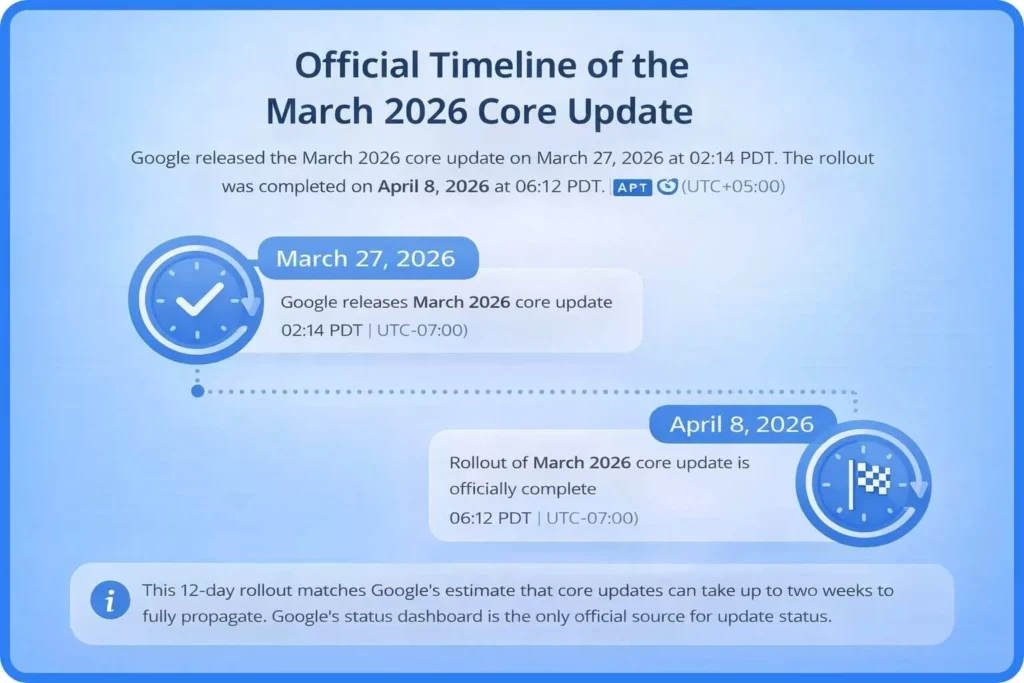
Official Timeline of the March 2026 Core Update
Relationship to the March 2026 Spam Update
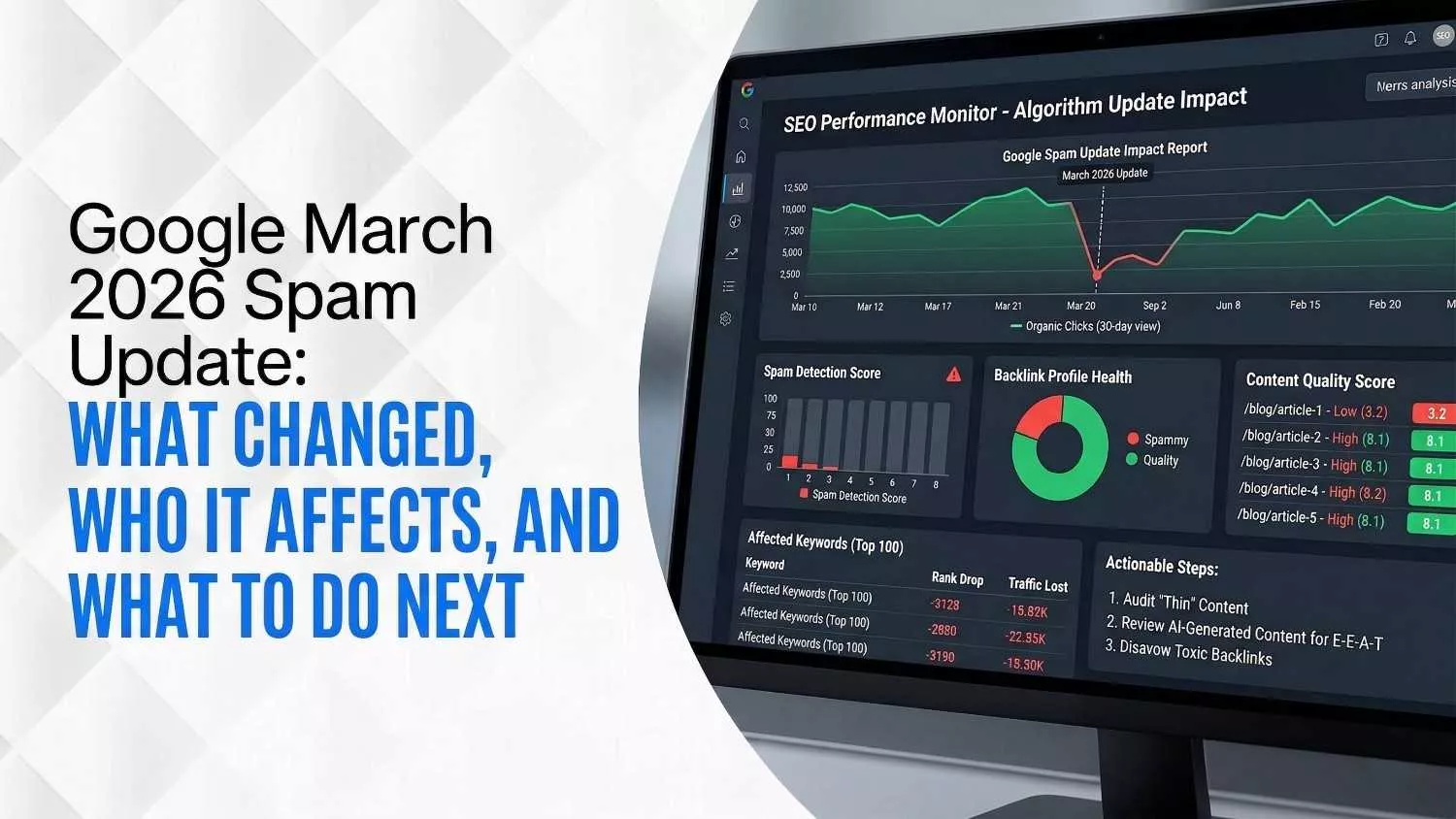
Just two days before the core update, Google completed a spam update (March 24–25) designed to remove low‑quality, manipulative content from the index. By clearing obvious violators first, the core update recalibrated ranking signals against a cleaner baseline.
In practice, sharp drops around March 24–25 are likely tied to the spam update, while gradual volatility from March 27 onwards is more attributable to the core update. Understanding this one‑two punch helps diagnose traffic fluctuations accurately.
What Changed in March 2026
1. Experience‑Led Content
The March 2026 core update reinforces Google’s commitment to rewarding first‑hand experience and depth over thin, generic summaries. Official guidance emphasises that high‑quality content, supported by real use cases, case studies and expert insights, will be prioritised. Low‑value or repetitive output, even if produced by AI, is unlikely to perform well.
2. E‑E‑A‑T Applies Everywhere
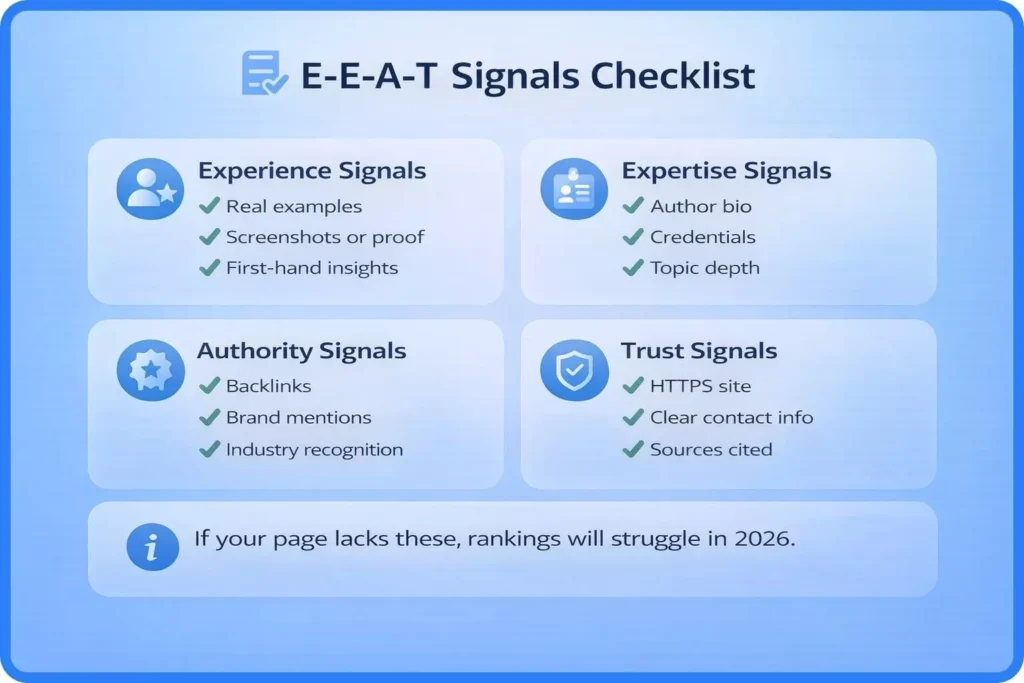
Google’s E‑E‑A‑T framework (Experience, Expertise, Authoritativeness and Trustworthiness) now influences all content types, not just health, finance, and legal topics. The update means sites of any size or niche must demonstrate real authorship, verifiable credentials and topical consistency.
Content that lacks depth or is thinly rewritten from other sources risks demotion. To improve E‑E‑A‑T:
Experience: Use first‑hand observations, detailed case studies, tutorials or process walkthroughs showing you have actually used the products or services you write about. For example, instead of summarising “how to optimise images,” describe the exact tools and steps you used on your own site.
Expertise: Associate articles with authors whose credentials are verifiable, link to their professional profiles or credentials pages. Anonymous or fictitious authorship can hurt rankings.
Authoritativeness: Focus your domain on a clear topic area and cover it comprehensively. Scattershot content across unrelated subjects dilutes authority.
Trustworthiness: Ensure technical basics like HTTPS, accurate citations, transparent ownership and up‑to‑date publication dates.
3. Stricter Search‑Intent Matching
Google continues to refine how it matches search intent with content. Content must align with the specific intent of the query, informational, navigational, commercial or transactional.
This shift means that pages optimised for exact keyword matches but lacking true user intent satisfaction may lose visibility. Each page should deliver exactly what searchers expect when they use certain terms, with clear headings and well‑structured answers.
4. Technical & User‑Experience Emphasis
While content quality remains central, the March 2026 update reaffirmed that technical performance and user experience are ranking factors. Google highlights Core Web Vitals, Largest Contentful Paint (LCP), Interaction to Next Paint (INP) and Cumulative Layout Shift (CLS) as key metrics. Pages that load quickly, respond smoothly and maintain visual stability are more likely to retain rankings. Ensure your site meets these benchmarks by optimising images, scripts and server response times.
5. Continued Anti‑Spam Reinforcement
Google’s spam policies remain in effect. After the spam update, Google continues to reassess content quality to ensure manipulative tactics do not regain visibility. This underscores the importance of eliminating low‑value content, keyword stuffing, hidden text, link schemes and other spammy practices.
Who Is Most Impacted?
The March 2026 core update produced winners and losers across industries. Although Google does not target specific sites, patterns have emerged:
Sites Likely to See Declines:
Scaled AI content without original expertise: High‑volume AI‑generated posts without unique insights or first‑hand experience are vulnerable.
Thin affiliate content: Pages that simply republish manufacturer descriptions or product feeds with little added value tend to lose visibility.
Syndicated articles without added value: Republishing news or blog posts from other outlets without commentary or analysis can result in ranking drops.
Lack of author credentials: Content that omits clear author bios or hides the identity of the writer undermines trust.
Sites Likely to Gain:
Verified authorship and professional credentials: Pages that credit real experts, link to credential pages, and maintain transparent authorship see stronger signals.
Original analysis and research: Content offering proprietary data, case studies or unique viewpoints rather than re‑hashing existing information tends to rise.
Focused topical authority: Sites covering their niche deeply and consistently build authority across the domain.
Technical health: Meeting Core Web Vitals, ensuring mobile responsiveness and maintaining clean site architecture support rankings.
GEO‑ready structure: Structuring content so AI systems (e.g., AI Overviews or other generative engines) can extract and cite answers improves visibility. This practice, sometimes called Generative Engine Optimisation (GEO), involves clear headings, concise answers, schema markup and citing authoritative sources. Brands cited within AI Overviews often receive a significant increase in click‑through rate, even when their traditional ranking remains the same.
Impact on AI Overviews and Generative Engine Optimisation
AI‑driven answer boxes, such as Google’s AI Overviews, summarise information directly on the results page. Studies across thousands of informational queries reveal that when an AI Overview appears, the organic click‑through rate (CTR) can drop sharply.
For example, analyses have shown organic CTR falling from around 1.76% to 0.61% when AI overviews are present, a 61% decline. In other words, holding a top ranking no longer guarantees traffic; being cited within the AI Overview may matter more than the blue link position.
Brands cited inside AI Overviews reportedly earn 35% more organic clicks and 91% more paid clicks than brands not cited on the same query.
Generative Engine Optimisation (GEO) is an emerging discipline that bridges traditional SEO with AI citation strategies. GEO involves structuring content in a way that AI systems can extract concise, authoritative snippets: using clear subheadings, answering questions directly, adding structured data (like FAQPage or HowTo schema) and linking to reputable sources. GEO is not a replacement for SEO; rather, it enhances the chance that high‑quality content will be cited in AI responses, thereby recovering traffic lost to zero‑click results.
How to Diagnose the Impact of a Core Update
Google advises site owners to take a measured, data‑driven approach when evaluating traffic drops:
Confirm rollout completion: Use Google’s Search Status Dashboard to verify that the core update has finished. Do not analyse traffic trends until at least a week after completion.
Compare accurate date ranges: In Search Console or analytics, compare a full week after the update to a comparable week before the rollout. This helps pinpoint genuine declines versus normal daily fluctuation.
Review top pages and queries: Identify which pages experienced the largest drops and evaluate how they compare to competing pages. Minor position changes (e.g., dropping from #2 to #4) may not require drastic action; a fall from #4 to #29 does.
Analyse by search vertical: Determine whether the decline occurred in web search, images, videos or news. Different verticals may be affected differently.
Assess site‑wide quality: If the drop is large and sustained, conduct a holistic assessment of your site and its content. Ask neutral parties to review your pages using Google’s self‑assessment questions on helpful, reliable content.
Recovery and Optimisation Strategies
While there is no magic fix for a core update, there are sustainable steps you can take to recover and build long‑term resilience:
1. Perform a Comprehensive Content Audit
Identify which pages lost traffic, which are outdated or thin, and where competitors now outrank you. Look for gaps in depth, relevance or freshness. Remove or consolidate low‑value content and plan improvements.
2. Deepen Content Quality and Relevance
Enhance your articles with detailed explanations, original research, statistics and real‑world examples. Align each page with a specific search intent and answer related questions clearly. Resist the temptation to target broad keywords without providing comprehensive answers.
3. Strengthen Internal Linking
Improve site architecture by adding contextual internal links. This helps Google understand how pages are related, distributes link equity and encourages users to explore further. A clear navigation structure also improves user experience and reduces bounce rate.
4. Enhance Technical SEO
Ensure pages load quickly, especially the main content elements. Optimise images, compress files, leverage browser caching, and adopt responsive design. Fix crawl errors, broken links and duplicate content. Maintain a logical URL structure and use HTTPS throughout your site. Technical health is foundational; no amount of content quality will compensate for an unusable site.
5. Build Author Authority and Transparency
Create detailed author bios with verifiable credentials. Link to professional profiles and highlight contributions to reputable publications or industry events. Encourage authors to share unique insights and experiences. Transparent, human authorship fosters trust and satisfies E‑E‑A‑T requirements.
6. Adopt GEO‑Friendly Structures
Use descriptive headings (<h2>, <h3>) that reflect questions users might ask. Provide concise, well‑formatted answers directly under those headings. Implement structured data such as FAQPage, HowTo, Article and Organization schema to signal key information to AI systems. Cite authoritative sources within your content to improve the likelihood of being referenced in AI summaries.
7. Monitor Continuously but Act Patiently
Google notes that improvements may take several months to manifest in Search results. Ongoing monitoring is vital, but avoid overreacting to short‑term fluctuations. Focus on sustainable enhancements rather than chasing quick wins.
Need Expert Help?
After reviewing your content and making improvements, consider seeking expert guidance. Need a hands‑on audit of your site? Our team at Wide Ripples Digital can perform a comprehensive SEO and GEO assessment tailored to your business.
We’ll analyse your content depth, author signals, Core Web Vitals and schema markup, then provide a clear action plan. Contact us today for a free consultation and ensure your site is prepared not just for this update, but for the evolving future of search.
FAQs About the March 2026 Core Update
When did the March 2026 core update begin and end?
Google released the March 2026 core update on March 27 2026, and the rollout concluded on April 8 2026. The rollout lasted roughly 12 days, matching Google’s guidance that core updates can take up to two weeks.
How is the core update different from the spam update?
The spam update (March 24–25) targeted sites using manipulative tactics such as link schemes or auto‑generated low‑quality content. The core update, released two days later, reweighted ranking signals across all content types. Sharp drops around March 24–25 likely stem from the spam update, while gradual volatility after March 27 is attributed to the core update.
Will AI‑generated content be penalised?
Google’s Search Liaison has clarified that the quality of content, not the method of production, determines performance. AI‑assisted content can rank well if it demonstrates experience, expertise and provides value. The violation lies in the abuse of scaled content, publishing high volumes of unoriginal AI content to manipulate rankings.
How long does recovery take if my site was hit?
There is no fixed timeline. Google notes that improvements may take days to months to be reflected in Search results and could require waiting until the next core update. Focus on long‑term improvements rather than expecting immediate recovery.
Should I delete content that lost rankings?
Deleting content is a last resort. Google recommends avoiding quick‑fix changes and instead focusing on sustainable improvements. If content truly cannot be salvaged (for example, thin pages created solely for search engines), deletion may help the remaining quality content perform better.
Why is my ranking stable but traffic dropping?
AI Overviews can reduce click‑through rates even when your position holds steady. Being cited within AI summaries can generate more traffic than a top ranking without a citation. Implement GEO practices to increase your chances of being cited.