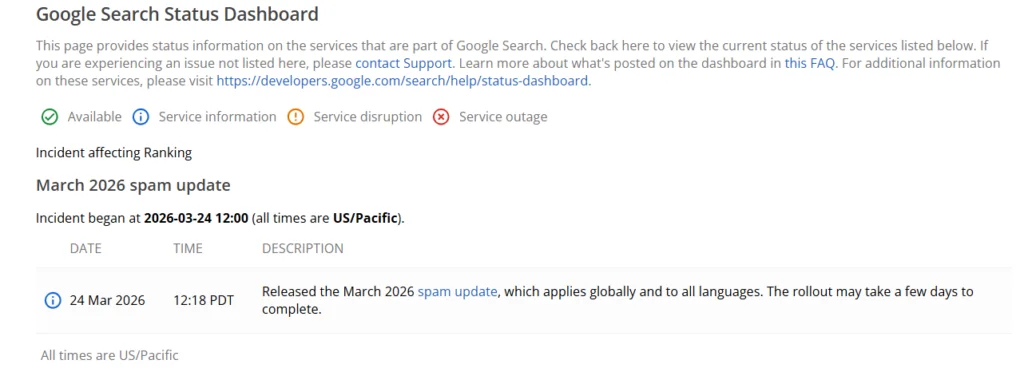
The March 2026 spam update is live, and Google has confirmed only a few core facts so far: it began on March 24, 2026, it applies globally, it affects all languages, and the rollout may take a few days to finish. For site owners, the real question about the Google spam update 2026 is not whether rankings moved yesterday. It is whether your site depends on tactics that Google already treats as spam, even if they looked fine a week ago.
That is why this article matters. Most early coverage repeats the announcement, then stops. What you actually need is a clear way to separate facts from guesswork, spot the pages most at risk, and make smart decisions before panic leads to bad edits.
What changed, and what did not
Here is the honest answer: Google has not published a detailed list of what changed inside this update. That matters. When Google stays broad, the smartest response is not to invent a target. It is to review your site against the spam framework Google already uses.
Google’s own documentation explains that spam updates are notable improvements to its spam-detection systems. It also says sites that lose visibility after one should review their compliance with spam rules, and that improvements can take months to be reflected once the systems learn that the site now complies. Google also notes that when an update is specifically about link spam, the benefit previously gained from spammy links may simply disappear and not come back.
So, what is actually new right now? Not a new public rulebook. What is new is enforcement.
A quick comparison with the last announced spam update
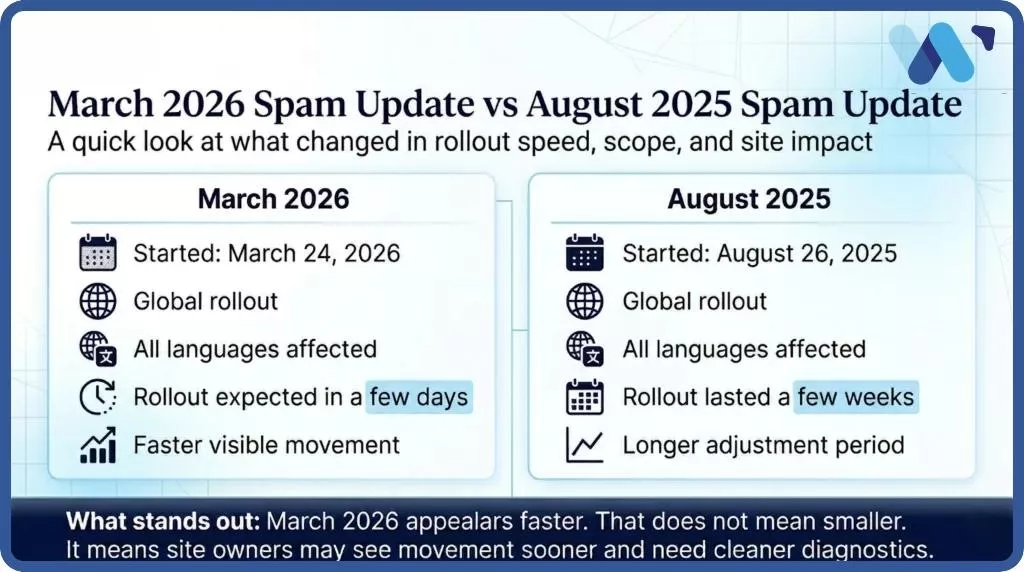
The March 2026 Google spam update rollout looks different from the last announced spam update in one simple way: speed. Google’s August 2025 spam update took a few weeks to complete and ran until September 22, 2025. This new update has been announced with a much shorter rollout window. That does not necessarily mean the update is smaller. It just means Google expects the visible adjustment period to be tighter.
Update
Start date
Rollout guidance
What that suggests
March 2026 spam update
March 24, 2026
A few days
Fast enforcement window, quicker visible movement
August 2025 spam update
August 26, 2025
A few weeks
Longer adjustment period, slower pattern reading
Table placement note: If you are publishing this on your site, this is a strong place to insert a styled comparison table or a short infographic.
The biggest mistake people will make this week
Many will assume Google is targeting one specific trend.
That is where early chatter usually goes wrong. Some people will say this is mainly about AI content. Others will say parasite SEO. Others will blame backlinks. But Search Engine Journal noted that Google has not announced any new spam policy categories with this update, which means the existing spam framework remains the right lens for analysis.
That point matters more than it seems. If Google had introduced a brand-new public standard, the conversation would be different. Instead, this looks more like a stronger application of rules that site owners have already had time to read, ignore, or work around.
Which sites should look hardest at themselves now
Your cleanest lens is still Google spam policies. That is where the risk patterns are spelled out, and those patterns map closely to the kinds of shortcuts many sites still use at scale. Google explicitly lists scaled content abuse, doorway abuse, expired domain abuse, site reputation abuse, cloaking, and other manipulative practices as violations. In plain terms, that means the danger zone includes large batches of low-value pages, city or service pages built mainly to catch near-identical queries, repurposed expired domains used for ranking leverage, and third-party content published mainly to borrow a host site’s authority.
That risk is especially real for four groups of sites.
First, affiliate and lead-gen sites that scaled faster than their expertise. A site can look polished and still be weak if its pages say the same thing in multiple ways, with only the place name or service label changed.
Second, local SEO sites with mass-produced landing pages. One clean city page is not the issue. Fifty thin variations with nearly identical copy, weak proof, and soft redirects in the funnel can become a pattern problem.
Third, established publishers that hosted outside commercial content because it ranked easily under their domain. Google has been tightening its stance here for a while, so any section that feels disconnected from the core purpose of the site deserves a hard review.
Fourth, sites that confuse output with usefulness. Publishing more pages does not create more value. When the pages are unoriginal, generic, or built mostly to capture search variations, scale becomes a liability.
What does this mean for good sites that still see a drop
Not every decline during rollout week means your site is spammy.
Sometimes rankings wobble because a page drops from position two to four. Sometimes demand changed. Sometimes a template broke. Sometimes one group of pages lost traction while the rest of the site stayed steady. That is why diagnosis matters more than emotion.
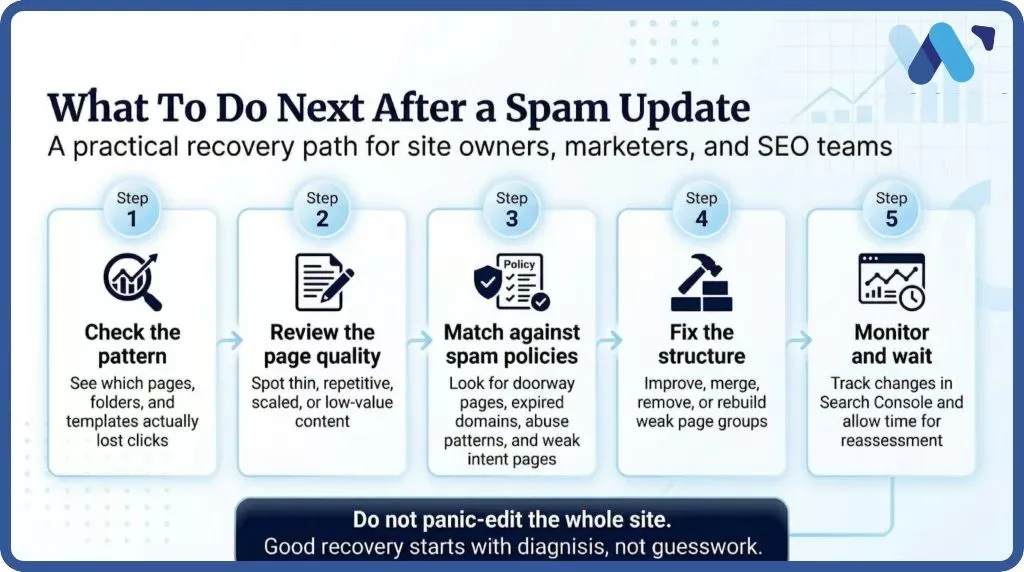
Start with pattern-finding. In Search Console, compare the drop period to a similar earlier period. Then break the loss down by page, query, country, and device. If only one page type is falling, that is a clue. If only one country or device group moved, that is a clue too. Google’s help documentation also recommends checking for periodic drops and looking at index coverage when the issue looks wider than a single page set.
This part is boring, but it saves months of wasted work. A site-wide content rewrite will not fix a canonical issue. A backlink cleanup will not fix a broken template. A fresh blog post will not solve a doorway pattern.
What to do in the first seven days
The first job is to hold still long enough to see the shape of the problem.
Do not start deleting half the site. Do not rewrite every title tag. Do not assume the homepage is the issue because traffic feels down. And do not trust a single third-party volatility chart more than your own data.
Instead, do this.
Review which directories, templates, or clusters lost clicks. If the drop is concentrated in city pages, old blog archives, review pages, or partner-hosted sections, that tells you where to inspect first. Open the worst-hit pages and ask simple questions. Is this page original? Does it serve a real user need on its own? Would I keep it if search traffic vanished? Is it clearly more useful than the next five results?
Then look for pattern signals: thin intros, repeated subheadings, recycled paragraphs, vague claims, weak sourcing, spun FAQs, and pages that exist mainly to pass users to another page. Those are the places where cleanup usually starts.
This is also a good time to check internal quality signals that often get ignored. Are your authors clear? Is your first-hand expertise visible? Do your pages carry real proof, examples, screenshots, pricing detail, or process detail? Spam systems and helpfulness systems are not the same thing, but weak pages often fail both tests at once.
How to recover from the Google spam update
Real Google spam update recovery starts with diagnosis, not publishing more content.
That means you should first isolate the tactic or page type that likely triggered the loss. If you find a thin cluster, merge and improve it. If you find doorway pages, remove the pattern instead of lightly rewording it. If you find outside commercial content living on your site only because your domain is strong, re-evaluate whether it belongs there at all. If you find an expired-domain play that added traffic but not trust, do not patch around it. Remove the abuse and rebuild on stable ground.
The hard truth is that cleanup needs to be structural. Cosmetic edits rarely solve structural spam patterns. Changing a few sentences on a bad template usually does not change the reason the template exists.
A second truth is just as important: patience is part of the work. Recovery is not always immediate because Google’s systems do not reward one quick edit and call it a day. They look for sustained compliance and a better long-term quality pattern.
A practical recovery plan that site owners can follow
Begin with page groups, not isolated URLs. It is easier to fix a pattern than to chase one page at a time.
For each affected group, choose one of four actions: keep, improve, merge, or remove.
Keep the pages that are original, specific, and clearly useful.
Improve the pages that have value but are too thin, too generic, or too repetitive.
Merge pages that compete with each other and say mostly the same thing.
Remove pages that only existed to catch search demand without real standalone value.
After that, review linking and site architecture. Spam issues are not only about wording. They can live in how a site routes authority, how it creates similar-entry pages, and how it hides weak pages behind strong navigation.
Then check Search Console for manual actions. If Google has applied one, fix the issue completely before you request a review. Google’s Manual Actions report explains that manually detected attempts to manipulate the search index can cause pages or whole sites to rank lower or be omitted, and that once the violations are fixed you can request a review through Search Console.
That is the point where many sites fail. They ask for forgiveness before they have really changed the system that created the problem.
The smarter takeaway for publishers, agencies, and local businesses
This update is bigger than one week of rank swings.
It is another reminder that SEO built on scale-first shortcuts keeps getting more fragile. The safer model is slower, but it lasts longer: original pages, fewer duplicates, stronger evidence, tighter editorial control, clear purpose, and a site structure that makes sense even without search traffic.
That does not mean you need a tiny site. It means every page needs a reason to exist.
The March 2026 spam update is not just another SEO headline. It is a stress test for how your site was built. Sites that relied on borrowed authority, thin page factories, or ranking-first publishing are the ones that should worry most. Sites that use search to distribute genuinely useful work still need to review their data, but they do not need to panic. They need to diagnose carefully, fix what is real, and let the noise pass.