In Canada, service businesses operate in a vast and competitive landscape, spanning bustling cities like Toronto, Vancouver, Calgary, Montreal and numerous smaller towns. Customers increasingly rely on mobile searches to find local services, searching for terms such as “mechanic near me” or “therapist in Mississauga.” Local search results display a map with a handful of businesses at the top of the page, and studies show that businesses appearing in this “map pack” get most of the calls and visits.
Local SEO for service businesses in Canada is the process of optimizing your online presence so that Google and other search engines prominently display your business when nearby customers search. Without a strong local SEO strategy, even high‑quality service providers struggle to appear on Google’s map, and 60 % of smartphone users contact a business directly from those local search results.
This guide explains what actually moves rankings in local search, how to build long‑term visibility, and how to serve Canadian customers throughout the year.
What Is Local SEO and Why Does It Matter
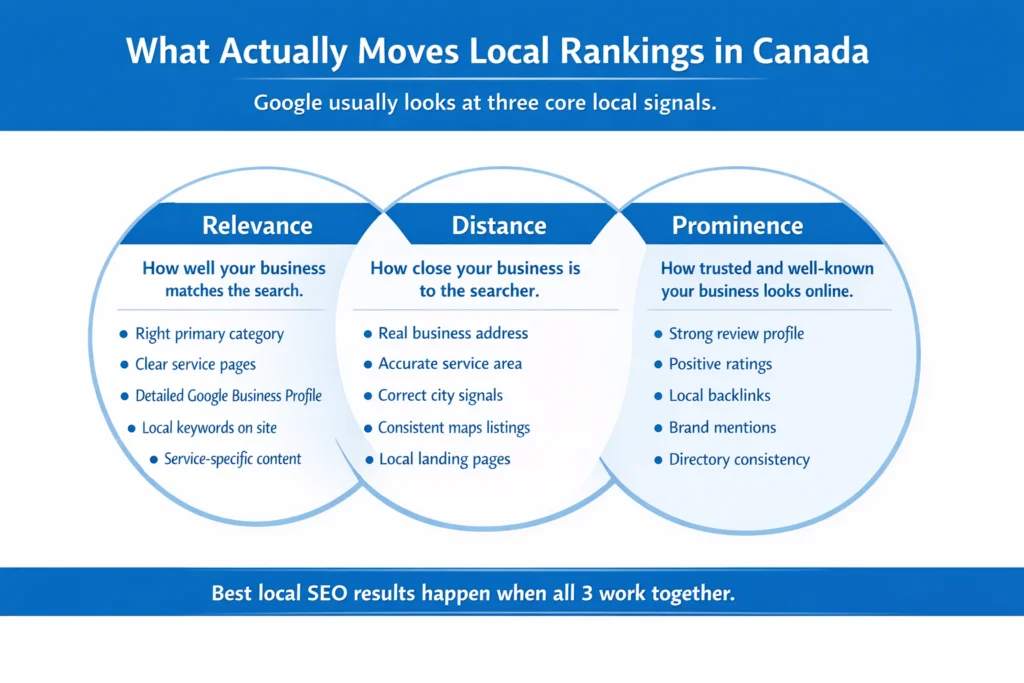
Local SEO focuses on making your business visible to people near your location. When Google receives a search with local intent, it uses relevance, distance (proximity) and prominence to determine which businesses appear.
Relevance measures how well your business matches the search. Complete Google Business Profile information, industry‑specific keywords on your website and detailed services help Google understand what you offer.
Distance (Proximity) looks at how close your business is to the searcher. You can’t change your physical location, but you must keep your name, address and phone (NAP) accurate across the web.
Prominence gauges how well‑known and trusted your business is. Backlinks, social media mentions and positive reviews signal prominence.
Google’s own help page confirms that local results depend on relevance, distance and prominence. By optimizing for all three pillars, service businesses can earn a spot in the coveted Local 3‑Pack, which captures most clicks and conversions.
Local SEO vs. Traditional SEO
General SEO aims to rank content nationally or globally. Local SEO adds a geographic element, Google must understand where you operate. You therefore need local signals such as city names, postal codes and references to neighbourhoods, as well as accurate NAP citations across directories. Local SEO also emphasises Google Business Profile (GBP) optimization and reviews, which are less important in broader SEO campaigns.
Claim and Optimize Your Google Business Profile
The Google Business Profile is the foundation of local SEO. Experts notes that Google pulls map pack information directly from your GBP, and businesses with fully built profiles are more likely to appear. Follow these steps:
Claim and verify your profile. Verification via email, text or phone proves you own the business. Without verification, Google may show inaccurate information.
Fill out every field: business name, physical address, primary category, hours, local phone number and detailed description. Use the exact name on your storefront and avoid keyword stuffing. Google’s guidelines state that complete and accurate info increases your chances to appear.
Choose the right categories. Your primary category heavily influences where you appear in local searches. Use supporting categories for secondary services.
Add photos and videos. Upload your logo and photos of your storefront, team and services. Regularly updated visuals show that your business is active and increase click‑throughs.
Use Google Posts and messaging. Posts allow you to announce seasonal offers, events or tips, while messaging lets customers contact you directly.
Maintain accurate hours, including holidays. Google recommends keeping your hours up‑to‑date so users know when they can visit or call.
Pro Tip: Use UTM tags on your GBP website link to track traffic from your profile. This shows which queries drive visits and helps refine your strategy.
Manage Reviews and Build Reputation
Online reviews are critical. Review signals are the third‑most important ranking factor for Google’s Local Pack. Experts note that reviews provide contextual information about your products and services that Google picks up. Here’s how to manage them:
Encourage customers to leave reviews. Ask satisfied clients after appointments, send follow‑up emails or use SMS campaigns. Review‑request software can automate the process and filter negative feedback to you before it goes public.
Respond promptly and professionally, especially to negative reviews. A polite reply that resolves the issue can turn a 1‑star review into a 5‑star review. Reviews also contribute to the prominence signal.
Display reviews on your website. Use widgets or manually select compelling testimonials. Show star ratings prominently; high average ratings boost click‑through rates.
Monitor review sites regularly. Claim your listings on Yelp, Tripadvisor and niche directories; then track and respond to feedback. Removing fake reviews may require contacting Google’s support.
Local Citations and NAP Consistency
Citations, mentions of your business name, address and phone number on directories and websites, help Google verify your location. Inconsistent NAP data across listings can suppress rankings. Listing your business on top aggregators like Yelp, the Better Business Bureau and Apple Maps and ensuring your details match everywhere.
How to Manage Citations
Audit existing citations. Search your company name and city; note any outdated addresses or phone numbers.
Claim major directories. Create or update profiles on Google Business Profile, Bing Places and Apple Maps Connect. Then add your business to national directories (YellowPages.ca, Yelp.ca) and Canadian‑specific sites like 411.ca or Canada411.
Use local chambers and industry associations. These citations signal credibility and often include backlinks.
Employ citation management tools such as BrightLocal, Whitespark or Moz Local.
Keep information consistent. Even a missing suite number can create duplicates. Use the same formatting for addresses (St. vs. Street) across all platforms.
Pro Tip: For service‑area businesses (e.g., plumbers or electricians who serve multiple cities), list a real physical address, not a virtual office. Google now places more trust in businesses with verifiable addresses and may suspend profiles that use P.O. boxes.
Create Hyperlocal, Helpful Content
Modern local SEO isn’t just about citations, it’s about demonstrating expertise in your community. T Parker Marketing’s 2026 trends report emphasizes hyperlocal content marketing, suggesting that blogs targeting neighbourhoods and landmarks often outrank broader city‑wide pages. For example, a post titled “Best family dentists near Kitsilano Beach” may attract more relevant clicks than a generic “Best dentists in Vancouver.”
Content Strategies
Neighborhood‑specific blog posts. Write articles about local events, seasonal tips and neighbourhood highlights. Include landmarks, intersections and postal codes; this shows search engines you’re truly local. Hyperlocal content also builds trust with residents.
Case studies and success stories. Share real‑world examples of how your service solved a problem for a local client. Personal narratives and customer testimonials give you an edge over AI‑generated content.
Frequently Asked Questions (FAQs). Populate your website’s service pages and GBP Q&A section with questions customers typically ask. Answer them clearly to improve Answer Engine Optimization (AEO).
Update older content. Refresh your blogs regularly with current statistics and insights; Google prefers updated pages. Audit your top‑performing posts and schedule quarterly updates.
Use schema markup. LocalBusiness schema clarifies your business name, address, hours and services. Google can then create rich snippets and AI summaries that feature your business.
Keyword Research and On‑Page Optimization
Finding the right keywords requires a blend of SEO tools and local knowledge:
Identify service keywords. Use Google Keyword Planner, Semrush or Ahrefs to find core service terms such as “electrician,” “physiotherapist,” or “HVAC repair.”
Add geographic modifiers. Combine service terms with city names or neighbourhoods (“physiotherapist in Calgary SE”). These long‑tail keywords tend to convert better because they reflect specific intent.
Analyze competitors. Look at the keywords used by top‑ranking local competitors; tools like PlePer or GMBSpy can reveal the categories and keywords they use on their GBPs.
Optimize titles and meta descriptions. Include the focus keyword and city in your H1 tag and meta description. Keep meta titles under 60 characters and descriptions under 145 characters to ensure full display in search results.
Internal linking. Use descriptive anchor text linking your service pages and location pages. A logical structure helps search engines understand your site and spreads link equity.
On‑Page Essentials
Service pages for each city: Create separate pages for each service and location (e.g., /plumbing-mississauga/ and /plumbing-brampton/). Each page should feature unique content.
Structured headings: Use H2 and H3 tags to organize content. Include local keywords naturally. Avoid keyword stuffing; clarity and readability matter.
Alt text and captions: Describe images with location‑specific keywords. This improves accessibility and relevance.
Mobile‑friendly design: Over 50 % of searches occur on mobile devices. Ensure your site loads quickly (INP < 200 ms, LCP < 2.5 s, CLS < 0.1).
Build Quality Local Backlinks
Backlinks remain a significant ranking factor for local organic search. However, the quality and relevance of those links matter more than sheer quantity. Strategies include:
Sponsoring local events, charities and sports teams. These organizations often link back to sponsors, and the community exposure builds trust.
Partnering with complementary businesses. For example, a home cleaning service might write a guest blog on a real estate agent’s website.
Joining local associations and chambers of commerce. Membership directories provide authoritative backlinks and citations.
Media and PR. Pitch stories to local news outlets about community projects, awards or charitable efforts. Earned media generates high‑authority links and increases prominence.
Technical Optimization and Site Architecture
Search engines reward sites that load quickly and deliver a smooth user experience. Follow these technical tips:
Optimize for speed. Compress images, leverage browser caching and use a content delivery network (CDN). Aim for less than 2.5 seconds load time on mobile.
Secure your site. Use HTTPS encryption to protect user data.
Implement structured data. Use the LocalBusiness schema to mark up your business name, address, phone number, operating hours, and service area. Structured data helps search engines and AI assistants generate accurate local summaries.
Submit an XML sitemap to Google Search Console and Bing Webmaster Tools. Ensure all core pages are crawlable.
Accessibility. Use descriptive alt text and maintain contrast ratios for readability. An accessible site reaches more users and signals quality to search engines.
Seasonal and Geographic Considerations
Canada’s climate varies dramatically, from snowy winters in Winnipeg and Calgary to mild, rainy winters in Vancouver. Service businesses should adjust their local SEO strategies to reflect seasonal demands:
Seasonal keywords: In winter, HVAC companies might target “furnace repair in Edmonton” or “snow removal services in Montreal.” In summer, landscapers could optimize for “lawn maintenance in Halifax” or “sprinkler repair in Regina.” Update service pages and GBP posts accordingly.
Holiday hours and events: Update holiday hours on your GBP and website so that customers know when you’re open. Post about local events (e.g, Canada Day celebrations on July 1 or Calgary Stampede in July) to show community involvement.
Regional dialects and languages: In Québec, include French translations of your service pages and GBP descriptions. Use local terms (e.g, “déneigement” for snow removal).
Local landmarks and roads: Reference major highways (e.g., Highway 401 in Ontario, Trans‑Canada Highway) and neighbourhoods (e.g, Yonge–Eglinton, Gastown) to signal local relevance. Provide driving directions and mention transit options.
AI Overviews and Human‑First Content
Google’s AI Overviews are changing search results by providing summarized answers. Businesses create human‑first content and use AI to augment but not replace expertise. Here’s how to adapt:
Leverage real stories: AI struggles with nuance and local context. Share customer success stories, case studies and behind‑the‑scenes details of your service.
Humanize your brand: Show photos of your team and use conversational language. Include staff bios and local credentials.
Provide unique insights: Offer tips or tricks specific to your region (e.g., how to protect plumbing from freezing in the Prairies). AI cannot replicate local, experience‑based advice.
Monitor AI Overviews: Search for your keywords in Google to see if AI Overviews pull your content. Optimize pages with concise, well‑structured answers.
Conclusion and Next Steps
Local SEO is not a one‑time project but a continuous commitment to serving your community better. By optimizing your Google Business Profile, encouraging reviews, maintaining NAP consistency, creating hyperlocal content, and securing relevant backlinks, your service business can dominate local search results in Canada. Seasonal updates and human‑first content will keep your brand fresh and engaging.
Ready to take your local presence to the next level?
If you need expert help with local SEO or want a customized strategy for your service business, contact us. Our team specializes in Canadian service markets and can help you achieve sustained growth.
Quick FAQs
How long does it take to see results from local SEO?
Local SEO is an ongoing process. If you optimize your GBP, secure citations and publish local content, you can see improvements in 3–6 months; competitive niches may take longer. Regularly updating your site and GBP keeps you ahead of competitors.
Do I need a physical address to rank?
Yes. Google now requires a verifiable physical address for service‑area businesses; virtual offices can lead to suspensions. If you operate from home, hide your address but still provide a real location.
Which directories matter most in Canada?
Start with Google Business Profile, Bing Places, Apple Maps, YellowPages.ca, Yelp.ca and 411.ca. Local chambers of commerce and industry‑specific directories also provide valuable citations and backlinks.
How often should I post on my GBP?
Post at least once a week to signal activity. Share seasonal promotions, community events or new services.
Can reviews from international customers help my local SEO?
Yes, but reviews from local customers carry more weight because they reinforce your prominence and relevance within the searcher’s area.
Disclaimer: The information provided in this blog is for general informational purposes only. For professional assistance and advice, please contact experts