Artificial‑intelligence (AI) answer engines like Google’s AI Overviews and generative systems in chat tools create a summarized answer before the user clicks through. For Canadian brands, this is both an opportunity and a risk: recent research shows that AI summaries reduce clicks to result links, only 8 % of searches with an AI summary resulted in a click versus 15 % without, and just 1 % of users clicked a cited source.
AI systems increasingly draw on government (.gov) and authoritative websites, making it crucial for Canadian organisations to be part of the cited answer. To surface your content in AI answers you must follow a combination of technical eligibility (crawlable pages, structured data) and extractable content structure (answer‑first paragraphs, question‑led headings, lists and proofs).
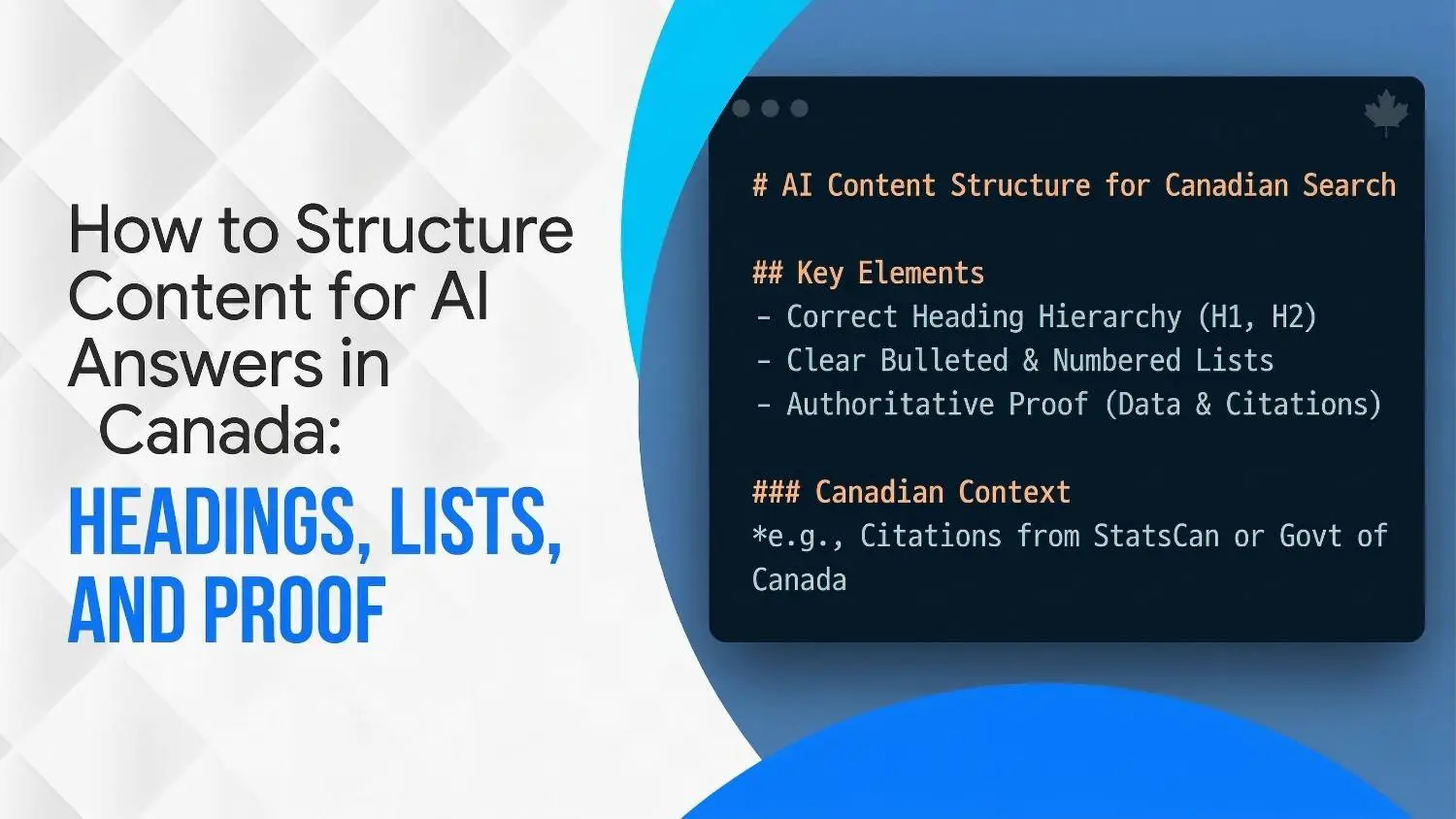
This guide explains how to structure content for AI answers and what you have to do:
Why AI answers change the game for Canadian SEO
Traditional SEO sought to rank webpages on results pages. AI answer engines summarise information across multiple sources and many users never click through, so being cited in the summary is now the goal.
A Pew Research Center analysis of 68,879 Google searches in March 2025 found that AI summaries appeared for about 18 % of searches and users rarely clicked the sources inside them. The same study noted that longer queries and questions starting with who, what, when, why were more likely to trigger AI summaries.
Another insight was that government websites appear more often in AI summaries than in standard search results. This gives the Canadian government and official organisations a built‑in advantage, but only if their content is structured for machine extraction.
AI overviews use a query fan‑out technique, issuing related searches across subtopics. This means your content must not only answer the primary question but also provide self‑contained sections answering the follow‑up questions.
According to Google’s own documentation, there are no special files or schema required to appear in AI Overviews; instead, follow standard SEO best practices (indexability, crawlability, internal linking, structured data and good page experience).
From a Canadian perspective, Generative Engine Optimization (GEO), the process of making your content easy for AI assistants to find, understand and use, is becoming essential.
In Canada, compliance with bilingual requirements and accessibility standards must be integrated into this foundation, as discussed later.
The goal of your AI‑answer strategy
The overarching goal is to ensure that when someone in Canada or abroad asks a question that your organisation can answer, such as “What is the best time to visit Banff in winter?” or “How do I renew a Canadian passport?”, the AI system pulls your information and cites your page. To achieve this you must:
Be eligible: make sure your page is crawlable, indexed and snippet‑ready. Fix robots.txt, canonical, rendering and snippet preview issues. Government of Canada guidelines also require AI outputs to include at least one authoritative citation.
Structure for extraction: present each answer in a clear answer‑first block with a direct sentence, bullet list and supporting detail. Use descriptive, question‑based headings to mirror user queries.
Prove credibility: cite authoritative sources, indicate dates and regions, and provide transparent authorship. Google’s people‑first guidelines stress demonstrating expertise, authoritativeness and trustworthiness (E‑E‑A‑T).
Localise and humanise: include Canadian geography, bilingual considerations and local regulatory context. Canada.ca guidelines require French and English versions and language‑matched citations.
The sections below explain how to implement these principles.
Technical prerequisites: becoming eligible for AI features
AI answer engines will not cite your page if it is not eligible. Google clarifies that there are no extra technical requirements for AI Overviews beyond standard indexing; a page must simply be crawlable and able to appear with a snippet.
Below is a step‑by‑step checklist aligned with Google’s guidance:
Requirement
Action & Canadian considerations
Crawling allowed
Ensure robots.txt and CDN rules allow Googlebot and other engines. Use Search Console to confirm no-block status.
Indexability & rendering
Fix noindex tags, canonical errors and soft‑404s. Test rendering to ensure main content loads without user interaction.
Snippet eligibility
Do not block snippets with nosnippet or data-nosnippet tags unless intentionally limiting AI use. Use the URL Inspection tool to verify snippet eligibility.
Metadata & structured data
Provide unique titles and descriptions (120–160 characters), and implement structured data (Organization, LocalBusiness, Article, BreadcrumbList) that matches visible text. Use schema to clarify entities such as your organisation’s address, phone number, hours and services.
Internal linking & navigation
Link relevant pages within your site so AI can understand relationships. All important pages should be accessible within six clicks. Use anchor text that reflects real follow‑up questions.
Site health & speed
Repair broken links, ensure mobile‑friendly design, and aim for high Core Web Vitals scores. Destination Canada suggests a site health score of 80–90/100 and emphasises page speed as part of GEO.
Bilingual compliance & accessibility
Provide English and French versions of AI content; citations should link to pages in the same language as the user session. Follow the Standard on Web Accessibility for navigation and screen‑reader compatibility.
Pro tip: add a “last updated” note with a date, especially for legal or time‑sensitive topics; this improves verifiability and signals recency.
Additional eligibility tips for Canadian organisations
Local business details: ensure your Name, Address and Phone number (NAP) are consistent across your site and external citations. Experts notes that consistent NAP details improve credibility and local visibility.
Technical measurement: use Search Console’s Performance report to track AI features traffic. AI citations may not drive high click volume but they improve brand exposure.
Privacy & transparency: Canada.ca requires AI applications to display notices about privacy, potential errors and how data will be used. For AI answer pages, include a disclaimer that AI can make mistakes and instruct users to verify information.
Answer‑first content: deliver the answer upfront
AI systems scan pages and extract concise answers. Answer‑first content places a clear, direct response at the top of the page or section, followed by supporting details. This structure makes the answer easier to quote and helps users quickly confirm they’re in the right place.
Model your answer block
Use the I‑A‑C‑E‑N blueprint recommended by SEO experts: Intent → Answer → Context → Evidence → Next step. Here’s how to implement it in a Canadian context:
Intent: Define what job the page or section does: inform (explain a concept like “what is GEO?”), compare (e.g., “GEO vs SEO”), help decide (e.g., “which Canadian province offers the most AI‑friendly policies?”) or guide action (e.g., “renew your passport”).
Answer: Immediately after the heading, write 1–2 sentences summarising the answer. AI overviews rarely include more than 67 words per summary, so brevity is key.
Context: Provide bullet points or a short paragraph explaining the “how” and “why.” Use numbered lists for processes and bullets for criteria or benefits.
Evidence: Cite authoritative sources. Canada.ca guidelines say every AI answer must have at least one authoritative citation, preferably to a Government of Canada page. Include dates and regional context when quoting statistics.
Next step: End each section with a clear call‑to‑action or link directing readers to a deeper resource, service page or related guide.
Why answer‑first works
Answer‑first content respects both human and AI readers. People confirm they’re in the right place, and AI can extract a complete answer without misinterpreting context. The SEO Team Toronto blueprint emphasises starting each section with a direct answer followed by bullets, and Google’s documentation notes that AI features use “query fan‑out” to explore subtopics.
By aligning your headings with real queries (e.g., How do I apply for a student permit in Canada?) and placing the answer up front, you make your content more likely to appear in AI summaries.
Avoid: long introductions, vague headings and burying the answer mid‑paragraph, common mistakes that competitor analyses reveal. Google’s people‑first guidelines explicitly discourage content that leaves readers needing to search again.
Structuring headings for AI: match the question & stay concise
AI answer engines rely heavily on heading tags (H1, H2, H3) to interpret your content structure. Use them strategically:
Rules for AI‑friendly headings
Mirror search queries: Use headings that reflect real questions or search phrases. For example, instead of “Services,” use “What services does our Toronto AI agency offer?” The SEO Team Toronto guide notes that question‑led headings produce better AI extraction.
One idea per section: Each H2 should answer one question. Avoid combining unrelated topics.
Hierarchy: Follow a logical H1 → H2 → H3 hierarchy to signal context. Google emphasises the importance of a clear information hierarchy and natural progression.
Avoid cleverness: Save creativity for your copy; headings should be descriptive and direct. Complicated or pun‑filled headings confuse both users and algorithms.
Keep them concise: An H2 should be descriptive but brief (5–10 words). Use H3s and bullet lists for subpoints.
Language considerations: Provide French equivalents where relevant. Canada.ca guidelines require that the language of the citation matches the language of the answer.
Using lists and tables
Lists help AI understand relationships. Use bulleted lists for benefits, criteria or parallel ideas, and numbered lists for steps or processes.
Avoid dense paragraphs; AI systems extract information in chunks, and long paragraphs are difficult to parse. When comparing options (e.g., “SEO vs GEO”), consider a simple table or structured list with sub‑bullets (“Option / Best for / Tradeoff / What to look for”).
Pro tips for formatting:
Use bold text to emphasise critical phrases, such as “Direct answer first” or “Citation required”.
Add anchor links (jump links) within long guides so readers (and AI) can quickly navigate to sections.
Keep paragraphs to 2–4 sentences; this isolation makes each idea more extractable.
Incorporating proof: citations, evidence and E‑E‑A‑T
AI engines favour verifiable information. Government of Canada guidelines for AI help applications state that all in‑scope answers must include at least one authoritative citation link, preferably to a Government of Canada page. Here’s how to build proof into your content:
Cite authoritative Canadian sources
Government websites: .gov sites are more frequently cited in AI summaries. Use Canada.ca, provincial tourism boards and official municipal pages as references.
Research institutions: Quote data from universities, Statistics Canada and peer‑reviewed studies. Include the date and region (e.g., “Statistics Canada 2024, Ontario”).
Industry associations: For travel content, cite Destination Canada or regional DMOs (Destination Ontario, Tourism Vancouver). For technology topics, reference industry standards and organizations such as the Standards Council of Canada.
Show experience, expertise, authority and trust (E‑E‑A‑T)
Google’s people‑first guidance highlights E‑E‑A‑T as a key indicator of quality. To demonstrate these factors:
Experience: Share first‑hand knowledge, case studies or client stories relevant to the topic (e.g., your agency’s experience optimising AI content for a Vancouver tourism board).
Expertise: Provide bios for authors with credentials. Canada.ca guidelines encourage specifying who created the content and how.
Authority: Link to external recognitions (e.g., awards, certifications) and highlight partnerships. Destination Canada emphasises building a strong online reputation through backlinks and positive reviews.
Trust: Include clear privacy statements and AI‑generation disclosures. Canada.ca requires transparency about AI use and accuracy testing.
Build a simple facts base
Wide Ripples Digital suggests creating a facts-based summarising your service definitions, audience, process, pricing ranges and proof points. Keep this base consistent across your site, Google Business Profile and directories to reinforce your entity.
Contextual depth & topical clusters: from pillar to cluster content
AI answer engines favour content that covers a subject comprehensively. Instead of publishing dozens of shallow articles, build cornerstone guides that act as your pillar content and support them with related articles. Here’s how to implement this:
Identify core topics relevant to your audience. For example, a tourism board might have pillars like “Winter activities in Quebec,” “Visa requirements for Canada” and “Indigenous tourism experiences.” An AI‑focused agency might have pillars like “AI search optimization for Canadian businesses” and “Bilingual content strategies for AI.”
Develop pillar pages that answer the broad question comprehensively using the answer‑first model. Each pillar should exceed competitor length (e.g., 2,500+ words) and include multiple subsections.
Create cluster articles targeting specific questions (e.g., “How to drive from Toronto to Banff,” “Best time to see the Northern Lights in Yukon”). Each cluster piece should link back to the pillar and to other clusters, creating a web of internal links.
Use clear URLs (slugs) that reflect the query (e.g., /ai-search-optimization-canada instead of /blog123).
Update regularly to reflect seasonality. Tourism content in Canada is particularly seasonal; update itineraries to reflect winter vs summer conditions and daylight hours. In technology topics, update after major algorithm changes (e.g., Google or Bing AI updates) and date your content accordingly.
Seasonal tip: for travel guides, include best months to visit each destination and mention Canadian holiday periods (e.g., July 1 for Canada Day, late December to January for winter travel). For AI‑related guides, note when major AI features were launched (e.g., Google’s AI Overviews rolled out to US users in 2024 and expanded in 2025) and update when they reach Canada.
Localising content: speak to Canadians & reflect bilingual needs
AI systems sometimes default to United States sources. To ensure your content is recognized as Canadian:
Define your entity clearly. Thread Digital emphasises “entity clarity” – specify who you are, what you do, where you operate and whom you serve. For example, instead of “We are an SEO agency,” write “We are an SEO and AI search optimisation firm based in Toronto serving businesses across Ontario and Atlantic Canada.”
Reinforce geographic signals. Mention cities (Toronto, Montreal, Vancouver), provinces and attractions (Banff National Park, Niagara Falls). Use internal links to pages about your offices or regional services.
Meet bilingual requirements. Experts instructs that if a user visits a French page, the AI application should cite French sources, and vice versa. Provide French versions of headings and answers; for example, pair “When is the best time to visit Nova Scotia?” with “Quand visiter la Nouvelle‑Écosse ?”
Use Canadian terminology and spelling. Write “favour” instead of “favor,” “centre” instead of “center” and include uniquely Canadian terms like “loonie” or “toque” when relevant.
Comply with accessibility. Ensure navigation is keyboard‑accessible and screen‑reader friendly. Provide alt text in both official languages for images.
Answer engine content templates & examples
To implement the principles above, here are reusable templates:
Measurement & iteration: how to track AI citation success
Traditional SEO metrics like ranking positions are less relevant for AI answers. Instead, monitor:
AI citation presence: Check whether your pages are cited in AI Overviews using tools such as brand monitoring or manual checks. SEO Team Toronto recommends tagging queries by intent and recording which sources are cited.
Engagement metrics: Evaluate time on page, scroll depth and conversions from pages structured for AI. Google notes that clicks from AI Overviews are of higher quality.
Query coverage: Track the range of search terms for which your content is cited. Longer, question‑based queries produce more AI summaries.
Develop a content refresh cycle: review top pages quarterly, update citations, correct outdated information and add new subtopics based on emerging questions. Use analytics to prioritize pages that rank well but are not cited and tighten their answer blocks.
Common mistakes to avoid
Structuring content for AI answers is as much about what not to do as it is about what to do. Avoid these pitfalls:
Keyword stuffing & prompt hacking: Repeating focus terms excessively or trying to engineer prompts inside your text does not improve visibility and may harm trust. Use keywords naturally in headings and key sentences.
Thin or generic AI‑generated pages: Publishing dozens of AI‑generated posts without depth erodes authority. Focus on fewer, high‑quality pages.
Schema abuse: Only use structured data that accurately reflects your content. Avoid marking everything as FAQ or HowTo.
Hidden information: Do not place critical information only in images or interactive widgets. Google’s documentation reminds site owners that important content must be available in text.
Neglecting bilingual and accessibility requirements: Failing to provide French versions, correct citations and accessible navigation can alienate users and violate federal guidelines.
Recommended image ideas
High‑quality visuals enhance user experience and help AI recognise context (through alt text). Here are image suggestions aligned with sections of this guide:
Canadian AI search landscape map: An illustrated map of Canada highlighting major cities (Toronto, Vancouver, Montreal) with icons representing AI search adoption. Use alt text like “Map of Canada showing AI adoption hotspots in Toronto, Vancouver and Montreal.”
Answer‑first template illustration: A flowchart or infographic showing the I‑A‑C‑E‑N model (Intent, Answer, Context, Evidence, Next step). Alt text: “Infographic explaining answer‑first content blocks for AI answer engines.”
GEO vs SEO comparison table: A visually engaging table comparing generative engine optimization with traditional SEO. Alt text: “Comparison table of GEO vs SEO highlighting goals, structure and metrics.”
Pew Research chart reproduction: An infographic summarising the Pew Research findings that AI summaries lead to fewer clicks, with bars for 8 % vs 15 % click rates. Alt text: “Bar chart showing click rates for searches with and without AI summaries.”
Bilingual content graphic: A split‑screen graphic showing English and French versions of the same heading and answer block. Alt text: “Example of bilingual answer block with English on the left and French on the right.”
Include captions below images and credit sources when using third‑party data (e.g., Pew Research). Ensure all images have descriptive alt text in English and French to comply with accessibility guidelines.
Get Ready for AI‑driven search
Structuring content for AI answers is no longer optional, it’s how Canadian businesses, tourism boards and organisations can remain visible in an AI‑dominated search landscape. By ensuring technical eligibility, using answer‑first structures, aligning headings with real queries, providing verifiable proof and localising content for Canadian audiences, you give AI systems the clarity they need to cite your page.
Ready to make your content AI‑friendly? Wide Ripples Digital can help. Our Canadian-focused SEO and content team builds AI-ready content structures, strengthens on-page clarity, and develops tailored GEO strategies that improve your chances of being cited in AI search results. Book a free consultation with Wide Ripples Digital to review your site’s AI readiness and turn your best content into clear, citable answers.
Quick FAQs
Do I need special schema or an AI.txt file to appear in Google’s AI Overviews?
No. Google states that there are no additional requirements or special markup for AI features; you simply need your page to be indexed and meet standard technical requirements. Use schema to clarify content but avoid overuse or spam.
Q:Should I write longer articles to rank in AI answers?
A: Depth matters more than sheer length. Long articles should be comprehensive and well‑structured. Destination Canada’s GEO playbook emphasises that quality, technical health and authority contribute to visibility. Don’t add fluff; focus on answering user questions thoroughly.
Q:How often should I update AI‑targeted content?
A: Refresh high‑value pages quarterly or after major algorithm updates. Include a “last updated” date to improve trust. For seasonal topics (e.g., tourism guides), update before peak seasons to reflect new schedules and weather patterns.
Q:What is the best way to incorporate citations?
A: Use footnotes or in‑text citations with hyperlinks. Canada.ca guidelines require at least one authoritative citation per AI answer, and those citations should point to pages in the same language as the user. Include the source name and date in the text to enhance credibility.
Q:Can I use AI tools to generate content for AI search?
A: Yes, but be transparent. Google’s people‑first guidelines advise disclosing AI involvement and ensuring the content adds value. Always fact‑check AI‑generated text and add human‑authored insights.
Disclaimer: The information provided in this blog is for general informational purposes only. For professional assistance and advice, please contact experts.
Neha Ghauri, a graduate, has seven years of experience in writing for the digital marketing, finance, and business industries. She specializes in SEO-driven...