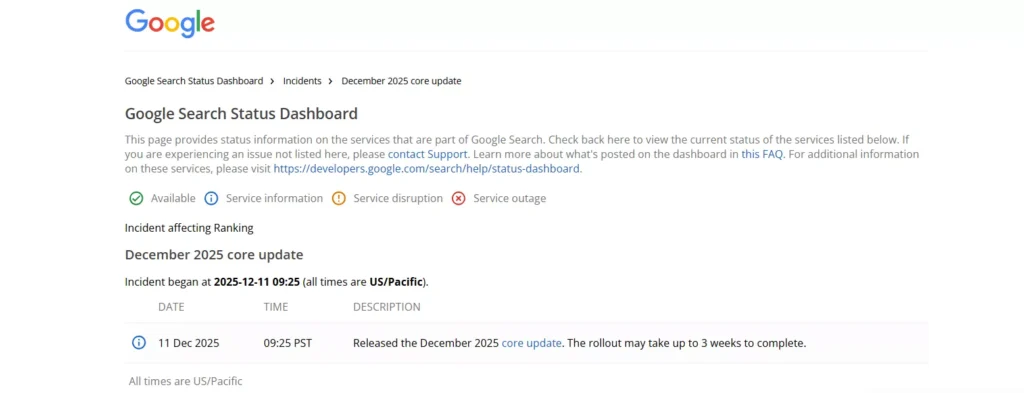
Google began rolling out the December 2025 core update on December 11, 2025, at 09:25 Pacific time. Google also said the rollout may take up to three weeks, so the movement you see today can still change again before it settles.
If your rankings moved, Google is not handing out punishments. Google is reshuffling results based on what it thinks answers the search best right now. Your job is to figure out which pages stopped matching intent or stopped feeling clearly useful, then fix those pages with calm, measurable edits.
What the December 2025 Google Core Update covers
This is a broad core update. That phrase matters because it means the update is not limited to one industry, one country, or one content format. Core updates adjust the main systems Google uses to rank pages. When those systems get reweighted, every type of page can move, including blogs, service pages, category pages, and product pages.
Google confirmed the rollout on the Search Status Dashboard and repeated the expected rollout window there.
This is also the third core update of 2025, after the March and June core updates. That context helps because it tells you this is part of an ongoing pattern, not a one-off shock event.
One more detail that is easy to miss but important: a couple days before the rollout, Google updated its documentation to clarify that improvements can be reflected even between major updates because Google also makes smaller, less noticeable core changes that are not announced. In other words, you do not have to sit and wait for the next big core update to see recovery if you make real improvements.
Why did you not see this update coming
A late-year core update feels personal because it lands when teams are stretched thin and planning deadlines are already tight. But Google framed this as a standard relevance improvement. Search volatility is a known side effect when core systems are rebalanced.
So the best mindset is not panic. It is triage.
If you treat a core update like a crisis, you make rushed changes that are hard to measure.
If you treat it like a quality review, you make smarter changes you can validate.
How the December 2025 Update Changes Search Relevance
Core updates usually reward one thing that sounds boring but pays the bills: pages that satisfy the search quickly and completely.
Not louder pages. Not longer pages. Not pages that repeat the keyword ten times. Pages that actually help.
This is where many sites get caught. They have content, but it is not shaped like an answer. It circles the topic, it talks around the point, or it assumes the reader already understands the basics. That is not how real people search. Most people want clarity in the first few seconds.
Google’s own core update guidance is built around that idea. If a page drops, it does not automatically mean the page is bad. It often means other pages do a better job meeting the search intent.
What Relevance Means Now
Relevance is no longer just matching words. It is matching the job the user is trying to get done.
A page that matches intent tends to do three things well:
It answers directly. The reader should not need to scroll five screens to find the point.
It proves the answer. If you make claims, you support them. If you give advice, you show experience.
It helps the user finish the task. Clear steps, clear options, clear next action.
Google’s guidance for core updates strongly encourages this kind of helpful, people-first content and recommends avoiding drastic changes to pages that are already performing well.
Looking Back: The August 2025 Update and Its Side Effects
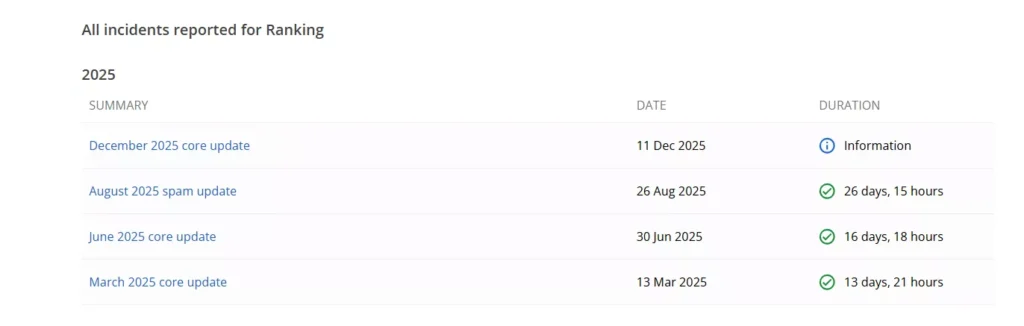
August 2025 was a spam update, not a core update. That means it was more about enforcement and filtering tactics than about rebalancing overall relevance.
Why does that matter now?
Because spam cleanups leave footprints.
If a site relied on thin pages, doorway-like variations, or low-value automation, a spam update can weaken it. Then a later core update can widen the gap by promoting pages that feel genuinely useful and demoting pages that feel like they were created mainly to rank.
So even if December is a core update, the sites that were already shaky after August may feel the shake more.
How This Core Update Differs From August 2025
Here is a simple way to separate them without overthinking it.
A spam update is about what should not rank because it breaks the rules.
A core update is about what should rank higher because it serves the user better.
The December core update is not just hunting spam. It is re-scoring content value across the web. That includes clarity, usefulness, trust signals, and how well the page matches intent.
In practice, this is what that means for your site.
If you lost rankings because of spam signals, you need cleanup.
If you lost rankings because your pages are not the best answer anymore, you need improvements.
Those are different jobs. Do not mix them.
Early Signals and SEO Community Reactions
When a core update begins, the internet does what it always does. People refresh dashboards every five minutes and declare victory or disaster based on a single bad day.
Try not to do that.
During rollout, rankings can move in waves. Google’s rollout window is long enough that you can see a drop, then a partial rebound. That is normal.
Also, remember this. You do not need to win every keyword during rollout. You need to understand which pages are losing and why.
Signals affecting rankings now
A few early patterns being discussed across the industry line up with what we often see during broad relevance reweights:
Pages with thin explanations are more fragile.
Pages that answer the question quickly tend to hold steadier.
Pages that feel repetitive across a site tend to leak visibility because they compete with each other and dilute relevance.
Do not treat these as final conclusions. Treat them as direction. Your own data decides what is true for your site.
What to Do if Your Traffic Dropped
First, do not make changes just to feel productive. Core updates punish chaos more than they punish imperfection.
Google’s recommended analysis approach is clear:
Confirm the update finished rolling out.
Wait at least one full week after it finishes before doing your before and after comparison.
Then review top pages and top queries to see what actually changed.
Now here is the plan that works in real teams, with real deadlines.
The first 48 hours: stop the bleeding with data, not guesses
Mark the timeline. Note the start date and keep a running log of big moves.
Find your top losers. Identify the pages and queries that lost the most clicks and impressions.
Segment by search type. Google recommends separating Web results from Images, Video, and News if relevant, because drops can be isolated to one area.
Do a quick intent check. For each losing page, ask one question: is this still the best answer for that query.
If you need help setting this up and making the diagnosis clean, this is a perfect place to bring in a structured audit.
The first 7 days: Fix what is clearly wrong
This is where experienced teams win, because they do not chase everything. They fix the highest-impact issues first.
Start with your top five to ten affected pages. For each page, do this:
Make the first 6 to 10 lines give the answer.
Rewrite the opening so it is not a slow story. It should be a clear solution.
Tighten headings so each section has one job.
Remove filler that repeats what the reader already knows.
Add one short example that proves you understand the topic, not just the keyword.
Then strengthen trust signals.
If your page mentions facts, cite reputable sources.
If your page gives advice, show experience. That can be real examples, clear process, or detailed specifics that only someone who has done the work would include.
If your page has outdated sections, update them now.
If you want this done in a way that stays consistent across the site, this is where technical SEO and content teams should work together.
The next 2 to 6 weeks: Rebuild pages into stronger answers
This is the part people skip because it takes focus. It is also the part that tends to create stable recovery.
Take your best-performing topics and turn them into clear hubs.
Merge overlapping pages that fight each other.
Expand the pages that matter with content that helps users make decisions.
Add internal links that guide the reader to the next step, not just random links for SEO.
Clean up low-value pages that exist only to target tiny keyword variations.
If your site is ecommerce or lead gen, invest in pages that reduce uncertainty. Buyers and decision makers are looking for proof, clarity, and confidence. Give them that.
How to Prepare Content for Google’s Relevance Standards
A core update is basically Google asking a question with a straight face. If we had to rank this page today, would we still pick it. To get your pages ready for that question, build them like tools, not like essays.
Here is what that looks like:
Your page should have a purpose that fits in one sentence.
Your headings should guide the reader like steps, not like decoration.
Your content should explain, then prove, then guide.
When you do that, you naturally become more AEO friendly because your page is easy to extract answers from and easy for humans to trust.
Practical improvements you can make
Here are changes that tend to improve clarity fast without turning the page into a novel.
Add a short answer section near the top, then expand below.
Replace vague words with specific ones.
Add step-by-step guidance where the query is a how-to query.
Use short paragraphs. Long blocks of text hide your best points.
Add internal links only when they help the reader continue the journey.
Remove sections that exist only to pad word count.
Also, do not forget site-level basics.
Broken internal links, slow templates, messy mobile layout, and confusing navigation all make content feel less satisfying. Even great writing struggles if the page experience is frustrating.
Google’s core update documentation specifically warns against quick-fix thinking and encourages a deeper assessment when drops are large and sustained.
How This Update Ties to Google’s Spam Policy
Even though this is a core update, spam signals still matter because they shape trust.
If a site is filled with repetitive templates, near-duplicate pages, or content that looks like it was made to game search, it becomes harder to defend when relevance is recalculated.
The safest approach is simple.
Build content to help people. Structure it so it is easy to read. Support it with credibility. Keep it honest.
Google’s public messaging around core updates keeps coming back to that same idea. Helpful, reliable, people-first content wins in the long run.
What SEOs Must Learn From This Update
This update is not just about rankings. It is a reminder about what rankings are made of.
1) Relevance is the main gatekeeper
If your page does not match the query intent, it does not matter how optimized the title is. It will slide when the system is rebalanced.
2) Clarity beats cleverness
Many pages drop because they are wordy, not because they are wrong.
Make the point. Prove it. Move on.
3) Thin content is a liability
If your site has pages that say little and promise a lot, you are carrying extra weight. A core update is when that weight starts to drag.
4) Recovery is a process, not a button
Google even recommends waiting until the rollout is done and then waiting an additional week before measuring impact, because the system needs time to stabilize.
If your team wants a clean path forward, the best move is to treat this like a quality project with clear deliverables, not like a daily emotional roller coaster. Explore the best SEO and content strategists.
Google Core Update December 2024 Vs. December 2025
Aspect
December 2024 Core Update
December 2025 Core Update
Update timing
December 12, 2024
December 11, 2025
Update cadence
Part of a higher-frequency update cycle
Followed a more spaced update cycle in 2025
Rollout behavior
Faster, sharper volatility
Slower, uneven movement across verticals
Primary effect
Broad quality reassessment
Comparative ranking recalibration
Content impact
Thin, templated, and low-value content more directly affected
Pages reassessed relative to competing content
AI-generated content
Increased pressure on low-effort AI content
Focus on usefulness and clarity over the creation method
Discover relationship
Stronger alignment with Search rankings
Minimal alignment with Search rankings
Nature of change
Felt corrective
Feels evaluative and comparative
Overall takeaway
Cleanup-oriented update
Refinement-oriented update
Final Thoughts
The December 2025 core update is not a riddle. It is a reset of relevance.
If you want the safest response, do this:
Track the timing
Wait for rollout to finish before judging winners and losers
Fix your most impacted pages by improving clarity, intent match, and trust.
Strengthen internal linking so users can move to the next step naturally.
And one last truth. Most sites do not lose because they are terrible. They lose because someone else answered the question better.
Your goal is not to chase the algorithm. Your goal is to become the best answer on the page.
Neha Ghauri, a graduate, has seven years of experience in writing for the digital marketing, finance, and business industries. She specializes in SEO-driven...