In 2026, you can look professional and still feel forgettable. Your posts can be clean. Your logo can be sharp. Yet people scroll past like you never existed. The problem is not effort. The problem is that your brand does not land fast enough in the first two seconds.
If you are searching for how to create a brand identity on social media, you do not need another pretty template. You need a repeatable system that makes people recognize you, trust you, and come back when they are ready to buy.
A brand identity on social media is the set of signals that makes people recognize you quickly and remember you later. It includes your look, your voice, your proof, and how you behave with your audience. It matters because trust is built in public, and trust is what turns attention into sales.
What Brand Identity On Social Media Really Means
The simple definition
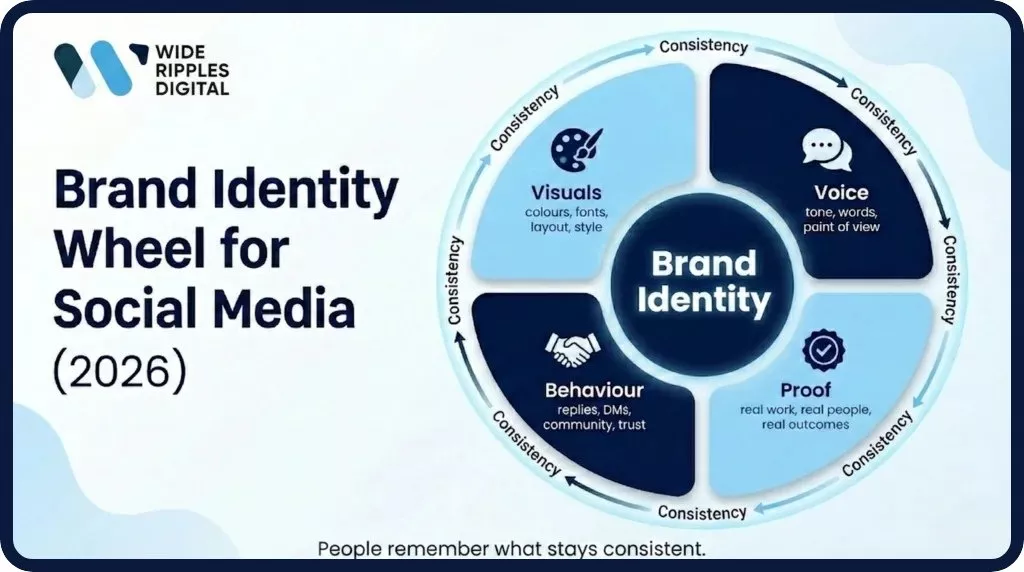
Brand identity is how people recognize you fast, then remember you later. On social, it is not only a logo. It is your look, your voice, your proof, and your consistency. When those four pieces match, your audience starts to feel like they know you. That is the start of long-term growth.
The four parts that make it stick
Visual identity is your colours, fonts, layout, and style. Verbal identity is your tone, the words you choose, and your point of view. Proof is real work, real people, and real outcomes. Behaviour is how you show up, reply, and handle questions when nobody is watching. Most businesses focus on the first two. The brands that grow focus on all four.
The 2026 Trust Problem Most Brand Guides Ignore
Why is nice design not enough anymore
Today, a polished feed is easy to copy. Edited screenshots are easy to fake. Testimonials can be made up. Repost accounts can mimic your style. That creates a trust gap. People now look for signals that you are real, not only polished. If they cannot verify you, they delay, and that delay kills sales.
Your unique advantage. The Proof of Real system
This is where most guides stop too early. The faster path is to make proof part of your identity, not a random post once a month. This is also where how to create a brand identity on social media becomes simple. You build a pattern people can spot and trust.
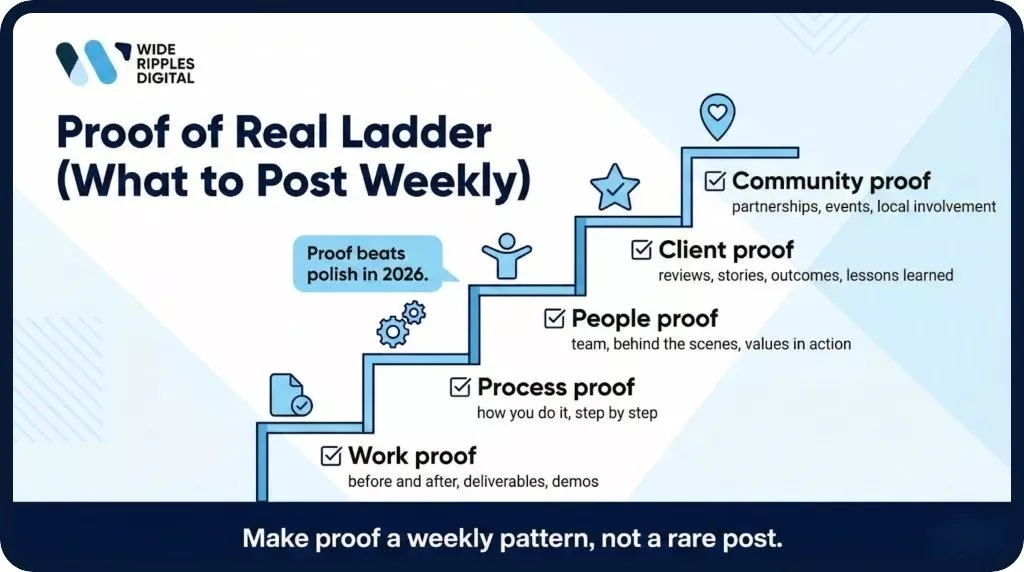
A Proof of Real system is not complicated. It is a weekly rhythm that shows what you do, how you do it, and what changed because of it. When proof becomes predictable, your audience relaxes. They stop guessing. They start choosing.
Set The Foundation Before You Touch Colours or Content
Your one-sentence brand promise
Start with one sentence that you can say without thinking. It should answer three things in order. Who you help, what outcome you deliver, and why you are different. If you cannot say it in one breath, your audience will not remember it in one scroll.
Your audience map in three lines
Keep this simple. Write what they want, what they fear, and what they need to see before they buy. This keeps your content focused. It also stops you from posting random ideas that get likes but do not lead to work.
Your no confusion positioning
Say what you do, what you do not do, and who you are not for. This feels risky, but it attracts better clients. It also protects your brand when someone tries to pull you into the wrong kind of work.
Build a Visual Identity That Stays Consistent At Speed
Your visual kit
You do not need a full brand book to start. You need a small kit that you can follow every time. Here is a practical setup.
Pick 2 to 3 brand colours and 2 neutral colours
Choose 1 to 2 fonts that stay readable on mobile
Set one photo style rule such as bright natural light or dark studio style
Set one layout rule, such as the same margins, spacing, and icon style
Templates that keep you consistent
Templates make you faster and more consistent. Build a few that fit your work.
One carousel template for teaching
One reel cover template for quick scanning
One quote or proof card template for trust
One story template for updates and polls
Accessibility is part of brand quality
A strong brand is easy to read. If people struggle to read your posts, your message dies before it starts. Make contrast and size part of your identity rules. WCAG guidance is a solid reference for contrast basics, including a common minimum of 4.5 to 1 for normal text.
Build a Voice People Can Recognize In One Line
Your tone in three words
Pick three words that describe your tone. For example, direct, warm, and confident. Then test it. Read your last five captions. Do they sound like those three words, or do they sound like five different brands?
Your language rules
Your voice gets stronger when you set boundaries. Choose words you always use and words you never use. Decide how you explain complex ideas simply. Decide how you handle criticism without sounding defensive. This is the part that helps with personal branding, too, because people remember how you speak, not only what you post.
Your comment and DM style
Keep it human. Reply with short, helpful answers. Give one clear next step. Avoid robotic scripts. If you want to know how to brand yourself in a way that builds trust, start here. Many businesses lose sales because their comments feel cold or confusing.
The Proof of Real Content System For Long-Term Growth
The five proof types to rotate weekly
This is the heart of social media branding that leads to growth. Rotate these proof types so your feed stays credible.
Work proof. Before and after, deliverables, demos
Process proof. How you do it, step by step
People proof. Team, behind the scenes, values in action
Community proof. Partnerships, events, and local involvement
Make the proof easy to verify
Keep screenshots, dates, and context. Avoid vague claims like best, number one, or guaranteed. Show what changed and why it mattered. A simple post that shows a real problem, the fix, and the outcome builds more trust than a perfect graphic with no substance.
UGC and permissions, the safe way
User-generated content can be powerful, but only if you respect permissions. Ask clearly. Save approvals. Credit the creator when it makes sense. This protects trust and avoids the awkward situation where someone asks why you used their content.
Social SEO. Make Your Brand Searchable, Not Just Scrollable
Profile setup that helps discovery
Your profile is your storefront. Make your handle and display name match your niche. Make your bio say what you do and who you help. Then set one clear path for the link. One link that leads to one next step usually beats five links that confuse people.
Content signals that help with indexing
Social platforms index topics more than most people realize. Put the topic in the first line of the caption. Use on-screen text that matches what people search. Add alt text where available. Pin a helpful comment that answers the main question. This is how to build a brand on social media that gets found by the right people.
Your Content Architecture. What To Post So It Compounds
Pick 3 to 5 content pillars
Choose a small set of pillars you can repeat without boredom. Education, proof, behind the scenes, offers, and community are a strong start. This keeps your social media brand marketing focused, and it helps your audience learn what you stand for.
Turn pillars into repeatable series
Series build memory. A weekly Q&A, a monthly case story, and a quick tip format can do more than random posting. Over time, your audience starts to expect your content. That expectation turns into a habit.
Match formats to surfaces
Different surfaces reward different behaviour. Discovery surfaces reward, clear hooks and quick value. Follower surfaces reward consistency and personality. Search-friendly surfaces reward clear topics and helpful answers. When you match format to surface, reach and engagement become easier to repeat.
Consistency Without Burnout, Governance and Ownership
Assign a brand owner
Even small teams need ownership. One person owns the look and tone. One person approves the proof and claims. This stops your content from becoming a patchwork of styles.
Create a small brand library
Store templates, fonts, and colour codes, approved logos and icons, and a proof folder with permissions. When you can find assets fast, you post faster, and consistency becomes normal.
Quality checks before posting
Before you publish, ask three questions. Is the topic clear in two seconds? Does the visual match the brand kit? Does the proof feel real and specific? This tiny habit saves you months of weak posts.
Engagement That Builds Trust and Creates Demand
The 3 reply habits that grow brands
Reply fast to real questions. Turn good comments into new posts. Use DMs to guide next steps, not push. This is how to use social media for personal branding and business branding at the same time, because your responses show your values.
Community signals
Partner posts, local collaborations, and creator features can build trust faster than solo posting. They also put your brand in front of people who already trust someone else. That borrowed trust can become your trust.
Measurement For Long-Term Business Growth
Track identity signals, not only vanity metrics
Likes can be nice, but they can lie. Track saves and shares, profile visits, website clicks, DMs, booked calls, and repeat viewers. These show whether your brand identity is landing.
Build a simple monthly dashboard
Once a month, review what content got saved most, what got shared most, what drove clicks and leads, and what proof posts closed trust gaps. This turns guesswork into a plan.
Neutral sources to support stats
If you need one Canada stat to add context, DataReportal reports that Canada had 33.0 million social media user identities in October 2025, which is about 82.1 percent of the population.
For platform trend context, you can also reference a neutral overview like Statista’s Canada social media statistics page, but keep it to one simple stat box so your post stays clean.
A Simple 30-Day Starter Plan
Week 1
Write your one-sentence brand promise. Build the visual kit. Fix your profile for search. Then choose your three content pillars so you stop posting random topics.
Week 2
Publish two proof posts, one educational post, and one behind-the-scenes post. Keep the layouts consistent so people start recognizing you quickly.
Week 3
Start one recurring series. Collect two pieces of permission-based proof. Add pinned comments that answer questions so your posts feel complete.
Week 4
Review the dashboard. Double down on the best proof type. Improve templates and captions based on what got saves, shares, and DMs.
Common Mistakes That Weaken Brand Identity
These mistakes do not look dramatic, but they quietly kill growth.
Posting random topics with no pillars
Over-polished content that feels staged
Inconsistent fonts, colours, and layouts
Big claims with no proof
Ignoring accessibility basics
Chasing reach and forgetting trust
Finally
Long-term growth is not a viral moment. It is memory plus trust, repeated every week. If you keep visuals, voice, proof, and behaviour aligned, your audience will start recognizing you without thinking, and that is where sales get easier.
Here is your next step. Build the Proof of Real system and publish it weekly for 30 days. If you want help turning this into templates, a proof library, and a simple tracking dashboard, Wide Ripples Digital can set it up and keep it consistent, so your brand feels real, clear, and easy to choose.
Quick FAQs
What is brand identity on social media?
It is the mix of your look, voice, proof, and behaviour that helps people recognise you fast and remember you later.
How long does it take to build a brand on social media?
Most businesses see early signs in 30 days, but stronger trust and steady leads usually take a few months of consistent posting and proof.
Do small businesses need a brand style guide?
Yes, but it can be small. A one-page kit with colours, fonts, templates, and tone rules is enough to start.
What should I post if I have no case studies yet?
Post-process proof and people proof. Show how you work, what you believe, and what a good result looks like.
How do I make my brand look consistent across platforms?
Use the same visual kit, the same templates, and the same tone rules. Keep your profile wording aligned, too.
How do I prove credibility without sounding salesy?
Show proof with context. Share what changed, how you did it, and what you learned. Let the outcome speak.
Disclaimer:The information provided in this blog is for general informational purposes only. For professional assistance and advice, please contact experts.