Most small businesses do not have a marketing problem. They have a focus problem. Businesses try ten things for two days each, then wonder why nothing sticks. Meanwhile, your best customers are already searching and choosing someone else.
In 2026, the smartest marketing ideas are the ones you can run, measure, and repeat without burning your budget. Think fewer tactics, better timing, and simple proof that builds trust fast.
If you run a local business, one of the quickest wins is showing up where buyers decide in seconds, like the Google local pack. If you run online, the fastest wins come from fixing the pages and messages that already get traffic.
This guide gives you a tight system and ten low-cost plays you can run this month.
The 3-Minute Filter To Pick The Right Marketing Ideas
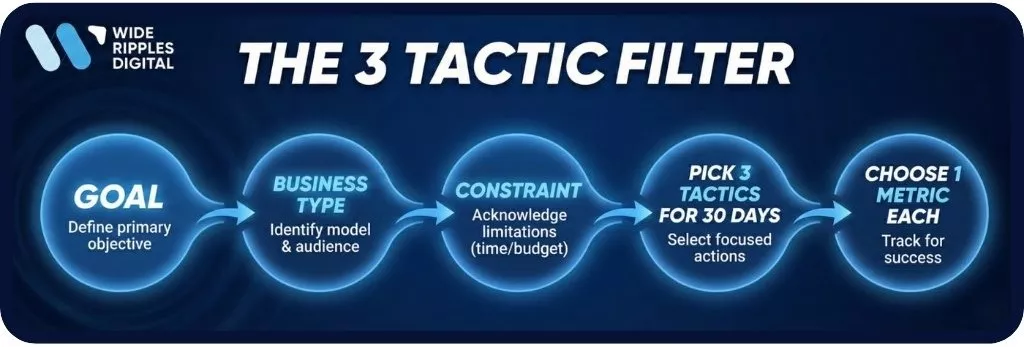
Before you start, choose only three tactics for the next 30 days. This keeps you consistent, and it stops random posting and random spending.
Pick one goal for the next 30 days, calls, bookings, sales, or repeat customers
Pick your business type, local service, retail, ecommerce, or B2B
Pick your main constraint: time, budget, or skills
Choose three tactics that match your goal and constraints
Decide one metric per tactic, then track it weekly
This tiny filter is the difference between a small business and marketing that feels busy, and a marketing strategy to boost sales that you can actually prove.
Demand Capture Ideas, Get Customers Who Are Already Searching
Demand capture means you show up when people are already looking for what you sell. It is often the best starting point for small-business advertising because you are not trying to convince cold audiences. You are meeting people who already want help.
If you are marketing a small service business, start with your Google Business Profile, your service pages, and your reviews. These three work together. Your profile helps you get discovered, your website helps you get chosen, and your reviews help you get trusted. When those signals match, it is easier to earn visibility in places like the Google local pack, which can bring calls and direction requests without a big ad budget.
Measure demand capture in simple terms. Track calls, form fills, booking clicks, and direction requests. If you get views but no actions, your offer, proof, or page clarity needs work.
Trust Builders That Make People Choose You Faster
Most buyers have the same thought when they land on your page. Can I trust this business? Low-cost marketing works best when it answers that question quickly.
Trust is not a long paragraph about your mission. It is proof placed near the decision point. Add real photos, real results, and clear expectations. If you can share a short before-and-after story, do it. If you can share a response time, do it. If you can show what happens after someone contacts you, do it.
The goal is simple. Reduce doubt. When doubt drops, conversions rise. That is why trust is one of the most underrated marketing tactics for small businesses.
Conversion Upgrades That Turn Traffic Into Leads
If your traffic is not turning into leads, you do not need more traffic yet. You need fewer leaks.
Start with the basics. Make the main call to action obvious. Make the form short. Make the phone number easy to tap on a mobile. Add a clear service promise above the fold, and back it up with proof right below it.
Then add one follow-up system. A quick email reply, a text confirmation, or a booking confirmation. People do not only choose the best business. They often choose the business that replies first with a clear next step. That is a marketing method for small businesses that costs almost nothing and pays back fast.
Retention and Referrals: The Cheapest Growth Channel
The lowest cost growth often comes from the customers you already have. Retention gives you repeat sales. Referrals give you warm leads.
Make follow-up a habit. Check in after delivery or service. Ask one simple question about the experience. Then ask for a review. Then ask for one referral only when it makes sense.
Referrals work best when the offer is simple, and the timing is right. Do not wait six months. Ask while the customer is still happy, and the result is fresh.
10 Low-Cost Marketing Ideas You Can Run This Month
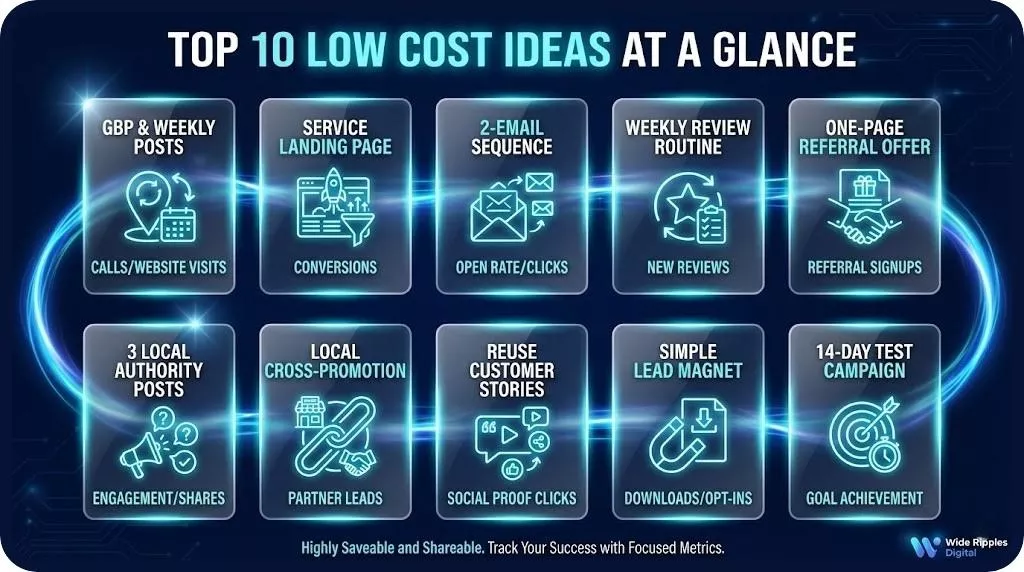
1. Refresh Your Google Business Profile and Post Weekly
What to do. Complete every important field, choose the best category, add services, add fresh photos, and post once a week with something useful, like an offer, a tip, or a short update.
Why it works. Profiles that look complete and active build trust faster. Posts also give you a steady habit of showing up with something new.
How to measure. Track calls, website clicks, and direction requests from your profile. Watch what changes after each update.
2. Turn One Service Page Into a High-Converting Landing Page
What to do. Pick your top money service and rebuild that page like a decision page. Add who it is for, what you do, what it costs in simple terms, and what happens next. Add proof near the call to action.
Why it works. Most traffic lands on service pages. When the page answers questions quickly, fewer people bounce.
How to measure. Track form fills, booking clicks, and call clicks from that page. Compare before and after.
3. Launch a Two-Email Welcome and Follow-Up Sequence
What to do. Offer one useful free item, like a checklist, a pricing guide, or a quick template. Then send two emails. Email one delivers the item and sets expectations. Email two answers to common questions and invite the next step.
Why it works, email is still one of the best marketing methods for small businesses because you own the audience. You are not relying on a feed.
How to measure. Track signups, reply rate, and clicks to your booking or quote page.
4. Create a Review Routine That Runs Every Week
What to do. Ask every happy customer for a review. Do it right after a good result. Reply to every review, even short ones. Add your best reviews to key pages. Why it works, reviews are trusted at scale. They also improve click behaviour because people compare ratings fast. How to measure. Track review count, review recency, and changes in calls and enquiries.
5. Build a One-Page Referral Offer Your Customers Will Actually Share
What to do. Create a simple referral page. Explain who it is for, what the reward is, and how to claim it. Keep it easy. One link. One form. One clear rule. Why it works. Referrals bring warmer leads and shorter sales cycles. It is advertising that small business owners often forget they already have. How to measure. Track referral submissions and closed deals from referrals.
6. Publish Three Local Authority Posts That Answer Buyer Questions
What to do. Choose three questions people search for before buying. Write one helpful post per week for three weeks. Link each post to your service page with a clear next step. Why it works. These posts catch high-intent searches and build authority. They also support small businesses and marketing goals long-term. How to measure. Track impressions, clicks, and assisted conversions from those posts in Search Console and analytics.
7. Partner With One Local Business For a Cross-Promotion
What to do. Find a business that serves the same audience but does not compete. Swap value. You can do a newsletter mention, a social post swap, a small bundle offer, or a joint event. Why it works. You borrow trust and reach without paying for ads. It is one of the most practical marketing suggestions for small businesses that want local growth. How to measure. Track referral traffic, new followers, and leads that mention the partner.
8. Reuse Customer Stories Into Short Social Posts And a Website Proof Block
What to do. Turn one customer story into three assets. A short post, a short reel script, and a proof block on your website with one quote and one result. Why it works. Stories feel real. Proof blocks also raise conversion because they show outcomes, not promises. How to measure. Track saves and shares on social, and time on page and enquiries on the website page you updated.
9. Create a Simple Lead Magnet That Solves One Urgent Problem
What to do. Pick one urgent problem your buyers have and solve it in one page. Examples include a checklist, a budget guide, a quick planning template, or a comparison sheet. Why it works. Lead magnets give you a reason to collect emails and start follow-up. This supports a marketing strategy for a small business that is not dependent on ads. How to measure. Track the signup rate and the number of signups that turn into calls or quotes.
10. Run a 14-Day Test Campaign With One Goal And One Metric
What to do. Choose one channel, one offer, and one metric. Keep everything else steady. Do not change the message every day. Run it for 14 days, then decide. Why it works. Consistency makes results clearer. You learn what works, not what feels busy. How to measure. Track the single metric you chose, like bookings, qualified leads, or sales.
The 14-Day Test Method: How To Measure Any Marketing Idea
Here is the rule. Every tactic gets 14 days, one goal, and one success metric. This keeps your marketing strategy to boost sales grounded in results.
Step one is setup. Make sure tracking is in place, and the offer is clear. Step two is run. Keep the message steady for two weeks. Step three is decide. If it hits the metric, you scale it. If it misses, you improve one variable and rerun, or you stop and switch.
A simple tip helps. Always track quality, not only quantity. Ten weak leads can waste more time than three strong ones.
A Simple 30-Day Starter Plan For Canadian Small Businesses
Week 1 is the foundation week. Update your Google Business Profile, tighten your top service page, and set up basic tracking so you can see calls and forms.
Week 2 is the demand capture week. Publish one authority post that answers a buyer’s question and link it to your service page. Ask for reviews from recent happy customers.
Week 3 is trust week. Add a proof block to your service page and reuse one customer story into social content. Start a simple two-email follow-up sequence.
Week 4 is scale week. Choose the best performer from the month and double down. Add one more partner promotion or one more post, and keep the same tracking so you can compare fairly.
Concluding Remarks
The best marketing ideas are not the fanciest. They are the ones you can run consistently, measure clearly, and improve without stress. Pick three tactics, track one metric each, and give them enough time to work.
If you want a fast, practical starting point, Wide Ripples Digital can help by building a tight 30-day plan, improving your key pages, and setting up tracking so you can see what brings leads and sales. The goal is simple, more clicks, more enquiries, and a clearer path from marketing to revenue.
Quick FAQs
What are the best low-cost marketing ideas for a small business in 2026?
Start with demand capture, trust proof, and conversion fixes. Pick three tactics for 30 days, then track calls, forms, and sales.
How do I advertise my small business with almost no budget?
Use your Google Business Profile, collect reviews weekly, and publish content that answers buyer questions. Then improve your service page so traffic turns into leads.
What is the fastest marketing method for small businesses?
For many local businesses, profile optimization plus reviews can improve calls quickly. For online businesses, a better landing page and follow-up sequence can improve leads fast.
How do I market a small service business locally?
Focus on being easy to find and easy to trust. Update your profile, show clear proof, and make the booking or quote step simple on mobile.
How long does marketing take to show results?
Some changes can move leads in days, like fixing a page and adding proof. Search visibility often takes weeks to months. That is why tracking matters.
What should I track each week?
Track one metric per tactic, like calls, bookings, email signups, or sales. Also, track lead quality so you do not chase the wrong audience.
What is a simple marketing strategy for small business owners?
Use a 30-day plan with three tactics. Add one demand capture play, one trust builder, and one conversion upgrade. Test for 14 days, then scale the winner.
Disclaimer: The information provided in this blog is for general informational purposes only. For professional assistance and advice, please contact experts
Neha Ghauri, a graduate, has seven years of experience in writing for the digital marketing, finance, and business industries. She specializes in SEO-driven...