With the digital landscape evolving at lightning speed, ranking well on Google in 2026 is more important than ever. Businesses in Canada compete not only locally but internationally for attention on search engines. According to recent statistics, more than 8.5 billion searches are performed on Google every day, and over 79 % of all online searches are conducted through Google. To get noticed amid this volume of traffic, your site needs a strategic, user‑first approach that aligns with modern search‑engine ranking factors.
This comprehensive guide explains how to rank higher on Google by taking you through ten actionable steps.
10 Steps Guide on How to Rank Higher on Google
1. Understand Google’s Ranking System
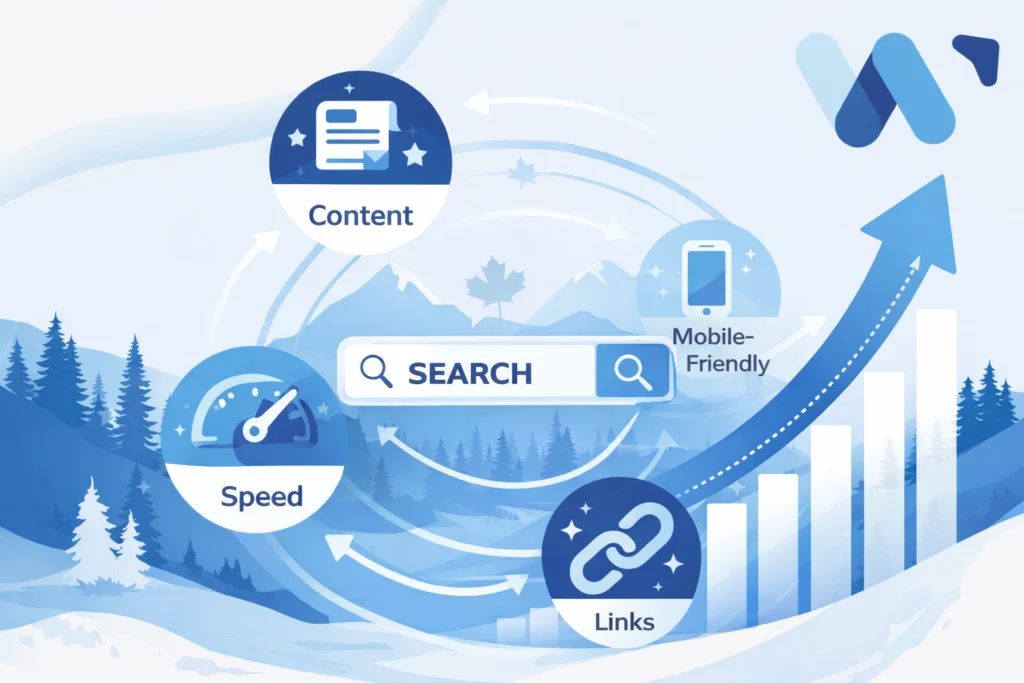
Before diving into tactical SEO, you need to know how Google ranks pages. Google ranking factors are criteria that the search engine uses to determine how well a page matches a search query. There are more than 200 ranking factors; however, not all of them carry equal weight. High‑priority factors include high‑quality content, backlinks, search intent, page speed, mobile‑friendliness, domain authority, keyword optimization, site structure, security (HTTPS) and on‑page experience. Rather than obsess over every detail, focus on these fundamentals.
Google’s goal is to serve the most relevant and trustworthy results to a user. For instance, search intent refers to the user’s reason for typing a query. If someone searches “best WordPress plugin,” Google shows listicles because users want to compare options. Match your content to the intent behind keywords, and you’re already ahead of many competitors.
Why ranking on Google matters in Canada
Canada’s digital marketplace is diverse. From Vancouver startups to Montreal cafés, businesses rely on Google for discovery. Moreover, Canada’s bilingual nature means you should consider French and English keywords when targeting national audiences. Local search is particularly important in large cities such as Toronto and Calgary; optimizing for “near me” queries will help you capture high‑intent local traffic.
2. Master Keyword Research
Keywords connect what people search for with your content. In other words, they’re how potential customers find you. Mastering keyword research ensures you speak your audience’s language and tailor content to their needs.
Why keywords matter
Audience language: Keywords tell you how people describe your products or services. For example, Canadians may search “best poutine in Toronto” rather than “top French fries in Toronto.”
Understanding user intent: Analyzing keywords reveals whether someone wants to buy, learn or navigate. Matching the intent behind queries leads to higher engagement.
Content relevance: Choosing the right terms helps Google see that your page answers a specific question.
Tools for keyword research
Google Keyword Planner: Free and ideal for gauging search volume and competition.
SEMrush or Ahrefs: Advanced platforms for discovering long‑tail keywords and analyzing competitors.
AnswerThePublic: Visualizes questions and phrases around a topic; great for understanding conversational queries.
Choosing the right keywords
Relevance: The keyword should directly relate to your content or business.
Search volume: Don’t chase only high‑volume terms; consider long‑tail phrases with moderate search volume but less competition.
Competition: Assess whether you can realistically rank for a keyword. For a new blog, targeting “digital marketing agency Calgary” may be more achievable than “marketing agency.”
Using keywords in your content
Title tags and meta descriptions: Include the focus keyword early in your title tag and meta description.
Headers and body content: Use keywords naturally in H1, H2 and throughout the article.
Image alt text: Describe images using relevant keywords to help search engines understand the content.
URL slugs: Keep URLs short and descriptive; add keywords separated by hyphens.
Pro tip: Avoid keyword stuffing. Use synonyms and related phrases (LSI keywords) to keep your writing natural. For example, instead of repeating “how to rank higher on Google” multiple times, use variations like “improve Google search ranking” or “increase your Google rankings.”
3. Fine‑Tune Your On‑Page Elements
On‑page SEO refers to optimizing elements directly on your web pages. It ensures that search engines and users easily understand your content.
Craft irresistible titles and meta descriptions
Title tags: Write short, clear titles (50–60 characters) that describe the page and include your primary keyword.
Meta descriptions: Summarize the content in 150–160 characters and naturally include keywords. Google might choose not to display your meta description, but providing one gives you control over the message.
Organize content with headers
Treat each page like a well‑structured book. Use H1 for the main title, followed by H2, H3 and so on. This hierarchy helps both readers and search engines understand your page’s structure.
Create clean URLs
Make URLs short and descriptive. Include relevant keywords and use hyphens as separators. For example, a blog about Vancouver’s Cherry Blossom Festival could use /vancouver-cherry-blossom-festival-guide.
Optimize images
Large, unoptimized images slow down your site. Compress images without sacrificing quality, use the appropriate file type (JPEG for photos, PNG for graphics) and add descriptive alt text. Consider tools that automatically compress images when uploading especially beneficial for WordPress users.
Use schema markup
Structured data (Schema.org) helps search engines understand and display your content more effectively. Adding structured data, such as Article schema or FAQ schema, can enhance visibility and may improve click‑through rates. Marking up published and modified dates also aids crawling and recrawling.
4. Get Your Technical SEO Right
Technical SEO ensures that search engines can easily access, index and understand your website. Without a solid technical foundation, even the best content will struggle to rank.
Speed up your website
Users expect fast-loading pages, and slow sites can hurt rankings. Google incorporated page speed into its Core Web Vitals in 2021. Tips to improve speed include:
Reduce requests: Minimize CSS and JavaScript files.
Enable caching: Allow browsers to store files locally for faster return visits.
Compress images and code: Remove unnecessary spaces and characters from code and optimize images.
Use Content Delivery Networks (CDNs): CDNs serve your content from servers closer to users, improving load times.
For WordPress websites, choose hosting optimized for performance and consider built‑in tools for speed improvements.
Make your site mobile‑friendly
Google primarily uses the mobile version of a site for indexing. Over 60 % of web traffic comes from mobile devices. Responsive design ensures your site adapts to any screen size. Additional mobile tips include:
Fast loading: Compress images and reduce code, as mobile connections can be slower.
Large tap targets: Design buttons big enough for fingers.
Avoid intrusive pop‑ups: Ensure pop‑ups are easy to close on small screens.
Local focus: For local businesses, ensure your address and phone number are consistent and accessible across mobile searches.
Ensure crawlability and indexing
Search engines need to access and understand your content. Check that your robots.txt file doesn’t block important pages and create an XML sitemap to submit through Google Search Console. A simple site structure without deep subdirectories aids crawling. Also, optimize your WordPress robots.txt file to save crawl quota.
Secure your site with HTTPS
Google confirmed HTTPS as a ranking signal in 2014. Ensure your website has an SSL certificate to encrypt data between your server and users. Besides improving security and building user trust, HTTPS may offer a small ranking boost.
Improve domain authority
Domain authority measures a site’s ability to rank based on expertise, authoritativeness and trustworthiness. While developed by Moz, it reflects how search engines gauge your site’s credibility. Boost authority by consistently creating high‑quality, topic‑focused content and earning high‑quality backlinks.
5. Create High‑Quality, Authoritative Content
Content remains the most important ranking factor. Unique, authoritative and helpful content drives organic traffic, builds authority, and improves relevancy.
Aim for E‑E‑A‑T: Experience, Expertise, Authoritativeness and Trustworthiness
Google increasingly emphasizes E‑E‑A‑T. This means your content should reflect first‑hand experience, subject‑matter expertise, credibility and trust. Incorporate personal insights or case studies to demonstrate practical experience, particularly effective for product reviews and advice.
Publish relevant, authoritative content
According to Michigan Tech University, authoritative content is the number‑one driver of search rankings. Writing specifically for your target audience increases traffic and signals relevance. Choose a specific keyword phrase per page and build separate pages for distinct topics.
Focus on depth and organization
Longer, in‑depth articles tend to rank better; research shows that posts in Google’s top ten results average around 1,447 words. But rather than targeting an arbitrary word count, cover your topic comprehensively. Organize ideas using headings, subheadings and bulleted lists. Google may even select well‑structured lists as featured snippets.
Keep your content original and fresh
Duplicate content can harm your SEO and reduce crawl rates. Always provide unique value and avoid copying from other sources. Regularly updating posts sends positive ranking signals, especially for news or trend‑driven topics.
Use different content formats
Diverse formats engage different audiences. Blog posts, in‑depth articles, videos, infographics, podcasts and interactive tools can help you reach a wider audience. Canadians are particularly active on social media platforms like Instagram and TikTok; creating shareable visuals can increase exposure.
Incorporate relevant images and videos
Adding media breaks up text and improves user engagement. Use captioned images, embedded YouTube videos or interactive maps to enrich your content. Just remember to optimize file sizes and alt text, as mentioned earlier.
6. Update Content Regularly & Engage Users
Google sees regularly updated content as a sign of relevancy. Audit your site on a set schedule (e.g., quarterly) to update information, add new insights and remove outdated details. Here’s how to keep your content fresh and engaging:
Audit and improve existing content
Perform a content inventory: Identify which pages perform well and which need updates. Tools like Google Analytics and Search Console reveal top‑performing pages, traffic sources and engagement metrics.
Enhance weak pages: Update outdated facts, add new research or case studies, incorporate more visuals and restructure content for clarity.
Combine or split articles: If multiple pages cover similar topics, consolidate them into a comprehensive guide. Conversely, break overly long articles into focused subpages.
Share your content strategically
Publishing is only half the battle. Promote your content via:
Social media: Share posts on platforms relevant to your audience and engage in discussions.
Email marketing: Notify subscribers about new or updated articles.
Influencer outreach: Partner with Canadian bloggers or community leaders in your niche.
Guest posting: Write for reputable websites in your industry; include a link back to your site.
Monitor user engagement metrics
User behavior influences rankings. Google monitors click‑through rate, bounce rate and dwell time as part of its on‑page experience factors. Improve these signals by:
Crafting compelling titles and meta descriptions to increase click‑through rates.
Ensuring your site loads quickly and offers a seamless experience to reduce bounce rates.
Encouraging further reading through internal links and related articles to increase dwell time.
7. Build a Link‑Worthy Website
Links remain a cornerstone of SEO. Google views backlinks as votes of confidence; links from high‑authority websites signal that your content is trustworthy. However, quality matters more than quantity.
Why backlinks matter
Backlinks are like recommendations. When reputable sites link to your content, they confer authority and help Google see your page as valuable. Pages without backlinks often receive little organic traffic because they’re buried in search results.
How to earn high‑quality backlinks
Guest posting: Contribute articles to respected blogs in your niche and include a link to your site in the author bio or within the content.
Create shareable assets: Develop infographics, videos or original research that others want to reference.
Fix broken links: Find broken links on relevant websites and suggest your content as a replacement.
Offer useful resources: Templates, checklists and tools encourage others to link to your site.
Internal linking
Link to your own articles using descriptive anchor text rather than “click here.” Descriptive links help search engines understand the context and improve accessibility. Interlinking also helps users discover additional content, thereby increasing dwell time.
Pro tip: Avoid buying or exchanging links, Google penalizes manipulative link schemes. Focus on creating valuable content that naturally attracts references.
8. Optimize for Local SEO in Canada
For Canadian businesses, local SEO is essential. Whether you run a Toronto bakery or a Halifax law firm, optimizing for local searches ensures that nearby customers can find you.
Why local search matters
People often search for businesses near them (e.g., “best sushi near me”). Local SEO helps your business appear in such searches and on Google Maps. With Canada’s vast geography and diverse communities, local optimization boosts visibility among high‑intent prospects.
Use Google My Business (now Google Business Profile)
Claim and verify your listing on Google My Business; fill out your business name, address, phone number, website, and hours. Add high‑quality photos and encourage customers to leave reviews. Regularly post updates and respond to reviews, positive or negative, to show engagement.
Consistent NAP citations
Ensure that your business’s Name, Address and Phone number (NAP) are consistent across all directories and social platforms. Mismatched information can confuse search engines and users.
Leverage local content & backlinks
Write blog posts about local events, sponsor community initiatives or collaborate with local influencers to earn local backlinks. For instance, a Vancouver travel agency might publish guides on exploring Stanley Park or the Okanagan wine region and partner with regional bloggers.
Bilingual SEO considerations
Canada’s official languages are English and French. If you serve bilingual audiences (especially in Quebec and New Brunswick), provide localized content in both languages. Use hreflang tags to indicate language versions to Google and avoid duplicate content issues.
If you’re a Canadian business owner, contact our SEO experts for a customized plan to dominate local search results.
9. Keep Up With SEO Changes
SEO isn’t a one‑time project; it requires continual adaptation. Google tweaks its search system hundreds of times each year. Some updates are small; others significantly reshape search results. Staying informed helps you avoid sudden drops and capitalize on new opportunities.
Stay informed
Google Search Central Blog: Google’s official SEO blog discusses major changes and best practices.
Trusted SEO sites & blogs: Follow reputable sources for insights and trends.
Industry events & webinars: Attend SEO conferences or local digital‑marketing meetups. Networking with other professionals fosters knowledge sharing.
SEO tools notifications: Many tools alert you when significant algorithm changes occur.
Be prepared to adapt
What worked last year may not work now. You may need to update your keyword research, adjust content formats, or refine link‑building tactics. Pay attention to:
Evolving search intent: New search trends may require fresh content or different formats.
User experience innovations: Google increasingly rewards sites offering rich on‑page experiences; monitor metrics like CTR, bounce rate and dwell time.
Voice search & AI: With the rise of voice assistants, optimize for conversational queries. Structured data and featured snippets become more important in voice results.
Pro tip: Schedule quarterly SEO reviews. Use analytics to identify changes in traffic patterns and adjust your strategy accordingly.
10. Leverage AI and Emerging Tools
Artificial intelligence (AI) is reshaping SEO. AI tools can assist with content creation, data analysis and automation, but they shouldn’t replace human expertise.
How AI helps with content
AI can suggest topics by analyzing search data, generate catchy titles and improve readability. It can also translate content into multiple languages, a useful feature for bilingual Canadian audiences. Tools like AI content generators can be used to brainstorm ideas or rewrite sections, but always review and edit AI‑generated content for accuracy and tone.
AI for data analysis and efficiency
AI excels at processing large datasets and identifying patterns. It can track keyword performance, analyze backlink profiles and automate routine tasks like outreach and reporting. This saves time and allows you to focus on strategic work.
The future of AI in SEO
AI will continue to evolve, enabling better content understanding and predictive analytics. However, human judgment remains critical for crafting meaningful narratives, making strategic decisions and connecting authentically with your audience.
Use AI ethically
Avoid using AI to mass‑produce thin or misleading content. Google’s algorithms are increasingly adept at identifying low‑quality, auto‑generated text. Instead, use AI as a support tool and ensure that the final product reflects your expertise and aligns with user needs.
Final Thoughts
Ranking higher on Google in 2026 requires a holistic strategy, one that blends technical excellence, compelling content, thoughtful keyword targeting and user‑centric design. Whether you’re a small Toronto café or an established Montreal tech company, following these ten steps will help you improve your Google rankings and achieve sustainable organic growth.
Remember, SEO is a long‑term journey, not a quick sprint. By committing to high‑quality content, continuous improvement and a deep understanding of your audience, you’ll not only climb the search results but also build lasting relationships with your readers.
Need a tailored SEO strategy? Get in touch with our SEO specialists at Wide Ripples for a comprehensive audit. Disclaimer:The information provided in this blog is for general informational purposes only. For professional assistance and advice, please contact experts.