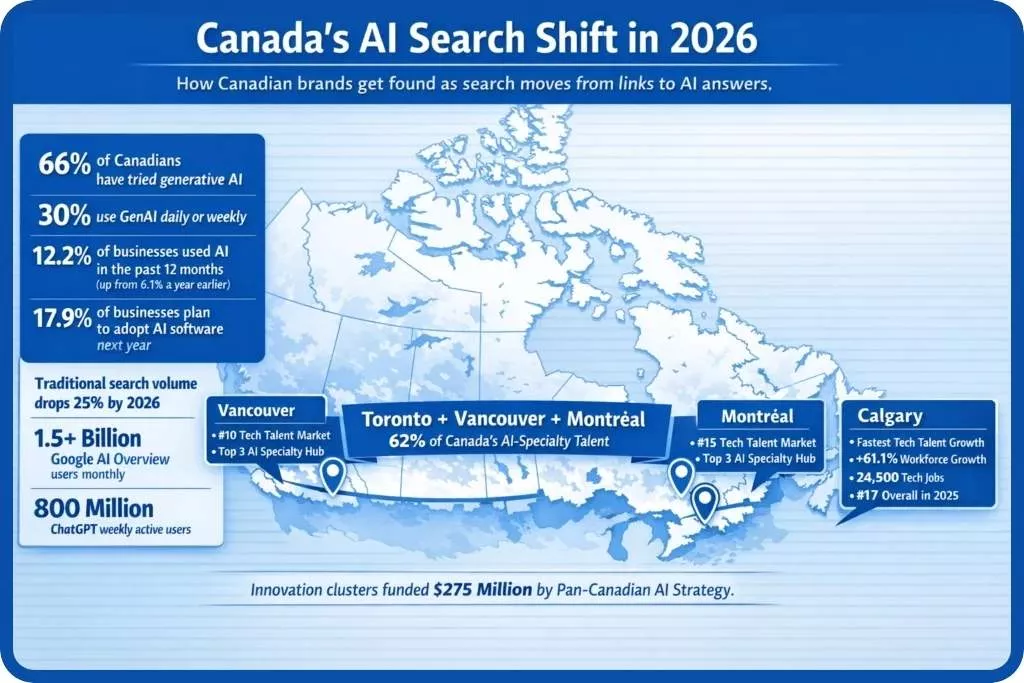
By 2026, generative AI tools have become the default starting point for information seekers.Gartner predicted that traditional search volumes would drop 25 % in 2026 as people ask AI agents like Google’s AI Overviews, ChatGPT and Perplexity for answers instead of scrolling through pages of blue links. These platforms now serve hundreds of millions of users each month, and studies show that queries are getting longer and more conversational, averaging 23 words and producing deeper sessions than classic search.
For Canadian brands, this shift means the Share of Summary, how often an AI engine mentions your brand, has become more valuable than ranking first on a SERP.
This guide explains Generative Engine Optimization (GEO) and why it matters in Canada.
Why 2026 Is the GEO Tipping Point
AI‑native search overtakes traditional search
Shift in user behaviour. In 2026, generative‑AI platforms drive billions of queries monthly and are quickly replacing search engines. Gartner projects a 25 % drop in traditional search volume, and Google’s AI Overviews alone reach more than 2 billion monthly users. ChatGPT serves 800 million users per week and Perplexity handles hundreds of millions of queries.
Longer, richer queries. With chat‑based interfaces, user questions average 23 words, six times longer than typical search terms, and sessions last around six minutes. AI tools remember context across turns and deliver personalised, multi‑source answers.
Zero‑click reality. When an AI Overview answers a query directly, click‑through rates for organic results can drop more than 30 %. To remain visible, brands must appear within the AI’s answer itself.
Why GEO matters more than ranking
Traditional SEO optimized for page rankings by focusing on keywords, backlinks and user behaviour. GEO, by contrast, is about being cited. LLMs typically include only two to seven sources in a response; being one of those sources delivers an implicit endorsement no blue link can match. Because most AI platforms are subscription‑based rather than ad‑supported, they have less incentive to drive traffic and more incentive to cite trustworthy information that enriches their answers.
How Generative Engine Optimization Differs from Traditional SEO
Search results vs. conversational answers
SEO aims to achieve high rankings so users click through to a page. GEO prepares content to be selected and cited within AI responses. Instead of showing up as a blue link, your brand appears in the AI’s narrative, often without a click.
Keyword strategy
Traditional SEO targets high‑volume keywords such as “cheap flights Toronto.” GEO relies on semantic relevance and natural‑language queries. Rather than optimizing for “MBA program Canada,” universities might target questions like “How long is the MBA at [University]?” or “What scholarships are available for international students?”. For brands, this means aligning content with the actual questions customers ask AI assistants.
Content structure and authority signals
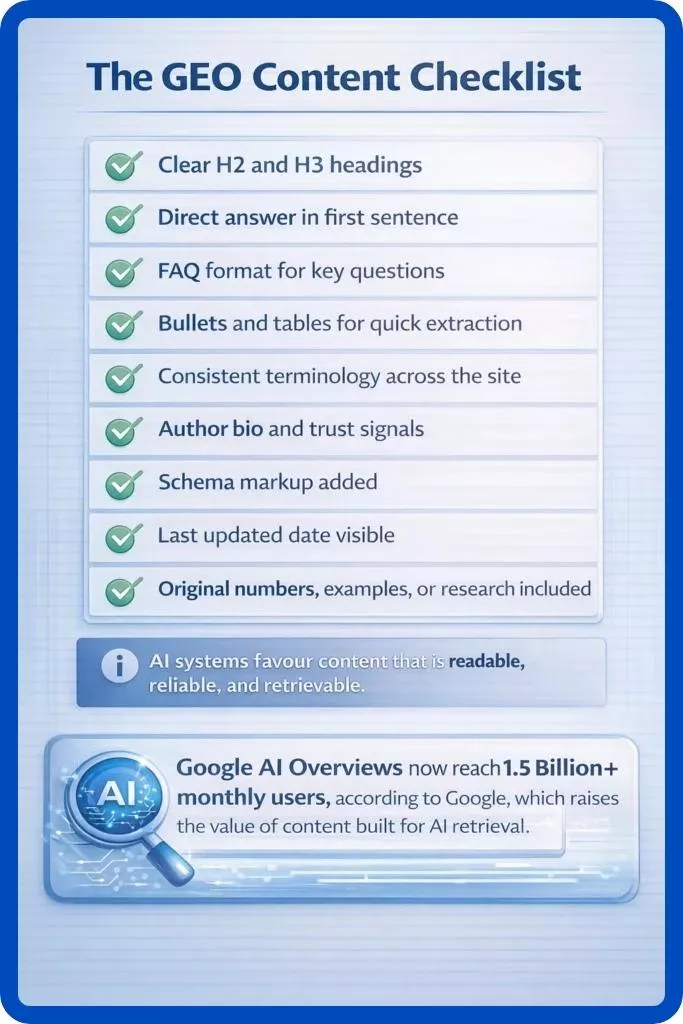
Clarity over flourish. AI engines prefer well‑organized content: headings, bullet points and tables make it easier to parse. Summary boxes and short answers work better than dense paragraphs.
E‑E‑A‑T matters differently. Experience, expertise, authoritativeness and trustworthiness are still important, but AI models infer authority from citation style, factual accuracy and consistency, not design or branding. Highlight expert credentials, cite trusted sources and present information factually.
Structured data. GEO adds machine‑readable markup, FAQPage, Product, Organization and other Schema.org types to improve AI interpretability. Clean, crawlable pages with canonical URLs ensure AI agents retrieve the right data.
Measuring success
SEO measures traffic and rankings. GEO measures citations, share of summary and AI referral traffic. Monitoring how often AI tools mention your brand and tracking visits from domains like chatgpt.com or perplexity.ai are critical to understanding performance.
The Canadian GEO Landscape: Trends and Local Considerations
Canada has emerged as a hub for GEO innovation, with specialized agencies and internal teams developing strategies tailored to AI‑driven search. While individual companies are not named here, the following trends illustrate how agencies and brands across Canada are approaching GEO:
Aspect
Insight (evidence)
What Canadian brands are doing
Structured data & schema
Leading agencies in Canada emphasize schema markup, entity optimization and knowledge‑graph connections to align brands with AI engines.
Canadian brands are investing in structured data (JSON‑LD schemas) so that AI models can understand product attributes, location details and corporate entities. Many are adopting “Search Everywhere Optimization” frameworks that include voice, maps and generative search.
Multilingual & local optimization
Firms specialising in GEO replicate AI query patterns from Google’s SGE and ChatGPT and optimize schema for English and French audiences.
Companies serving Quebec and bilingual markets ensure their structured data is available in both languages, tailoring content to local conversational queries (e.g., “Quel est le meilleur café à Montréal?”).
Entity & reputation management
Platforms monitor brand mentions in generative engines and track sentiment. Agencies build knowledge graphs and replicate AI prompts to guarantee brands appear as reliable sources.
Canadian brands are adopting tools that benchmark their presence in ChatGPT and Perplexity, tracking unaided awareness and adjusting content accordingly. Some integrate AI dashboards that show how often they are cited and by which engines.
E‑E‑A‑T & content quality
GEO agencies combine experience/expertise optimization with schema‑rich FAQs and brand sentiment monitoring across AI platforms.
Brands invest in expert‑authored content, highlight customer reviews and incorporate Q&A sections to capture AI queries. They monitor sentiment and adjust messaging to maintain a positive “latent vector” in AI models.
Affordable and enterprise packages
Providers offer both affordable GEO listings for small businesses and enterprise‑level optimisation for national brands.
Startups and SMEs in Canada are experimenting with entry‑level GEO packages that include simple visibility audits and schema fixes, while large retailers deploy enterprise GEO suites with predictive modelling and AI‑traffic dashboards.
Building the Pillars: Core GEO Strategies for Canadian Brands
1. Quotation and statistics addition
Research shows that LLMs are more likely to cite sources containing expert quotes and hard data. This tactic, called Statistics Addition, involves enriching your content with verifiable numbers:
Publish product durability tests (“survived 50 drops from 10 feet, 40 % better than industry average”).
Use industry surveys, government statistics and third‑party studies to back up claims. For instance, quoting a 2024 survey showing that 70 % of prospective students use AI tools during research helps universities strengthen their GEO authority.
Include footnotes or citations to authoritative sources (government, universities) in your content; AI models value information density and traceability.
Pro tip: When you update a blog post, add at least three original statistics or expert quotes. AI engines reward fresh data and factual detail.
2. Build “latent space” authority through earned media
Generative models construct latent vectors based on how often and where a brand is mentioned. Earned media, third‑party articles, forum posts and reviews, signals trust.
Encourage authentic reviews on platforms like Trustpilot and Reddit; AI models use these to infer sentiment.
Pursue coverage in niche blogs, podcasts and local news. Research indicates AI engines favour earned media over brand‑owned content when selecting citations.
Participate in community discussions relevant to your industry. For example, a Canadian outdoor gear brand might sponsor posts on r/OutdoorsCanada or collaborate with hiking influencers.
3. Optimize structured data and feeds
AI agents rely heavily on structured data to interpret content and products:
Product Schema: Ensure every product includes complete attributes, materials, colours, dimensions, energy efficiency, and shipping details, so AI agents can verify fit. Stores with near‑complete product schema achieve 3 to 4× greater visibility in AI shopping recommendations.
Merchant Center & Feeds: Google’s AI Overview uses Merchant Center feeds as a primary source. Write product titles in conversational language (“Breathable lightweight running shoe for marathon training”) to match natural queries.
llms.txt and robots.txt: Ensure AI crawlers (e.g., GPTBot, ClaudeBot, PerplexityBot) are not blocked and consider adding an llms.txt file to guide generative crawlers on how to interpret your site.
Data hubs: Offer machine‑readable data files (JSON/CSV) that list key facts—opening hours, rates, program details to make your content more ingestible.
4. Design content for AI and humans
Generative engines “skim” pages like humans but need explicit cues. Applying these strategies helps both:
Lead with the answer: Place the most important fact in the opening sentence. For example: “Our BSc Nursing program is four years, ranked top 5 in Canada and includes a paid co‑op.”
Use question‑first formats: Build sections around natural‑language questions (“What are the admission requirements?”). AI tools are trained on question–answer patterns and favour content with semantic clarity.
Headings, lists and tables: Break up long content with clear subheadings, bullet points and simple tables. A table of program deadlines or product specs is easier for AI to extract than a paragraph.
Standardize terminology: Use consistent labels across your site (e.g., “Application Deadline” rather than mixing “Closing Date” and “Due Date”). Uniform language supports AI parsing and reinforces trust.
Add Schema markup: Implement FAQPage, Product, EducationalOccupationalProgram, Organization and Event schemas. This helps AI identify and categorize content correctly.
5. Keep content fresh and consistent across platforms
Generative models weigh recency when choosing sources. Outdated or conflicting data can lead to exclusion or misrepresentation. Follow these practices:
Timestamp updates (“Last updated March 2026”) and regularly audit pages to eliminate outdated information.
Align external sources: Ensure your brand data matches across your site, Wikipedia, Google Business Profile and industry directories.
Coordinate promotional copy with factual content: Pair promotional phrases like “state‑of‑the‑art gym” with direct facts, “Open 24 hours; membership includes unlimited pool access”. This dual‑purpose approach satisfies both AI engines and human readers.
6. Earn and manage entity authority
GEO focuses on entities, your brand, products and people—not just pages. To strengthen your entity signals:
Publish detailed About and Author Bio pages and maintain a consistent brand description across platforms.
Pursue a Wikipedia presence where appropriate; AI engines heavily cite high‑authority sources like Wikipedia and academic publications.
Build and optimize your Google Knowledge Panel and organization schema.
Manage reputational signals by monitoring sentiment across AI outputs (new tools track how your brand appears in ChatGPT and Perplexity).
7. Embrace multilingual and regional GEO
Canada’s bilingual culture means AI models often serve content in both English and French. Ensure that structured data and key pages are localized:
Translate schema fields (e.g., name, description) and content to French where relevant.
Use natural queries relevant to each language (“Quel est le meilleur restaurant végan à Québec ?”).
Optimize voice search by including local slang and common phrasing.
Measuring GEO Success: Metrics and Tools
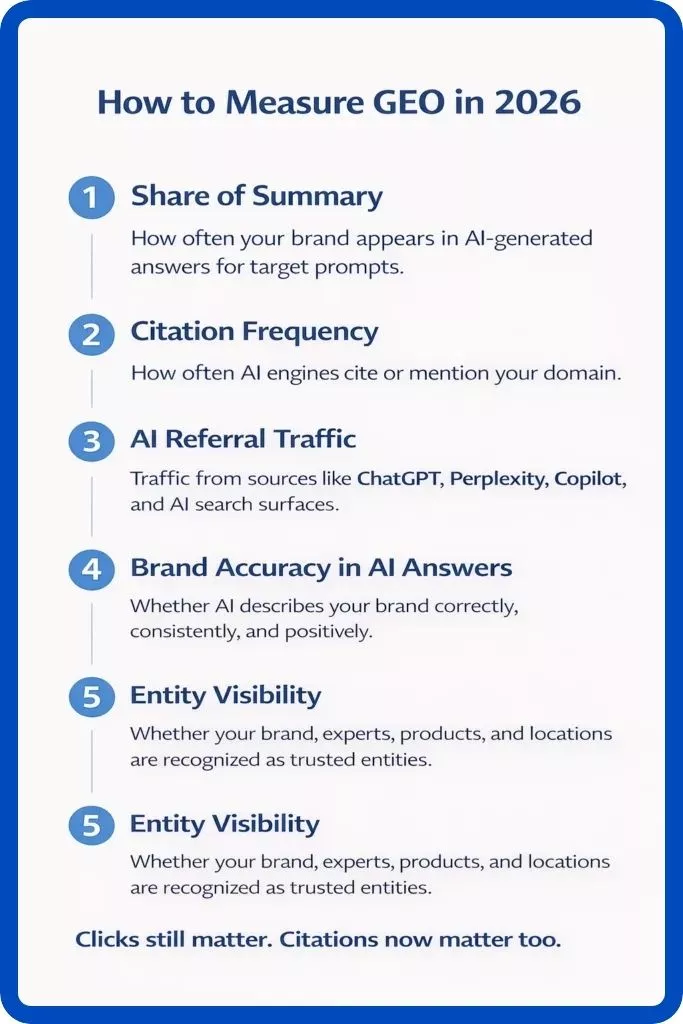
Traditional analytics platforms show little about AI citations, so brands need new measurement techniques:
Share of Summary: The percentage of AI answers mentioning your brand for a set of target queries.
Citation velocity: How often AI engines link back to your domain over time.
AI referral traffic: Visits coming from AI domains (chatgpt.com, bard.google.com, perplexity.ai). Configure your analytics to capture these.
AI sentiment & accuracy: Monitor whether AI tools describe your brand correctly and positively; adjust content if misrepresentations appear.
Knowledge‑panel and entity metrics: Track knowledge‑panel impressions, Wikipedia page views and domain authority as proxies for entity strength.
Pro tip: Create internal dashboards to log AI citations, referral traffic, and content updates. Correlate spikes in inquiries or sales with AI exposure to infer impact.
Future Trends: AI Search and Opportunities for Canadian Brands
Model fragmentation and platform competition
AI search is becoming fragmented across platforms, ChatGPT, Claude, Gemini, Copilot, Instagram, Amazon and more, each with different training data and user intents. Users develop loyalty to their preferred AI assistant, so brands must ensure visibility across multiple engines. Tools that monitor citations across various models (e.g., brand radar dashboards) are becoming essential.
Paywalled AI and incentive shifts
Unlike ad‑supported search engines, many LLMs are subscription‑driven services. They have less incentive to surface third‑party links unless it enriches their answers. This means quality, density and authority of information matter more than clickbait. Brands must focus on making their content indispensable to the AI’s understanding of a topic.
The emergence of GEO platforms
New companies are building tools that not only track citations but fine‑tune models to mirror brand‑relevant prompts, optimize content for AI memory and even run synthetic queries at scale. These platforms integrate insight, creative input and feedback loops, enabling marketing teams to generate campaigns and iterate quickly as LLM behaviour changes.
AI agents as commerce intermediaries
The rise of agentic commerce, where AI bots perform purchases on behalf of users means brands need 100 % accurate, machine‑readable product data. Merchant Center feeds and product schemas must include complete attributes; otherwise the AI may choose a competitor. Canadian retailers should anticipate voice‑activated purchases via Siri or Alexa and ensure their inventory and logistics data are accessible to these agents.
Ethical considerations & regulation
Canadian businesses should also monitor developments in AI transparency regulations. The Government of Canada and international bodies are considering policies that require AI engines to cite sources and disclose the provenance of information. Staying compliant will further incentivize brands to maintain accurate data and structured citations.
Final Thoughts and Call‑to‑Action
Generative AI is not a fad, it is a fundamental change in how people discover, evaluate and buy. For Canadian brands, Generative Engine Optimization in 2026 is the difference between being the answer and being invisible. By embracing structured data, rich factual content, earned media, and localized conversational queries, your brand can earn citations in the AI responses that matter.
Ready to future‑proof your marketing? Implement the strategies in this guide, monitor your AI citations, and continue refining your approach as models evolve. If you need help auditing your GEO readiness or developing a bespoke AI‑visibility strategy, consider consulting with a Canadian GEO specialist at Wide Ripples Digital.
Quick FAQs
Q1. What’s the difference between Generative Engine Optimization (GEO) and Search Engine Optimization (SEO)?
SEO focuses on ranking pages in search results through keywords and backlinks. GEO focuses on structuring content so AI engines like ChatGPT or Google AI Overviews select, summarize and cite your brand. GEO involves semantic queries, question‑answer formats, structured data and earned media citations.
Q2. Is traditional SEO still important for GEO?
Yes. AI models often pull information from top‑ranking pages. Without a solid SEO foundation, your content may not appear in the datasets that LLMs train on. Think of SEO as the baseline; GEO is the layer that ensures your content is selected and cited in generative answers.
Q3. How do I get my brand mentioned in ChatGPT or Gemini?
Focus on authority and semantic relevance. Provide expert quotes and hard data, maintain consistent Product and Organization schema, earn mentions on high‑authority blogs and forums, and ensure your content answers specific, conversational queries with clear Q&A formatting. Building entity authority through Wikipedia pages, knowledge panels and digital PR further increases your chances.
Q4. How do I track GEO performance?
Measure Share of Summary, citation velocity, AI referral traffic and sentiment accuracy. Use GA4 or similar analytics tools to identify visits from AI domains and create internal dashboards to log AI mentions and correlation with inquiries or sales.
Q5. Which pages should Canadian businesses prioritize for GEO?
Prioritize pages that answer high‑intent questions: product pages with complete attributes, FAQ and comparison pages, store locator pages with local schema, and evergreen guides that address common customer pain points. For universities or education providers, program pages, admissions pages, tuition/financial aid pages and alumni outcome pages are critical.
Disclaimer: The information provided in this blog is for general informational purposes only. For professional assistance and advice, please contact experts.
Neha Ghauri, a graduate, has seven years of experience in writing for the digital marketing, finance, and business industries. She specializes in SEO-driven...