Search is not just ten blue links anymore. In 2026, people get answers inside search results, compare businesses on maps, watch short videos, and shop right on the results page. You can still rank and still lose the click if your result looks weaker than what shows above it.
That is why SEO in 2026 means visibility across more surfaces. AI answers, local results, video carousels, shopping blocks, and classic organic pages all matter now.
Canada is still a huge opportunity for search. Google leads search share in Canada, with Bing second, based on Statcounter’s Canada data for January 2026.
This guide shows what SEO becomes in 2026 and what to fix now so you stay visible and get the click.
SEO Basics in 2026
SEO today is helping the right pages get discovered, understood, trusted, and chosen. That last word matters. Chosen. You can rank and still lose the click if the snippet looks unclear, the brand feels unknown, or the page loads slowly.
The new baseline is that SEO is not only about rankings. It is search visibility across surfaces. Your goal is to show up where decisions happen, not only where links live.
SEO has two jobs now. First, be the best answer. Second, be the easiest next step. If your page answers the question but makes the next action confusing, you will get traffic but fewer leads. If your page makes the next action easy but does not answer the question, you will not earn the click in the first place.
What SEO Will Be in 2026
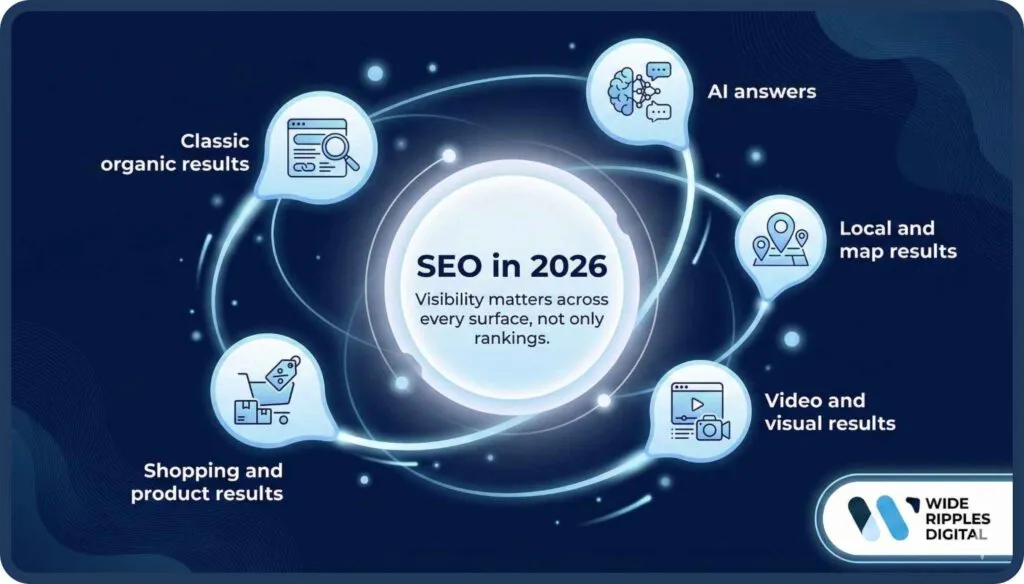
In 2026, SEO is multi-surface by default. A search for the same topic can trigger different result types depending on intent, device, and query wording. That is why one site can feel like it is “dropping” when it is really being pushed lower by new result features.
Here are the main surfaces to plan for.
Classic organic results
AI features in search, such as AI Overviews and AI Mode
Local and map results
Short video and visual results
Shopping and product results
The key shift is that clickless moments increase. People get quick answers without leaving the results page. They also compare options faster. So your brand and proof must show before the click. That means stronger titles, clearer descriptions, better review signals for local, and pages that look trustworthy when someone does click.
AI features and your website can sound scary, but Google has been clear on one important point. The core SEO best practices still apply for Google Search Central AI features like AI Overviews and AI Mode, and there are no special extra requirements just to appear there.
That is good news. It means you do not need gimmicks. You need strong fundamentals and better proof.
The 2026 Ranking Priorities That Matter Most
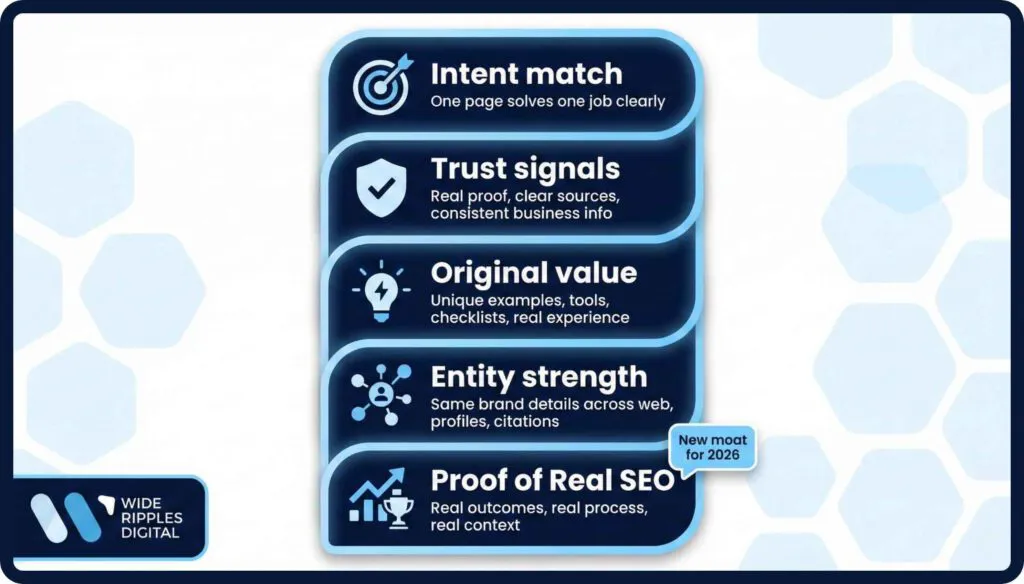
Intent match gets stricter. One page should solve one job clearly. If you try to rank one page for five different intents, you often end up ranking for none of them. In 2026, search systems reward pages that answer the query cleanly, then support that answer with useful depth.
Trust gets heavier. People are more cautious. They look for clear sources, real proof, and consistent business info across the web. If your site makes big claims without support, it feels like noise.
Original value wins. This is where most sites fall behind. You do not need longer content. You need better content. Unique examples, checklists, small tools, decision guides, and real experience beat generic advice. This is also where answer engine optimisation becomes practical. You write so that an answer can be lifted quickly, then you back it up with proof.
Entity strength matters more too. Your brand becomes an entity when your details are consistent across your site, profiles, citations, and mentions. That helps authority signals, and trust signals line up. When people see the same name, same service, same proof across surfaces, they choose faster.
The new moat is Proof of Real SEO. Proof becomes a system, not a nice add-on. Real outcomes, real process, real people, real context. If you want brand citation in AI answers and in generative summaries, this kind of proof gives search systems more confidence in your pages.
Content That Wins in 2026
Content that wins starts by answering first. Do not hide the answer under a long intro. Give a fast answer box, then short steps, then deeper proof. This structure helps humans and also supports AEO.
Next, build topic clusters that feel human. One pillar page should cover the main topic. Support pages should answer real questions people ask before they buy. This is what semantic content clusters look like when done well. They are not a “content farm.” They are a helpful map.
Decision pages matter more now. Many sites still write blog posts that attract visitors but do not convert. A decision page is different. It includes pricing cues, timelines, what happens next, and trust signals. It is built to help someone decide, not only learn.
Refresh plans also matter more than constant publishing. Start by updating the pages that already get impressions. Those pages are already in the conversation. Improve clarity, add proof, tighten headings, and upgrade titles. It is often the fastest path to better clicks.
Visual assets are also more valuable now. Simple diagrams, comparison tables, and checklists earn saves and links. They also keep people on the page longer, which can support better engagement signals and better conversion.
If you are stuck at the “what do we write about” stage, start with proper keyword work. That is still the simplest way to match intent and build clusters that make sense. Here is a practical internal guide you can review for how to do keyword research for a clear and better understanding.
Technical SEO That Supports Modern Search
Technical SEO in 2026 is not about fancy tricks. It is about removing friction so search systems and users can trust your site.
Indexing and crawl basics still come first. Clean architecture, strong internal linking, and a healthy sitemap keep your important pages discoverable. If your site has orphan pages or confusing navigation, you make it harder for search systems to connect your content.
Performance and UX are more important now because search results are more competitive. On mobile, people decide quickly. If a page jumps around, loads slowly, or feels awkward to use, they leave. That can turn into fewer leads even when rankings look fine.
Core Web Vitals are still a strong way to measure page experience and fix what hurts conversions. If you need a clear breakdown and fixes, this Core Web Vitals guide can help you understand and fix the related issues.
Structured data is still useful, but only when it matches what is visible on the page. Use a schema that genuinely matches page content. Do not add markup that does not reflect reality.
Local readiness matters too, even for brands that are not “local only.” Keep NAP consistent, be clear about service areas, and create location pages only when they are truly unique and useful. Thin location pages can backfire.
Content governance is also part of technical SEO now. Avoid duplication, doorway pages, and thin programmatic pages that add nothing. If you publish many near-identical pages, you increase maintenance, create cannibalisation, and weaken trust.
Measurement in 2026
If you only track rankings, you will make the wrong decisions. In 2026, measure what leads to business outcomes.
Track impressions and CTR because they tell you whether you are being seen and chosen. Track branded search lift because it shows whether your brand is becoming a default option. Track conversions and assisted conversions because SEO rarely converts in a single click.
Also, track visibility across surfaces when possible. You want to know whether the change is a ranking issue or a layout issue. Sometimes your ranking is stable but your traffic drops because the results page changed. That is common now with more rich features.
Here is the SEO Debugger most guides miss. It is a ten-minute weekly triage you can run without tools beyond Search Console and analytics.
If impressions drop, check indexing and intent match. Look for pages that lost visibility and see if they still match what the query is asking.
If CTR drops, rewrite titles, add proof, and improve snippet clarity. A title that was fine last year can look weak today if the results page gets more crowded.
If clicks hold but leads drop, fix page trust and next steps. Often, the offer is unclear, the form is annoying, or the page loads slowly on mobile.
If rankings hold but traffic drops, check SERP layout changes and surface shifts. Your page may still rank, but a new feature may be taking attention. That is a surface problem, not a content problem.
This is also where zero-click search experiences become real. Some searches will not send much traffic, no matter what. In those cases, the win is to show up with your brand and proof, then capture demand in higher intent queries.
How To Prepare For SEO in 2026
Preparation is not a massive rebuild. It is a focused plan that improves what already exists, then expands with intention.
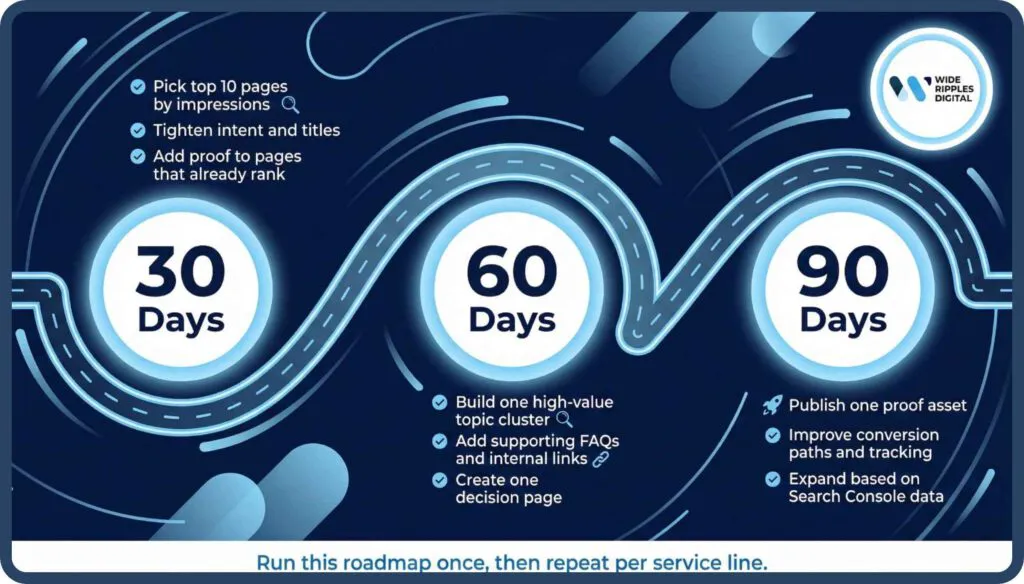
In the first 30 days, pick your top ten pages by impressions. Tighten intent, add proof, and improve titles. Many sites can lift clicks quickly here without publishing anything new.
In the next 60 days, build one cluster around a high-value service or product. Create one pillar page and a handful of support pages that answer real questions. Add supporting FAQs and internal links so the cluster feels connected.
In the next 90 days, publish one proof asset per month. A proof asset is a case study, a comparison guide, a checklist, or a small tool that people actually use. Improve conversion paths, forms, and tracking so traffic turns into enquiries. Then expand to the next cluster based on what Search Console shows people are already searching.
This approach supports answer engine optimisation and generative engine optimisation, often called GEO, without chasing hype. You build clear answers, strong proof, and connected topics. That is the safest path.
2026 SEO Readiness Checklist
Use this as a quick readiness check. Keep it simple and honest.
Content clarity: Does each key page solve one job clearly and answer the main question fast
Proof and trust signals: Do you show real outcomes, real process, and consistent business details
Technical health: Can search systems crawl and index your important pages easily
Local accuracy: Is your NAP consistent and your service area clear
Measurement and reporting: Do you track impressions, CTR, conversions, and lead quality
Update cadence: Do you refresh pages that already get impressions before publishing new ones
If you can answer yes to most of this, you are already ahead of many sites.
Concluding Remarks
SEO in 2026 is not just about content. It is clearer answers, stronger proof, better surfaces, and better measurement. When you treat SEO as visibility, not only rankings, you stop feeling surprised by search changes. If you want a practical next step, run a short SEO visibility audit. It should check surfaces, proof, and tracking, not only rankings. Wide Ripples Digital can do that and give you a fix list that is easy to act on, plus a simple 90-day plan tied to Search Console data. If you want more visibility and better leads without guesswork, this is the cleanest place to start.
Quick FAQs
What will SEO look like in 2026
It will be multi-surface. You will need visibility in classic results, AI features, local, video, and shopping, depending on your business.
Will traditional SEO die by 2026?
No. Strong fundamentals still matter. The change is that rankings alone are not the whole picture anymore.
What is GEO and why is it important for 2026?
GEO is generative engine optimisation. It focuses on making content clear, trustworthy, and easy to cite in AI style results, while still serving humans.
How do AI Overviews change organic traffic?
They can reduce clicks for some informational searches because users get a summary on the results page. You can still win by being a supporting link and by targeting higher intent queries.
What role will E-E-A-T and brand signals play in future rankings
They help trust. Real experience, clear authority, and consistent brand signals across the web reduce doubt and improve selection.
How should content creation evolve for 2026 SEO
Answer first, then prove it. Build clusters around real questions, refresh pages with impressions, and create proof assets people use.
How to optimise content to be cited by AI?
Make the answer clear early, add specific steps, cite real proof, and keep your page easy to crawl and understand.
Will zero-click searches reduce traffic to websites?
Yes, for some queries. That is why you should also target decision queries and build brand proof that shows before the click.
How can brands stay visible in AI-driven search?
Keep fundamentals strong, publish clear answers, show proof, and keep local and product data accurate.
What skills and tools will SEO professionals need by 2026?
They will need strong intent research, technical basics, content strategy, conversion thinking, and measurement across surfaces, not only rank tracking.
Disclaimer: The information provided in this blog is for general informational purposes only. For professional assistance and advice, please contact experts.
Neha Ghauri, a graduate, has seven years of experience in writing for the digital marketing, finance, and business industries. She specializes in SEO-driven...