
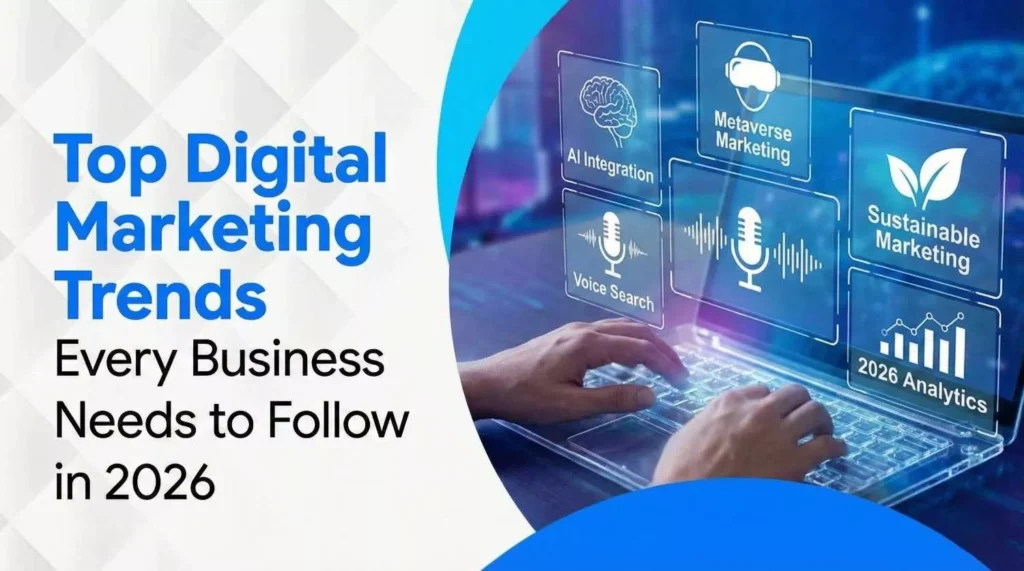
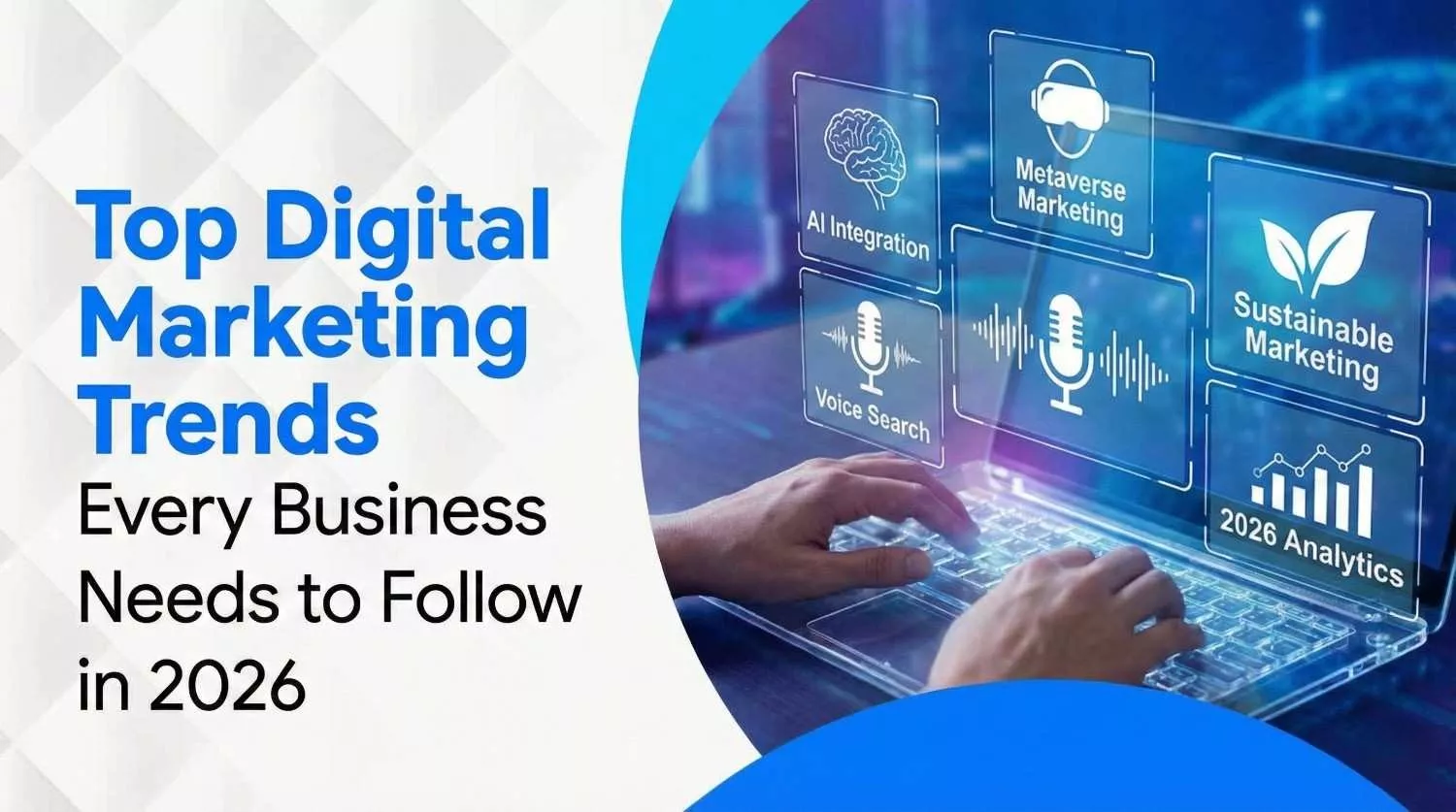
Top Digital Marketing Trends Every Business Needs to Follow in 2026
February 9, 2026
| Neha Ghauri | Reviewed by Haseeb Hamdani
Reading Time: 9 minutes
Jump To Section
- What Makes 2026 Different?
- 1: AI‑Driven Personalization & Hyper‑Targeting
- 2: Search Evolution: AEO, Voice & Visual Search
- 3: Community‑Driven Social Media & the Rise of Micro‑Influencers
- 4: Video Marketing Revolution
- 5: Next‑Gen Websites: AEO‑Friendly, Accessible & Agent‑Ready
- 6: Paid Media & Advertising in a Privacy‑First World
- 7: Ethical, Sustainable & Authentic Marketing
- 8: AR, VR & Immersive Experiences
- 9: Omnichannel Experience & Data‑Driven Personalization
- 10: Marketing Data & Budgets: Challenges and Opportunities
- 11: Canadian Innovations & Local Campaign Examples
- Bringing It All Together
- Frequently Asked Questions (FAQs)
Digital marketing is entering a new era. Emerging digital marketing trends in 2026 reflect a seismic shift in how brands connect with customers: AI tools are everywhere, audiences demand authenticity, and privacy regulations are reshaping data strategies. In Canada, home to vibrant cities like Toronto, Vancouver and Montreal, these changes are magnified by diverse audiences and rapid digital adoption.
Whether you operate a boutique coffee shop on Queen Street or run a national e‑commerce platform, understanding the latest digital marketing industry trends will determine whether you grow or fall behind.
The following guide synthesizes insights from industry reports and expert analyses.
What Makes 2026 Different?
- AI goes mainstream: A recent report shows 86.4 % of marketing teams use AI tools, and 68.2 % of marketers say they understand how to use AI. AI is no longer experimental; it’s central to daily workflows.
- SEO is becoming AEO: Answer Engine Optimization (AEO) and generative AI search are replacing keyword‑stuffed tactics. Brands are recalibrating content to be understood by AI assistants.
- Privacy laws bite: The end of third‑party cookies forces brands to collect and use first‑party data ethically. Canadian consumers reward transparent data practices.
- Video dominates: Short‑form and live‑streaming videos deliver the highest ROI, and Canadians spend over 100 minutes daily watching online video.
1: AI‑Driven Personalization & Hyper‑Targeting
Why It Matters
Gone are the days of generic campaigns. Customers now expect brands to tailor messages, offers and experiences to their unique needs.
How It Works
AI and machine learning can process customer data (purchase history, browsing patterns, location) to create highly segmented audiences. This enables real‑time dynamic content (e.g., personalized website pages or product recommendations).
Pro Tips
- Leverage first‑party data: Collect data directly via your website, app or loyalty program. With third‑party cookies disappearing, first‑party data is your most reliable asset.
- Use AI‑powered CRM and CDP platforms: These tools centralize customer data and automate segmentation. In Canada, structured first‑party data yields engagement rates 2.5× higher.
- Keep human oversight: AI should assist, not replace marketers. Nearly 73.4% of marketers believe AI must work alongside human creatives.
Canadian Context
Canadian SMBs can use hyper‑targeting to stand out in crowded markets. For example, a local Toronto bakery could combine CRM purchase data with location targeting to deliver “fresh croissants when you walk nearby” notifications.
2: Search Evolution: AEO, Voice & Visual Search
AEO Replaces Keyword‑First SEO
Search algorithms no longer reward keyword stuffing; they prioritize content that answers questions directly. TechWyse explains that stuffing pages with keywords is outdated and that AI tools and answer engines like ChatGPT or Bard look for clear structure and meaningful connections between topics. HubSpot’s report echoes this: 2026 is the year of recalibrating content for AI search, with 40.6 % of marketers updating SEO for search changes.
Generative Engine Optimization (GEO) goes a step further by optimizing content so that generative AI models recommend it within conversational answers. According to the Moneris report, nearly 27 % of Canadian internet users (16+) access AI tools like Copilot monthly, making GEO crucial.
Voice & Social Search
Voice search queries are longer, more conversational and often local (“Hey Siri, where’s the best pizza near me?”). Social search is rising too; people search TikTok and Instagram for reviews and product ideas, so visual content with relevant hashtags and location tags is essential.
Pro Tips
- Create Q&A sections and structured data: Step‑by‑step guides, FAQs and schema markup help AI assistants understand and recommend your content.
- Optimize for conversational queries: Use natural language and long‑tail keywords. Focus on local phrases (“best coffee in Vancouver”).
- Use video and images in search: Multi‑modal search incorporates voice, images and text; adding alt text and captions helps AI parse your content.
3: Community‑Driven Social Media & the Rise of Micro‑Influencers
From Social Networks to Communities
Experts notes that audiences trust authentic voices; community‑driven content is taking over. Users want to co‑create with brands via polls, live chats and feedback loops. Employee‑generated content (EGC) resonates because workers know the brand intimately.
Micro‑Influencers Take the Spotlight
Micro‑influencers (5 000–100 000 followers) deliver higher engagement and targeted reach. Recent data shows that despite influencer marketing’s proven ROI, only 21.2 % of brands leverage it, a clear opportunity.
Platforms in 2026
- Instagram vs. Facebook: Instagram overtook Facebook as the #1 platform for brands; 70 % of brands use Instagram vs. 69.6 % for Facebook. Instagram excels at video, stories and commerce.
- TikTok vs. X: TikTok beats X (formerly Twitter) for usage and ROI. Short‑form video and social commerce make TikTok essential, especially for Gen Z audiences.
- Social commerce: About 47% of Canadians purchase through social media. Platforms embed shopping directly into feeds and live streams.
Pro Tips
- Encourage user‑generated and employee‑generated content: Showcase behind‑the‑scenes stories, customer testimonials and team insights.
- Partner with local micro‑influencers: Align with influencers who share your values (e.g., sustainability) to build trust.
- Add shoppable tags and livestreams: Use Instagram, Facebook and TikTok to sell products during live demos; tag products for easy purchase.
4: Video Marketing Revolution
Live Interactive & Shoppable Video
Live‑interactive videos with polls, chats, and shop buttons let viewers participate and purchase immediately. Experts note that live streams are becoming more like real conversations, and data shows live streaming delivers high ROI. In Canada, video commerce is surging, with Canadians spending over 100 minutes per day on online video and video influencing 82 % of buying decisions.
Short‑ and Long‑Form Video
Short‑form videos (15–60 seconds) top the ROI charts because they capture attention quickly. However, long‑form vertical storytelling is growing: tech platforms encourage 10–15‑minute vertical “episodes” that enable deeper narratives.
AI‑Generated & Spatial Video
AI can adjust voices, languages, and visuals to personalize videos for different audiences. AR/VR and 360‑degree video are turning product demos into immersive experiences. Experts highlight that AR/VR increases conversions; cosmetics companies saw 20 to 30 % higher conversion rates with virtual try‑ons.
Pro Tips
- Start with short clips: Use Instagram Reels or TikTok to introduce your brand and highlight products.
- Integrate shoppable links: Tag products in videos and live streams so users can buy instantly.
- Experiment with AR try‑ons and VR tours: If you sell fashion or furniture, provide virtual try‑ons or 3D models to reduce returns.
5: Next‑Gen Websites: AEO‑Friendly, Accessible & Agent‑Ready
AEO‑Led Architecture
As answer engines and AI assistants handle more queries, websites must be structured for machine comprehension. Experts recommend semantic design, structured tags and strong entity connections so AI tools can interpret content. For Canadians, Generative Engine Optimization (GEO) is particularly important because AI usage is growing rapidly.
Instant & Accessible UX
Users expect pages to load in under a second. Accessibility isn’t just ethical; it improves ranking and user satisfaction. Incorporate predictive loading, responsive design and ARIA labels.
Agent‑Friendly Sites
Autonomous AI agents can now shop, compare and transact on behalf of users. To prepare, sites should offer clear APIs, accurate product data and frictionless triggers so agents can complete tasks seamlessly.
Pro Tips
- Implement schema and semantic markup: Use FAQPage, HowTo, Product and Review schemas to feed structured data to AI.
- Optimize for speed: Compress images, use lazy loading and adopt responsive frameworks to meet instant load expectations.
- Prepare APIs for agentic AI: Provide endpoints for product pricing, inventory and checkout so AI agents can operate smoothly.
6: Paid Media & Advertising in a Privacy‑First World
Predictive AI & New Ad Formats
AI handles bidding, pacing and budget adjustments on the fly. Paid media spreads beyond search and social to connected TV, digital billboards and gaming worlds. Brands must tailor creative to each context, no more one‑size‑fits‑all ads.
Post‑Cookie Targeting & First‑Party Data
As third‑party cookies disappear, brands shift to zero‑party and first‑party data.
Retail Media Networks & Commerce Ads
Retail media networks (RMNs) allow brands to advertise within ecommerce ecosystems (e.g., Amazon, Walmart). Experts notes that Canadian retail media ad spend will exceed $6 billion by 2028. Commerce ads embed shopping into videos, search results and social platforms (e.g., YouTube Shopping, Instagram Shops, Amazon Live).
Pro Tips
- Shift budgets to AI‑powered platforms: Allocate funds to channels where AI optimizes bidding (paid social, search, CTV).
- Invest in contextual and first‑party data: Use CRM and CDP tools; seek contextual ad placements aligned with your niche.
- Explore RMNs and shoppable ads: For ecommerce brands, advertise on Amazon, Walmart or Shopify networks to capture buyers at the moment of intent.
7: Ethical, Sustainable & Authentic Marketing
Ethical & Sustainable Influencer Marketing
Consumers care about environmental and social impact. Collaborations with ethically minded creators build trust and authenticity, while “greenwashing” erodes credibility.
Highlight Human Stories & Brand Values
TechWyse emphasises authentic, human‑centered storytelling. Show the faces behind your company, highlight community involvement and support local causes.
Transparent Data Practices
Consumers reward transparency; in post‑cookie Canada, 71% buy more from brands that are transparent about data use. Clearly communicate how you collect, store and use customer data.
Pro Tips
- Choose influencers carefully: Vet partners for alignment with your values. Micro‑influencers often bring authenticity and local relevance.
- Tell real stories: Share employee journeys, customer success stories and behind‑the‑scenes glimpses.
- Publish a privacy pledge: Outline your data collection and retention practices to build trust and comply with Canadian privacy laws.
8: AR, VR & Immersive Experiences
AR/VR Transform Commerce
Augmented reality and virtual reality create immersive experiences that bridge online and offline worlds. VR in Nike stores allows customers to test shoes in simulated sports environments. These technologies boost engagement, reduce returns and create memorable interactions.
Moneris underscores the impact: cosmetics companies using virtual make‑up try‑ons saw 20–30 % higher conversion rates, and eyewear retailers reduced returns by up to 40%.
Immersive Storytelling & 360‑Degree Content
AI‑generated and spatial videos allow brands to deliver 360‑degree experiences. Customers can explore products virtually, attend virtual events or take tours of facilities, perfect for tourism, real estate and retail.
Pro Tips
- Start with AR filters and 3D models: Use AR in your mobile app or social media (e.g., Instagram filters) to let customers try products virtually.
- Host virtual events: Provide VR tours, webinars or product demonstrations to engage remote audiences.
- Use 360‑degree video for storytelling: If you run a tourist business, film immersive tours of Canadian landmarks; if you’re in manufacturing, show the production process in a virtual environment.
9: Omnichannel Experience & Data‑Driven Personalization
Seamless Journeys Across Channels
Consumers interact with brands via websites, social networks, mobile apps and physical stores. The omnichannel trend focuses on providing a unified, fluid experience across these touchpoints. Recent reports notes that 73 % of shoppers use multiple channels before purchasing.
Personalization & Behavioral Signals
Delivering a unified experience requires personalization based on customer behaviors at each touchpoint. Experts emphasize tailoring messages to preferences and ensuring that customers can pick up conversations across channels without friction.
Pro Tips
- Centralize customer data: Use a CDP or CRM to unify online and offline interactions (e.g., purchase histories, chat transcripts).
- Optimize for mobile: Most omnichannel interactions start on mobile; ensure your site loads fast and offers easy checkout.
- Coordinate messaging: Align your email, push notifications and in‑store promotions so they complement rather than compete.
10: Marketing Data & Budgets: Challenges and Opportunities
Data Quality & Integration Struggles
HubSpot’s report reveals that data remains a major challenge: marketers struggle with disconnected data sources, silos and lack of high‑quality information. Only 65 % of marketers report having high‑quality audience data, leaving a sizable opportunity gap.
AI Adoption & Productivity Gains
AI adoption is high across marketing functions: 86.4 % of teams use AI, and over one‑third say it saves 10–14 hours per week. However, only 12.6 % of brands use hyper‑personalization (behavior‑based messaging), highlighting an opportunity to differentiate.
Budgets & Investments
Marketing budgets are increasing modestly, with 79.2 % of teams expecting at least a slight budget increase in 2026. Marketers plan to invest more in AI chatbots, paid social, video marketing, content marketing and SEO. Meanwhile, spending on traditional channels like print advertising and direct mail is expected to decline.
Pro Tips
- Invest in data management: Allocate budget for CDP/CRM solutions that integrate data sources and improve quality.
- Prioritize video and AI tools: Focus your budget on video production, AI chatbots and personalization platforms.
- Measure ROI carefully: With budgets under scrutiny, establish clear KPIs and track conversions, engagement and revenue for every channel.
11: Canadian Innovations & Local Campaign Examples
Digital Marketing for Tech & Beyond
Canada boasts a thriving tech ecosystem, and many local companies drive global marketing innovation. Examples include:
- Shopify’s Virtual Product Try‑On: Shopify (headquartered in Ottawa) integrated AR features that let customers visualize products in their homes. This innovation aligns with the AR/VR trend, reducing returns and boosting conversions.
- Tim Hortons’ 2025 Hockey Card NFT Campaign: To celebrate its famous roll‑up contest, the brand launched digital trading cards (NFTs) with exclusive offers, blending gamification with loyalty. It demonstrates how digital marketing and technology converge to create engaging experiences.
- Telus’ Sustainability Storytelling: Telus ran a “Connecting for Good” campaign showing real stories of communities benefiting from its technology. The focus on trend marketing (authentic, values‑driven storytelling) resonates with consumers.
- Recent Innovative Marketing Campaigns Examples 2025: In 2025, several Canadian brands pioneered AI‑driven campaigns. A grocery chain used predictive AI to send personalized recipe recommendations based on customers’ shopping habits, while a travel company deployed a chatbot that planned entire itineraries via voice.
Bringing It All Together
The digital marketing trends of 2026 represent a convergence of technology, consumer empowerment, and ethical considerations. AI is driving personalization and automation, while AEO and GEO are reshaping search strategies.
Social media is evolving into community platforms, and video, whether short, long, live or shoppable, dominates engagement. Websites must be agent‑friendly and accessible, advertising must navigate privacy regulations and harness new formats, and marketing must tell authentic stories that align with sustainability and community values.
Ready to implement these digital marketing trends? Wide Ripples Digital can help you craft personalized campaigns, optimize your site for AEO and GEO, and build community‑driven strategies tailored to your business. Contact Wide Ripples Digital today to start growing your brand in 2026 and beyond.
Frequently Asked Questions (FAQs)
What are the newest trends in digital marketing for 2026?
The newest trends include AI‑driven personalization, answer engine optimization (AEO), community‑driven social content, shoppable videos, immersive AR/VR experiences, and privacy‑first data practices. These digital trends reflect how technology and consumer expectations are evolving.
How can small businesses leverage digital marketing and technology without huge budgets?
Focus on high‑impact channels like short‑form video and localized SEO. Use affordable AI tools for email personalization and chatbots; partner with micro‑influencers; and collect first‑party data via loyalty programs. In Canada, tools like Moneris’ Total Commerce help integrate online and offline payments.
How important is voice search optimization?
Voice search is growing; approximately 58 % of consumers use voice search to find local businesses. Voice queries are conversational and often local, so incorporate long‑tail keywords and FAQs. Update your Google Business Profile and focus on “near me” searches.
Do I need to worry about “trend marketing” fatigue?
Trends come and go. The key is to focus on fundamentals, genuine storytelling, delivering value and respecting privacy. Adopt new tactics that align with your brand, but don’t chase every fad. Sustainable trends like personalization, video and ethical marketing will continue to pay off.
What are some digital marketing industry trends specific to Canada?
Hyper‑personalization, social commerce, agentic AI, privacy‑first data practices and retail media networks are particularly prominent. Canadian consumers also value sustainability and authenticity, so campaigns that highlight social impact and local stories resonate strongly.
What is Generative Engine Optimization (GEO)?
GEO is the practice of optimizing content so generative AI tools (like ChatGPT, Bard or Copilot) surface your content in conversational answers. It involves clear structure, semantic markup and addressing common questions. With 27 % of Canadians using AI tools monthly, GEO will become as important as traditional SEO.
Disclaimer: The information provided in this blog is for general informational purposes only. For professional assistance and advice, please contact experts.
Search Here
More Categories
Latest Posts

February 9, 2026
Neha Ghauri
February 6, 2026
Khadija Raees
February 3, 2026
Neha Ghauri

January 31, 2026
Khadija Raees
January 31, 2026
Khadija Raees
About Author

Neha Ghauri
Neha Ghauri, a graduate, has seven years of experience in writing for the digital marketing, finance, and business industries. She specializes in SEO-driven...