If you are comparing google ads vs facebook ads for a Canadian business, the better platform depends on the job you need the ad to do. Google Ads is usually better when people already know the problem and are actively searching for a solution, while Facebook Ads, now usually managed through Meta Ads, is usually better when your offer needs visuals, storytelling, education, or repeated exposure before someone trusts you enough to click.
That is the polite version. The kitchen-table version is this: Google is the customer walking into Canadian Tire with a list. Meta is the customer scrolling on the couch who did not know they wanted a new patio set until your ad ruined their peaceful evening in the best possible way.
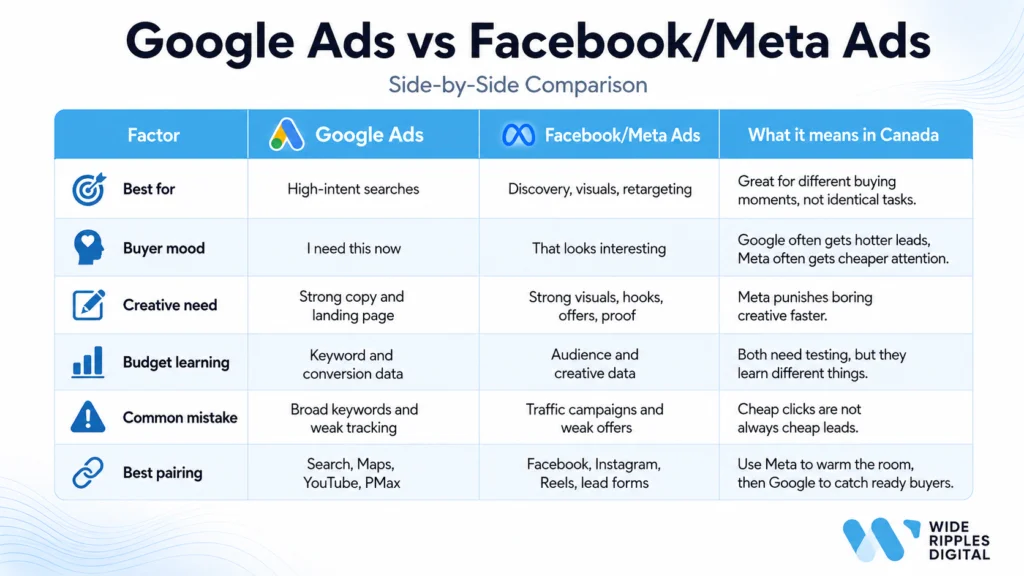
So, when business owners ask “facebook ads vs google ads which is better,” the honest answer is not one platform forever. The honest answer is: use Google when demand already exists, use Meta when demand needs to be created, and use both when your sales cycle has more steps than a simple “click, buy, done.”
Why This Question Gets Canadian Businesses Into Trouble
Most comparisons make paid ads sound like a boxing match. In the blue corner, we have Google Ads, wearing keyword gloves and looking very serious. In the other corner, we have Facebook Ads, holding a ring light, three Reels, and a suspiciously confident “limited-time offer.”
That makes the debate entertaining, but it also makes it less useful. Canadian businesses do not need a winner for the internet. They need a channel that fits their buyer, their budget, their location, their offer, their follow-up system, and their patience level, which is usually lower than it should be after the first invoice arrives.
A plumbing company in Mississauga, a boutique furniture brand in Toronto, a dental clinic in Calgary, a bookkeeping firm in Vancouver, and an online skincare shop shipping across Canada are not buying the same kind of attention. They may all run paid ads, but they are not playing the same game.
This is where the paid search vs paid social conversation becomes useful. Paid search is about capturing existing intent. Paid social is about creating attention before intent becomes obvious. When you understand that difference, you stop asking which platform is better and start asking which platform matches the next buying step.
Google Ads vs Facebook Ads: The Simple Difference
Google Ads is built around what people type, which means it works beautifully when people can name the thing they need. “Emergency dentist near me,” “bookkeeping services Mississauga,” “commercial cleaning company Toronto,” and “Google Ads consultant Canada” are not casual thoughts. Those searches usually mean someone has a problem, a deadline, or a boss asking for numbers by Friday.
Facebook Ads, under the Meta Ads system, is built around who people are, what they interact with, what they watch, and what kind of content earns their attention. This makes Meta powerful when the buyer does not yet know what to search, or when the product needs to be seen before it makes sense.
When Google Ads Usually Wins
Google Ads usually wins when the buyer is already problem-aware, solution-aware, and impatient. That is a fancy way of saying they are not browsing for fun. They are searching because something needs to be fixed, bought, booked, compared, or explained.
For Canadian service businesses, this matters a lot because many valuable leads start with location-based searches. Someone looking for a tax accountant in Mississauga, an immigration consultant in Brampton, a physiotherapy clinic in Edmonton, or a web design agency in Toronto is not always looking for inspiration. They are trying to narrow a list and make a decision.
Google Ads is usually stronger for these businesses
Local services where customers already search, such as accounting, legal, dental, repairs, tutoring, clinics, renovation services, and B2B consulting.
Urgent or deadline-based needs where timing matters more than brand entertainment, such as tax filing, emergency repair, last-minute bookings, or compliance support.
High-ticket services where buyers compare providers and need proof before booking a call.
Products with clear search demand, such as branded items, replacement parts, software categories, or services people already understand.
The hidden benefit of Google Ads is not just the click. It is the language you collect from real search terms. A good Google Ads account becomes a mini research lab that tells you how Canadians describe their problems when nobody is watching. That can improve your SEO pages, landing pages, FAQs, sales scripts, and even your Meta hooks.
The catch with Google Ads
Google is not magic, and it is especially not magic when an account is launched with broad keywords, weak landing pages, no call tracking, no offline lead quality review, and a budget that expects champagne results with sparkling-water discipline.
A campaign can show clicks and conversions while still attracting low-quality leads. This is common in Canada because a “lead” can mean anything from a serious buyer in Ontario with budget approved to a bored browser filling a form at midnight because the button was large and friendly.
That is why Google Ads needs clean conversion tracking, negative keywords, location discipline, landing pages that match the search, and lead scoring after the form submission. Without that, you are not running Google Ads. You are politely sponsoring confusion.
When Facebook Ads Usually Wins
Facebook Ads, or Meta Ads if we are being platform-correct at dinner parties, usually wins when the product needs to be seen, felt, understood, remembered, or emotionally framed before the buyer searches for it.
This is why Meta often works well for e-commerce, home decor, fitness offers, beauty, food, events, local experiences, personal brands, and visually driven services. People may not search “modern Italian dining chair for narrow Toronto condo,” but they will absolutely stop scrolling if the chair looks like it belongs in a beautiful condo where nobody has laundry on the couch.
Meta Ads is usually stronger for these businesses
Visual products that need demonstration, such as furniture, fashion, beauty, home decor, food, fitness, and lifestyle offers.
Local businesses with offers people may want once they see them, such as restaurants, events, gyms, clinics, studios, and seasonal promotions.
Brands with a longer education cycle where trust is built through repeated exposure, not one search click.
Retargeting campaigns for people who visited the site, watched a video, opened a lead form, or engaged with previous content.
The hidden benefit of Meta Ads is that it can teach you which angles make strangers care. Google tells you what people search. Meta tells you what makes them stop. For a Canadian business, both are gold, because a keyword can reveal demand while a winning creative can reveal the emotional reason behind the demand.
The catch with Meta Ads
Meta can make bad leads look exciting because the platform is excellent at generating volume when the offer is easy to click. This is especially true with lead forms, giveaways, broad targeting, and campaigns optimized for cheap actions instead of qualified conversations.
The other catch is creative fatigue. A Google Search ad can often run longer because it is triggered by intent. A Meta ad interrupts people, so the creative has to earn its stay. If your ad looks like a flyer from 2014, the algorithm may still spend your money, but the audience will scroll past it with the cold efficiency of a Toronto commuter avoiding eye contact.
Google Ads or Facebook Ads for Small Business: Use This Decision Framework
Small businesses in Canada usually do not have the luxury of testing everything with a giant budget, so the first decision should be based on buyer awareness, not platform popularity.
Start with Google Ads if
People already search for your service in your city or province.
You can answer a clear buying question on one landing page.
Your average customer value is high enough to afford competitive clicks.
You can answer calls, respond to forms, and follow up quickly.
Start with Meta Ads if
Your buyer needs education before they search for you by name or category.
Your product is visual, emotional, seasonal, or easier to understand through photos and videos.
You have strong creative, testimonials, before-and-after proof, or offers that people can understand quickly.
You are building demand in a market where people do not yet know the solution exists.
Use both if
Your buyer takes more than one touchpoint before becoming a lead.
You have enough budget to test search intent and creative angles at the same time.
You sell a service where people research, compare, leave, return, ask a spouse, vanish, and then suddenly book a call three weeks later.
You want Meta to warm up audiences and Google to catch people when they are finally ready to search.
The Canadian Layer Most Generic Blogs Miss
Canada adds a few wrinkles to the google ads vs facebook ads decision, and these wrinkles matter because Canadian markets are not one big identical blob wearing a polite winter jacket.
1. Local intent changes by city
A campaign targeting the GTA behaves differently from one targeting Regina, Halifax, Calgary, or rural Ontario. Search volume, competition, commute patterns, language, seasonality, and price sensitivity can all change. For Google Ads, this affects keyword costs and lead quality. For Meta Ads, it affects creative, offers, community cues, and how local the ad needs to feel.
2. Bilingual and multicultural markets need sharper messaging
In Canada, especially in areas like Quebec, Ottawa, Brampton, Mississauga, Surrey, and parts of Montreal, one generic English ad may not be enough. Sometimes the winning campaign is not a different platform. It is the same platform with clearer cultural context, better language matching, and landing pages that feel local instead of copied from a generic North American template.
3. Seasonality is not decoration
Canadian buyers change behaviour around tax season, winter, back-to-school, real estate cycles, Ramadan, Diwali, Christmas, long weekends, summer travel, and the first sunny week when everyone remembers patios exist. A campaign that ignores seasonality may blame the platform when the real issue is timing.
4. Trust signals matter more than clever ads
A fun ad can get the click, but Canadian buyers still check the boring things before they convert. Reviews, location pages, business hours, pricing clarity, case studies, service pages, team credibility, and fast follow-up can decide whether your paid traffic turns into money or just a nice-looking analytics graph.
Paid Search vs Paid Social: Think Like a Funnel, Not a Fan Club
Paid search vs paid social becomes easier when you stop treating the platforms like rival sports teams. The funnel usually looks like this: Meta introduces the idea, content builds trust, Google captures high-intent searches, the website proves you are real, retargeting brings people back, and follow-up turns the lead into revenue.
That is why a business can lose money on each platform separately but make money when the system is connected. Meta may not close the lead on day one, but it may make the buyer recognize your brand when they search on Google later. Google may get the final conversion, but that does not mean Google created all the demand by itself.
The problem is that most dashboards do not tell this story clearly. Platform attribution often behaves like every channel is taking credit for bringing the potato salad to the family dinner. This is why you need call tracking, CRM notes, UTM tags, landing page data, and simple human questions like “How did you first hear about us?”
Budget Split: A Practical Starting Point
There is no perfect budget split, but Canadian businesses can use a simple starting framework before testing.
Business Type
Suggested Starting Split
Why
Watch Closely
Local urgent service
80% Google, 20% Meta retargeting
Search intent is already strong.
Call quality and wasted search terms.
Visual e-commerce brand
60% Meta, 40% Google Shopping/Search
Creative can create demand while search captures branded and product intent.
Creative fatigue and true ROAS.
B2B service provider
70% Google/LinkedIn, 30% Meta retargeting
Buyers compare, research, and need proof.
Lead quality, not form volume.
New category or new offer
70% Meta, 30% Google
You may need to create demand before search volume exists.
Landing-page education and retargeting.
Established brand with traffic
50% Google, 50% Meta
Both intent capture and remarketing can work together.
Incremental lift, not vanity conversions.
This split is not a law. It is a starting bet. After 30 to 60 days, the budget should move toward the campaigns producing qualified opportunities, not just cheaper clicks, cheaper leads, or prettier dashboards.
The Mistakes That Waste Money Fast
The platform usually gets blamed when the real villain is campaign setup, weak creative, poor landing pages, slow follow-up, or tracking that treats every lead like it deserves a trophy.
Mistake 1: Choosing by CPC alone
A $1 click that does nothing is expensive, and a $9 click that becomes a $4,000 client may be a bargain. CPC is a cost metric, not a business result. Canadian businesses should judge paid ads by cost per qualified lead, booked call rate, close rate, customer value, and time to revenue.
Mistake 2: Sending every visitor to the homepage
Your homepage is a lobby. A landing page is a salesperson with one job. If someone searches “bookkeeping services Mississauga,” do not send them to a homepage where they must play hide-and-seek with the contact button. Match the page to the intent, show proof, answer objections, and make the next step painfully obvious.
Mistake 3: Running Meta traffic campaigns and expecting sales
Traffic campaigns can produce visitors, but visitors are not the same as buyers. If the real goal is leads or purchases, the campaign objective, landing page, event setup, and follow-up must match that goal. Otherwise, the algorithm may deliver exactly what you asked for, which is traffic, not revenue.
Mistake 4: Treating all leads as equal
Two leads can cost the same and have completely different value. One is ready to book. One is comparing prices for a cousin who may start a business someday. Without CRM tagging and lead-quality feedback, the ad platform keeps optimizing toward surface-level conversions instead of the people who actually pay.
Mistake 5: Forgetting the follow-up speed
Paid ads do not fix slow sales. If your team responds two days later, the lead may already be gone, annoyed, or happily booked with the competitor who replied while you were still deciding whether the form notification went to spam.
A 30-Day Test Plan for Canadian Businesses
If you are unsure whether to run google ads or facebook ads for small business growth, do not guess for six months. Run a focused 30-day test with one offer, one landing page path, and clear success metrics.
Week 1: Build the foundation
Pick one service or offer instead of advertising the whole business at once.
Build one landing page that matches the ad promise and includes proof, FAQs, location cues, and one CTA.
Set up conversion tracking, call tracking, UTMs, CRM tags, and a simple lead-quality score.
Week 2: Launch controlled tests
For Google, test high-intent keywords first, then add broader terms only when the account has data.
For Meta, test three to five creative angles, such as pain point, proof, comparison, offer, and founder-led explanation.
Avoid changing everything daily, because confused campaigns produce confused conclusions.
Week 3: Read the right numbers
Check search terms, ad comments, landing-page conversion rates, call recordings, form quality, and booked appointments.
Pause waste, but do not kill a campaign only because one day looked ugly.
Move budget toward signals that show buyer quality, not just platform activity.
Week 4: Decide the next bet
If Google produces fewer but stronger leads, scale carefully and improve landing-page conversion.
If Meta produces volume but weak quality, adjust the offer, qualification questions, and creative promise.
If both show partial success, connect them through retargeting and better follow-up instead of declaring a winner too early.
Meta Ads vs Google Ads Canada: Real-World Examples
Example 1: Accounting firm in Mississauga
Google should usually lead because people search for tax help, bookkeeping, CRA letters, payroll, and corporate tax support with clear intent. Meta can support the campaign with retargeting, educational posts, credibility videos, and reminders during tax season, but the hottest leads will often come from search.
Example 2: Home decor or furniture brand
Meta should often lead because the product is visual and emotional. People need to see the room, the texture, the lifestyle, and the before-and-after feeling. Google can still capture product searches, brand searches, and shopping intent, but Meta may create the original desire.
Example 3: B2B software or agency service
Google can work well for high-intent searches, but the landing page must do heavy lifting because B2B buyers compare more carefully. Meta may not always create immediate leads, but it can build familiarity, retarget visitors, and make the founder or team feel more credible before the sales call.
Example 4: New local clinic
Google can capture “near me” demand, while Meta can introduce the clinic to people in the area with proof, offers, staff videos, and educational content. The strongest setup often uses Google for search intent and Meta for neighbourhood awareness and retargeting.
Where Wide Ripples Fits In
At Wide Ripples Digital, the goal is not to simply buy clicks and hope the internet behaves. The team builds paid campaigns with the pieces that make ads work in the real world: keyword research, audience segmentation, creative content, conversion-focused landing pages, A/B testing, retargeting, performance tracking, and budget optimization.
Paid ads also work better when the rest of your digital system is clean, which is why services like SEO and content strategy, website design and development, social media management, lead generation, and marketing funnel automation matter together instead of sitting in separate corners of the website like awkward cousins at a wedding. You can explore the full service list here: Wide Ripples Digital Marketing Services
For internal linking, this article can also connect naturally to the Wide Ripples blog library, especially topics around Google Ads costs in Canada, B2B lead generation, SEO and content marketing, page speed, and website conversion. Blog hub: Wide Ripples Blogs
Final Verdict: So, Which Is Better?
Google Ads is usually better when your customer is already searching, comparing, and ready to act. Facebook Ads is usually better when your customer needs to notice, understand, trust, and remember you before they search. For many Canadian businesses, the best answer is not Google Ads or Facebook Ads. It is Google Ads plus Meta Ads, connected through better tracking, sharper landing pages, and a follow-up process that does not disappear after the lead arrives.
If your product solves an urgent, known problem, start with Google and use Meta to retarget and build familiarity. If your product is visual, emotional, new, or easier to sell through storytelling, start with Meta and use Google to capture the people who search later. If you sell something expensive, complex, or trust-heavy, use both and judge them by the quality of the sales pipeline, not by which dashboard looks happier.
The platform is not the strategy. The strategy is knowing what your buyer already believes, what they need to see next, and which ad channel can move them one step closer to becoming a customer.
Quick FAQs
Is Google Ads better than Facebook Ads for Canadian businesses?
Google Ads is often better for Canadian businesses with existing search demand, urgent services, or high-intent local searches. Facebook Ads is often better for visual products, awareness, retargeting, and offers that need storytelling before people search.
Facebook ads vs Google ads which is better for small businesses?
For small businesses, Google is usually better when people already search for the service, while Facebook is usually better when the business needs to create awareness or show a visual offer. The best choice depends on buyer intent, budget, creative quality, and follow-up speed.
What is the difference between paid search vs paid social?
Paid search targets people based on what they type into search engines, while paid social targets people based on audience signals, interests, behaviour, engagement, and creative response. Paid search captures demand, while paid social often creates or warms demand.
Should I run Meta ads vs Google ads Canada campaigns together?
Many Canadian businesses should test both if the budget allows, because Meta can build awareness and retarget visitors while Google captures people searching with higher intent. The key is to connect tracking and judge results by qualified leads or sales, not only clicks.
How much should a Canadian business spend to test both?
A practical test budget depends on the industry and location, but the budget should be large enough to collect meaningful data for at least 30 days. A small local service business may start with one platform first, while a brand with more creative assets and a longer buying journey may split spend between Google and Meta.