How Much Should a Small Business Spend on Marketing in Canada? (2026)
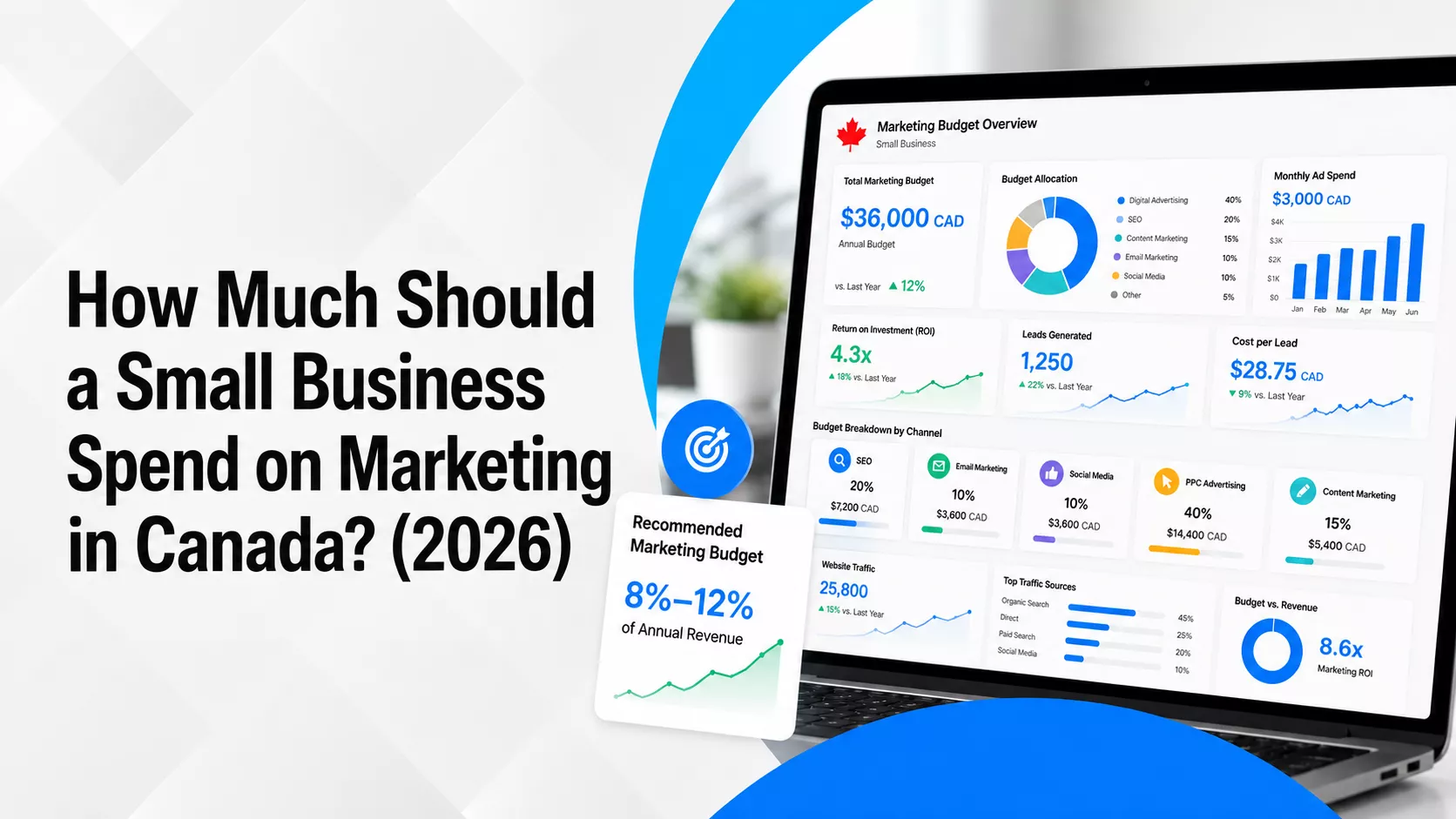
How much should a small business spend on marketing in Canada? For most owners, the working answer is 5 to 10 percent of revenue. Tight on cash and just keeping the lights on? You can survive on 2 to 5 percent for a while. Young, hungry, and trying to get noticed in a crowded market? You may need 12 to 20 percent to break through the noise.
You could close the tab now. But then you would miss the part where we tell you which of those numbers is a trap, what a marketing dollar actually buys in Canada this year, and why the shop down the street is outranking you on a smaller budget. Spoiler: it is not spending more. It is aiming better.
What percentage of revenue should a small business spend on marketing?
The percentage-of-revenue method is the one everybody quotes at dinner parties, and it holds up. Here is where the real numbers land in 2026.
Big companies with dedicated marketing teams average 7.7 percent of company revenue, flat for the third year running, according to the Gartner 2025 CMO Spend Survey. Buried in that same survey is a detail most articles skip: half of those marketing chiefs are working with 6 percent or less. So the "average" is doing a lot of heavy lifting.
The CMO Survey run by Deloitte, Duke, and the American Marketing Association puts the figure higher at 9.4 percent. And the U.S. Small Business Administration has long recommended 7 to 8 percent for businesses under $5 million in revenue. Different sources, similar neighbourhood.
Now the Canadian reality check. Percentages feel tidy until you convert them to dollars.
What does that look like in actual Canadian dollars?
Here is the trap in the percentage method: 8 percent of a $200,000 revenue means $16,000 a year, which is roughly $1,300 a month. That is not a war chest. That is one channel done properly.
The Business Development Bank of Canada surveyed more than 1,400 Canadian businesses and found small business marketing costs average just over $30,000 a year. Businesses with 20 to 49 employees spend about double that. Companies with 50 or more people push past $100,000.
A rough map by revenue for a typical Canadian small business:
| Annual revenue | 5% budget | 8% budget | 10% budget |
|---|---|---|---|
| $150,000 | $7,500 | $12,000 | $15,000 |
| $500,000 | $25,000 | $40,000 | $50,000 |
| $1,000,000 | $50,000 | $80,000 | $100,000 |
| $2,000,000 | $100,000 | $160,000 | $200,000 |
Use this as a starting bracket, not a rulebook. Then adjust for the two factors that actually move the number: your stage and your industry.
How does business stage change the number?
Brand new or breaking into a crowded market: aim high, 10 to 20 percent. Nobody knows you exist yet, and awareness is expensive. A new salon opening beside three established competitors cannot tiptoe in on $50 a month and hope the universe notices.
Growing with product-market fit: 7 to 12 percent. You have proof that people want what you sell. Now you are pouring fuel on a fire that already caught.
Established with steady repeat customers: 5 to 7 percent is often plenty. Your reputation does part of the selling for you, so your marketing maintains rather than manufactures demand.
Industry matters just as much. Consumer product brands spend far more of revenue than business-to-business service firms. A restaurant, a law firm, and a plumbing company should not budget the same way, because their customers decide to buy in completely different ways. A homeowner with a burst pipe is not scrolling Instagram. They are typing "emergency plumber near me" and calling the first trustworthy result.
What actually goes inside a marketing budget?
Most owners hear "marketing budget" and picture ad spend. Ad spend is a slice, not the pie. A real budget covers five buckets:
- Media spend. The money you hand to Google, Meta, and the rest to put you in front of people.
- Your owned assets. Your website, your content, the things you keep forever even if you turn ads off tomorrow.
- Tools and tracking. Analytics, email software, a CRM, the boring plumbing that tells you what is working.
- Creative. Copy, design, photography, video. The stuff that makes people stop scrolling.
- Time. Someone has to run all of this. Forget the time cost and you underestimate your real budget by half.
Skip that last one and your tidy spreadsheet lies to you.
How should you split the budget across channels?
Two frameworks do the heavy lifting here.
The 70/20/10 rule: put 70 percent into channels you know work, 20 percent into promising newer tactics, and 10 percent into pure experiments. It keeps you funding winners while still testing so you do not get left behind.
A simpler split for owners starting from scratch:
- 40 percent into the channel already bringing you customers. Double down on what works.
- 30 percent into your website and content, the assets you own.
- 20 percent into testing one new channel per quarter.
- 10 percent into tools, tracking, and the plumbing.
The exact percentages matter less than the principle: every dollar gets a job. A budget without categories is just a number you feel guilty about.
Worth noting the direction the money is flowing in 2026. Digital now takes roughly 76.7 percent of all advertising spend in Canada, with total digital marketing spend around $18.9 billion, per Made in CA. Search pulls the biggest share of that revenue, followed by social. And 94 percent of Canadian small businesses use social media for marketing at least monthly. If your budget is 100 percent flyers and a billboard, you are marketing to 2015.
What does marketing actually cost in Canada in 2026? (the part nobody publishes)
Here is where most budget guides go quiet. They will happily tell you "spend 8 percent" and then vanish before telling you what 8 percent buys. So here are real 2026 Canadian price ranges for the common services, drawn from published agency pricing across the market:
| Service | Typical monthly range (CAD) |
|---|---|
| SEO and content strategy | $500 to $2,000 |
| Paid ads (ad spend) | $500 to $1,500+ |
| Ad management fee | $300 to $500 |
| Content (2 to 4 blogs) | $500 to $1,000 |
| Social media management | $500 to $2,000 |
| Full-service agency retainer | $2,500 to $10,000+ |
A quick gut check for a business doing $500,000 a year. An 8 percent budget is about $3,300 a month. A sensible mix might be a $700 SEO foundation, $1,200 in ad spend with $400 management, $600 in fresh content, and the rest into tools and a bit of testing. That is a complete, funded, single-brain strategy. Notice what it is not: five channels each starved on $600 a month, teaching you nothing.
The BDC puts a floor on paid search specifically, recommending a minimum of about $1,000 a month on Google Ads for the campaign to gather enough data to be worth running. Below that, you are paying to guess.
The free groundwork to finish before you spend a cent
Before a single dollar goes to ads, there is work that costs nothing but an afternoon and returns more than most paid campaigns.
Fill out your Google Business Profile completely. For a local business this is the difference between showing up when a nearby customer searches and staying invisible. It is free through Google's Business Profile tool.
Then get reviews. Ask happy customers. Print a card with a QR code by the till. Reviews build trust no ad can buy, and they matter more every year: BDC's 2026 consumer research found 87 percent of consumers check reviews before buying something new, and 89 percent use digital channels to find new brands.
Fix the free stuff first. It makes every paid dollar work harder later, because the person who clicks your ad still checks your reviews before they call.
Where small business marketing budgets get wasted
The most common leak is not overspending. It is spreading too thin. Three hundred dollars split across five channels teaches you nothing about any of them. One channel, funded properly, for at least 90 days, teaches you something true.
The second leak is chasing every shiny trend. Video is powerful, but if your actual customers find you through local search, months of lovingly produced reels can rack up views and book nobody.
And the contrarian one that ruffles feathers: cheaper is not always smarter. Owners obsess over the lowest cost per click. But a channel that costs more per lead while closing far more sales is the cheaper option once the dust settles. Judge spending by what walks through the door, not by what looks affordable on a dashboard. Interestingly, recent research found top-performing marketers on return often spend less, not more, because they cut waste ruthlessly before adding spend.
Pro tips for setting your number
- Pro tip 1: Budget by customer, not just by percentage. Work out what a customer is worth to you over a year or two. If a client spends $2,000 a year and stays two years, that is $4,000. Suddenly a $60 lead cost looks like a bargain, not an expense. Set a target for customers you want, multiply by what one costs to acquire, and you have a budget grounded in reality.
- Pro tip 2: Track one number above all. Not clicks. Not likes. Cost per booked customer. It is the only metric that connects marketing to your bank account.
- Pro tip 3: Do not judge results in week two. SEO in particular is a slow fire, not a light switch. Give a channel two full quarters before you decide its fate.
- Pro tip 4: Let AI stretch the budget. The tools that write first drafts, edit video, and run customer research have made a modest 2026 budget go further than the same money did five years ago. Lean operations are quietly getting more from less.
Are Canadian businesses actually increasing their marketing spend?
Yes, cautiously. Despite economic uncertainty being the number one concern, a Clutch survey of marketers found 60 percent of small businesses plan to increase their marketing budgets in 2026, led by content and digital advertising. Meanwhile only a small minority plan to cut. The lesson from past downturns backs the instinct: businesses that hold or grow marketing through rough patches tend to come out ahead when things recover.
Translation: pulling back entirely is how you hand your market to a competitor who kept showing up.
The bottom line
A strong small business marketing budget in Canada is not about restraint or splurging. It is about aiming. Point steady, funded effort at the places your real customers already are, protect the assets you own, and measure by customers gained rather than dashboard vanity. Do that and a modest budget holds its own against far bigger spenders.
Still not sure how much your business should spend, or where that money would work hardest? That is the exact question we answer for Canadian businesses every day. Book a free strategy call with Wide Ripples and we will give you a straight read on where your dollars belong, no pressure and no jargon. Or see the full range of services we use to turn budgets into booked customers.
Quick FAQs
What is a good marketing budget for a small business in Canada?
How much should a startup spend on marketing?
Is $1,000 a month enough for marketing?
Should I spend on SEO or Google Ads?
How do I know if my marketing budget is working?
Disclaimer: The information provided in this blog is for general informational purposes only. For professional assistance and advice, please contact experts.
Written by Neha Ghauri
Last updated August 5, 2026