llms.txt: Should Your Website Have One? (2026 Guide)
The internet has a new file everyone is suddenly whispering about: llms.txt.
Yes, another tiny text file has entered the chat. First, we had robots.txt. Then came sitemap.xml. Now marketers, developers, SEO teams, and AI consultants are asking one very reasonable question:
Should my website have an llms.txt file in 2026?
The honest answer is this: maybe, but not for the reason most people think.
If you expect an llms.txt file to magically boost your Google rankings, make ChatGPT quote your website daily, or turn your homepage into an AI celebrity, please step away from the keyboard. That is not how this works.
But if you want to make your most important content easier for AI systems, agents, internal tools, developers, or future search experiences to understand, then llms.txt may be worth adding. It is low-cost, low-risk, and useful when done properly.
For Canadian businesses, this topic matters because AI use is rising fast. Statistics Canada reported that 19.2% of Canadian businesses used AI to produce goods or deliver services in Q2 2026, up from 6.1% in Q2 2024. That means AI use among Canadian businesses has roughly tripled in two years.
So yes, this little file deserves a serious look.
What Is llms.txt?
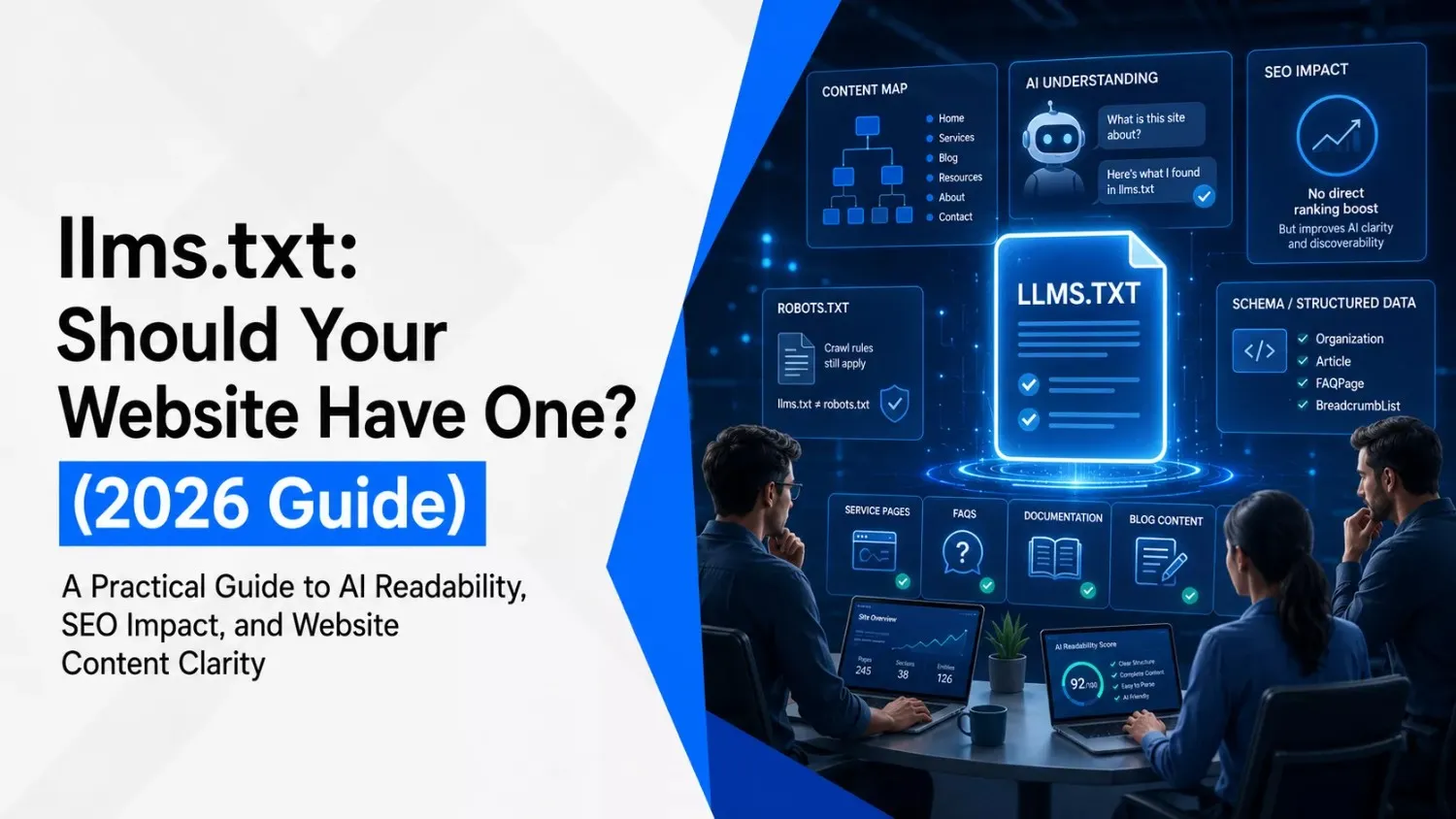
llms.txt is a proposed Markdown file placed at the root of a website to help large language models understand important website content.
Usually, it sits here:
yourwebsite.com/llms.txt
Think of it as a polite front desk for AI tools.
Instead of forcing an AI system to wander through your website like a confused tourist in a mall, llms.txt gives it a clear map. It can point to your best resources, product information, service pages, policies, documentation, FAQs, case studies, or Markdown versions of key pages.
The llms.txt proposal was published in September 2024. Its purpose is to provide information that helps language models use a website at inference time, meaning when a user is actively asking a model for help.
In plain English, llms.txt says:
“Dear AI system, here are the pages that actually matter. Please do not judge us by our old 2019 blog post about ‘digital transformation.’ We were going through something.”
llms.txt vs robots.txt vs sitemap.xml
This is where many website owners get confused.
These three files sound similar, but they do different jobs.
| File | Main Purpose | Who It Helps |
|---|---|---|
| robots.txt | Controls crawler access rules | Search engines and bots |
| sitemap.xml | Lists URLs you want indexed | Search engines |
| llms.txt | Curates useful content for AI systems | LLMs, agents, AI tools |
Google’s documentation says robots.txt can manage crawling traffic and prevent crawlers from accessing unimportant or similar pages. However, robots.txt should not be used to hide sensitive pages because not all crawlers obey it.
A sitemap tells search engines about the URLs you prefer to show in search results. Google also notes that a sitemap can influence which canonical URLs appear in search.
llms.txt is different. It does not block bots. It does not replace your sitemap. It does not control indexing. It simply gives AI systems a cleaner guide to your content.
Must-know tip: Do not treat llms.txt as a security file. It is not a lock. It is more like a menu.
Does Google Use llms.txt for Search Rankings?
No.
Google’s 2026 guidance is very clear: you do not need llms.txt or other special AI files to appear in Google Search, including generative AI features. Google says Search does not use these files, and creating one will neither help nor hurt your rankings.
That should calm down a lot of LinkedIn panic.
So, will llms.txt improve your Google SEO?
No, not directly.
Will missing llms.txt hurt your website?
No, not for Google Search.
Should you still consider it?
Yes, in certain cases.
That is the part many rushed articles miss. The value of llms.txt is not classic SEO. The value is AI readability, content clarity, and future-proofing.
What Happens If You Do Not Deploy llms.txt?
For most websites, nothing dramatic happens.
Your site will not disappear from Google. AI bots will not gather outside your homepage holding tiny protest signs. Your rankings will not collapse because you forgot one Markdown file.
As of 2026, not having llms.txt means:
- No direct Google ranking loss
- No confirmed Google AI visibility loss
- No effect on your sitemap
- No replacement for robots.txt
- No guaranteed loss of ChatGPT visibility
But here is the catch.
If AI agents, internal assistants, coding tools, or other systems start using llms.txt more often, websites with clean, structured files may become easier to interpret.
That matters for businesses with complex information.
For example:
- SaaS companies with technical documentation
- E-commerce brands with product categories
- Law firms with practice areas
- Accounting firms with tax guides
- Healthcare clinics with service pages
- Education websites with program pages
- Agencies with case studies and service pages
For a five-page brochure website, llms.txt may be optional. For a content-heavy website, it can become a useful content map.
Should Canadian Businesses Care About llms.txt?
Canadian businesses should care, but they should not panic.
AI adoption is no longer a “tech company only” conversation. Statistics Canada found that Canadian businesses used AI most often for data analytics, text analytics, virtual agents, natural language processing, and large language models in Q2 2026.
That means your customers, competitors, staff, and vendors are already using AI tools to search, compare, summarize, and make decisions.
Also, workers are moving even faster than businesses. Statistics Canada reported that from September 2024 to July 2025, about 22% of workers used generative AI at work in the previous 12 months, and usage rose from 17% in September 2024 to 30% in July 2025.
That is the real reason this matters.
People are not only “Googling” anymore. They are asking AI tools questions like:
- “Which accounting firm in Toronto handles corporate tax?”
- “What is the best local SEO agency in Mississauga?”
- “Compare these three service providers.”
- “Summarize this company’s services.”
- “Does this business look trustworthy?”
If your website is messy, thin, outdated, or hard to parse, llms.txt will not save it. But if your website already has strong content, llms.txt can help organize that content for AI-facing use cases.
The Real Use Case: Make Your Best Content Easier to Understand
The best reason to create llms.txt is simple:
It helps you tell AI systems which pages matter most.
This is useful because websites are messy. Even good websites have:
- Old blog posts
- Tag pages
- Archive pages
- Thin category pages
- Legal pages
- Duplicate service pages
- Plugin-generated URLs
- Random PDFs from 2018
- That one landing page nobody wants to talk about
An llms.txt file lets you point to your strongest assets.
For example, a Canadian SEO agency might include:
- Main SEO services page
- Local SEO page
- Technical SEO page
- Case studies
- Pricing or process page
- FAQs
- Contact page
- About page
A Canadian accounting firm might include:
- Corporate tax page
- Bookkeeping page
- Payroll page
- GST/HST page
- CRA audit support page
- Notice-to-reader statements page
- Industry-specific service pages
A SaaS company might include:
- API documentation
- Product overview
- Pricing
- Security page
- Integration docs
- Changelog
- Support centre
This is not “AI magic.” It is content hygiene.
And content hygiene is like dental hygiene. Nobody cheers for it, but everyone notices when it is missing.
When Should Your Website Have llms.txt?
You should consider adding llms.txt if your website has structured, useful content that AI tools may need to understand.
It is most useful when your website has:
- Technical documentation
- Many service pages
- Detailed product information
- Complex pricing or policies
- Educational resources
- Research or white papers
- A large blog library
- Multiple locations
- Industry-specific landing pages
- Important FAQs
You may not need it yet if your website has:
- Fewer than 10 pages
- Very little informational content
- No blog or resource section
- No technical documentation
- No public content you want AI tools to read
- Sensitive information that should not be surfaced
Pro tip: If your website content is weak, fix the website first. Creating llms.txt for poor content is like putting a luxury label on instant noodles.
What Should You Include in llms.txt?
A strong llms.txt file should be short, clear, and curated.
The proposed format uses Markdown. It usually includes:
- An H1 with the site or project name
- A short summary
- Notes about the business
- H2 sections
- Links to important pages
- Short descriptions for each link
- Optional resources that can be skipped if context is limited
The llms.txt proposal explains that the file can include Markdown sections with “file lists” of URLs where further detail is available. It also recommends concise language, clear link descriptions, and avoiding ambiguous terms.
Here is a simple structure:
# Company Name
> Short description of what the company does, who it helps, and where it operates.
## Core Services
- [Service Page](https://example.com/service/): Description of the service and who it is for.
- [Pricing](https://example.com/pricing/): Overview of packages and pricing model.
## Resources
- [Blog](https://example.com/blog/): Helpful guides and educational articles.
- [Case Studies](https://example.com/case-studies/): Real examples of client results.
## Policies
- [Privacy Policy](https://example.com/privacy-policy/): Privacy and data handling information.
- [Terms](https://example.com/terms/): Website and service terms.
## Optional
- [Older Blog Archive](https://example.com/archive/): Extra resources that may not be needed first.
Notice what is missing?
There is no keyword stuffing. No “best best best.” No awkward SEO soup. No paragraph that reads like it was written by a robot trying to win a spelling bee.
Keep it useful.
What Should You Not Include?
Do not dump your whole website into llms.txt.
That defeats the purpose.
Avoid adding:
- Private URLs
- Admin pages
- Client portals
- Thin tag pages
- Duplicate URLs
- Outdated articles
- Irrelevant PDFs
- Tracking URLs
- Search result pages
- Pages blocked by robots.txt
- Pages with personal or sensitive data
For Canadian businesses, be careful with personal information. The Office of the Privacy Commissioner of Canada advises organizations that develop or use generative AI tools to follow privacy principles and protect personal information entrusted to them.
So, do not include pages that expose client data, employee information, internal documents, private reports, or anything that should not be easy to summarize.
Must-know tip: If you would not want a stranger summarizing the page in an AI answer, do not highlight it in llms.txt.
llms.txt and AI Crawlers: The Important Difference
This is the part that deserves a giant sticky note.
llms.txt does not control AI crawlers. robots.txt does.
OpenAI’s crawler documentation says webmasters can manage how sites work with AI using robots.txt tags such as OAI-SearchBot and GPTBot. It also explains that a site can allow OAI-SearchBot for search visibility while disallowing GPTBot to indicate content should not be used for training generative AI foundation models.
Google also has Google-Extended, a robots.txt product token that helps publishers manage whether crawled content may be used for Gemini model training and grounding in certain Gemini experiences.
Anthropic states that its bots respect “do not crawl” signals through robots.txt directives.
So your AI crawler strategy should not start with llms.txt.
It should start with this question:
Do we want AI systems to access, use, cite, or train on our content?
Your answer may vary by bot.
For example:
- Allow search-related AI bots if you want visibility.
- Block training-related bots if your content is proprietary.
- Monitor server logs to see who actually crawls your site.
- Keep robots.txt clean and intentional.
- Do not copy random “block all AI” rules from the internet.
Random robots.txt rules can block useful visibility. That is like locking your store, turning off the lights, and wondering why nobody came in.
A Smarter 2026 Framework: The AI Content Access Stack
Here is the part most blogs skip.
Do not think of llms.txt as one file. Think of it as part of your AI Content Access Stack.
Your stack should include:
1. Robots.txt
Use this to manage crawler access.
This is where you decide which bots can crawl which sections of your website.
2. Sitemap.xml
Use this to help search engines find your canonical URLs.
This supports crawling, indexing, and URL discovery.
3. Structured Data
Use schema markup to clarify entities, services, reviews, products, FAQs, locations, and organization details.
This helps search engines understand meaning.
4. llms.txt
Use this to curate your most useful AI-readable resources.
This helps AI tools and agents understand your content faster.
5. Server Log Monitoring
Use this to see what bots actually visit.
Do not guess. Check logs. Guessing is how websites end up blocking their own money pages.
6. Content Quality
Use helpful, original, expert-led content.
No file can rescue weak pages. Not llms.txt. Not sitemap.xml. Not “final-final-v7-keywords-updated.docx.”
How to Create llms.txt Step by Step
Here is a simple process.
Step 1: Audit your important pages
List your strongest pages first.
Include pages that explain:
- Who you are
- What you do
- Who you help
- Where you serve
- Why you are credible
- How your service works
- What users should know before contacting you
Step 2: Remove weak or outdated content
Do not include pages that are thin, old, duplicate, or irrelevant.
If the page does not help a user make a decision, skip it.
Step 3: Group pages by intent
Use clean sections such as:
- Services
- Locations
- Products
- Documentation
- Case Studies
- FAQs
- Policies
- Support
- Optional Resources
Step 4: Write clear descriptions
Each link should have a short explanation.
Bad:
“SEO page.”
Better:
“SEO services for Canadian businesses, including technical SEO, local SEO, content strategy, and reporting.”
Step 5: Place the file at root level
Upload it here:
/llms.txt
Make sure it returns a 200 status code and is not blocked.
Step 6: Keep it updated
Review it every quarter.
Also update it when you:
- Launch new services
- Remove old pages
- Change pricing
- Add new locations
- Publish major resources
- Update policies
Pro tip: Treat llms.txt like a lobby directory. If the tenant moved out, remove the name.
llms.txt Template for a Canadian Service Business
Here is a simple example.
# Example Canadian Service Company
> Example Company provides professional services for small and mid-sized businesses across Canada, with a focus on practical advice, transparent processes, and measurable results.
## Core Services
- [Main Services](https://example.ca/services/): Overview of services, process, and client fit.
- [Local SEO](https://example.ca/local-seo/): Local SEO services for Canadian businesses that need visibility in Google Search and Maps.
- [Technical SEO](https://example.ca/technical-seo/): Website audits, crawlability fixes, speed improvements, and indexation support.
## Locations
- [Toronto](https://example.ca/seo-toronto/): Services for Toronto businesses.
- [Mississauga](https://example.ca/seo-mississauga/): Services for Mississauga businesses.
## Proof
- [Case Studies](https://example.ca/case-studies/): Examples of client results and completed projects.
- [About](https://example.ca/about/): Company background, team, values, and experience.
## Helpful Resources
- [Blog](https://example.ca/blog/): Educational guides for business owners.
- [FAQs](https://example.ca/faqs/): Common questions about services, timelines, and process.
## Policies
- [Privacy Policy](https://example.ca/privacy-policy/): How personal information is collected and handled.
- [Terms](https://example.ca/terms/): Website and service terms.
## Optional
- [Older Articles](https://example.ca/blog/archive/): Extra content that may be skipped if context is limited.
This gives AI systems a clean overview without handing them every dusty corner of your website.
Common Mistakes to Avoid
The fastest way to ruin llms.txt is to treat it like a keyword dumping ground.
Avoid these mistakes:
- Stuffing keywords into every line
- Adding every URL on your website
- Including pages blocked by robots.txt
- Adding private or sensitive pages
- Forgetting to update it
- Using vague descriptions
- Treating it as a ranking factor
- Replacing SEO work with one text file
Your llms.txt file should be clear enough that a human can read it and understand your website in one minute.
If a human cannot understand it, do not expect an AI tool to throw a parade.
Is llms.txt Worth It for SEO Agencies?
Yes, but only when positioned correctly.
For SEO agencies, llms.txt is not a “ranking hack.” It is a technical content asset.
It can support:
- AI search readiness
- Content audits
- Information architecture
- Crawl strategy conversations
- AI bot governance
- Documentation quality
- Client education
- Future GEO and AEO planning
The real authority move is not saying, “Everyone needs llms.txt immediately.”
The real authority move is saying:
“Here is where llms.txt helps, here is where it does not, and here is what to fix first.”
That builds trust.
And trust is still the best ranking factor that does not appear in a dashboard.
Our Recommendation for 2026
For most Canadian businesses, our recommendation is simple:
Create llms.txt if your website has useful, structured content worth surfacing. Do not expect it to improve Google rankings directly.
Before adding llms.txt, make sure you already have:
- A clean robots.txt file
- An accurate sitemap.xml
- Strong service pages
- Clear internal linking
- Updated schema markup
- Helpful FAQs
- Fast page speed
- Crawlable content
- Privacy-safe public pages
- A content strategy based on real user questions
If those basics are broken, fix them first.
If those basics are strong, llms.txt is a smart next layer.
Quick Decision Checklist
Use this checklist.
You should probably add llms.txt if:
- Your website has 25+ important pages
- You publish guides, docs, or resources
- You want AI tools to understand your services
- You care about AI search visibility
- You have technical or complex content
- You serve multiple locations
- You already maintain SEO basics well
You can probably wait if:
- Your site is very small
- Your content is outdated
- You have no resource pages
- You do not want AI tools reading your content
- You have privacy concerns
- Your robots.txt and sitemap are already messy
The file is easy. The strategy behind it is what matters.
Need Help With llms.txt and AI Search Readiness?
Adding an llms.txt file is simple. Building the right strategy behind it is where most websites get stuck.
A small text file will not fix thin content, poor page speed, weak service pages, messy technical SEO, or a website that makes visitors feel like they entered a maze with no exit sign. Before AI tools can understand your business, your website needs to be clear for real people first.
That is where Wide Ripples Digital can help.
We help Canadian businesses build stronger websites, better search visibility, and smarter digital systems. Our team connects SEO and content strategy with technical website improvements, conversion-focused content, and clear internal linking, so your site is easier for Google, AI tools, and customers to understand.
If you are not sure whether your website needs llms.txt, we can review the bigger picture first. That includes your technical website analysis, sitemap, robots.txt, crawl issues, page speed, service pages, schema, and content structure.
Final Takeaway
So, should your website have llms.txt?
Yes, if your website has strong public content that you want AI tools to understand clearly.
No, if you think it is a magic SEO shortcut.
In 2026, llms.txt is best viewed as a simple AI readability layer. It will not replace good content, technical SEO, structured data, robots.txt, sitemap.xml, or actual expertise.
But it can help organize your website for a world where people search with Google, ChatGPT, Gemini, Claude, Perplexity, and whatever new AI tool launches next Tuesday with a shiny logo and too much funding.
The smart move is not panic.
The smart move is structure.
Start with your website basics. Clean your content. Fix your crawl signals. Make your best pages useful. Then add llms.txt as a clear map for AI systems.
Because in the AI search era, messy websites will still be messy.
Quick FAQs
What is llms.txt?
Does llms.txt help Google rankings?
Is llms.txt required in 2026?
What happens if my website does not have llms.txt?
Is llms.txt the same as robots.txt?
Can llms.txt block AI bots?
Should e-commerce websites use llms.txt?
They will just be messy faster
Written by Neha Ghauri
Last updated July 27, 2026