Entity SEO: Why Google Maps Things, Not Keywords
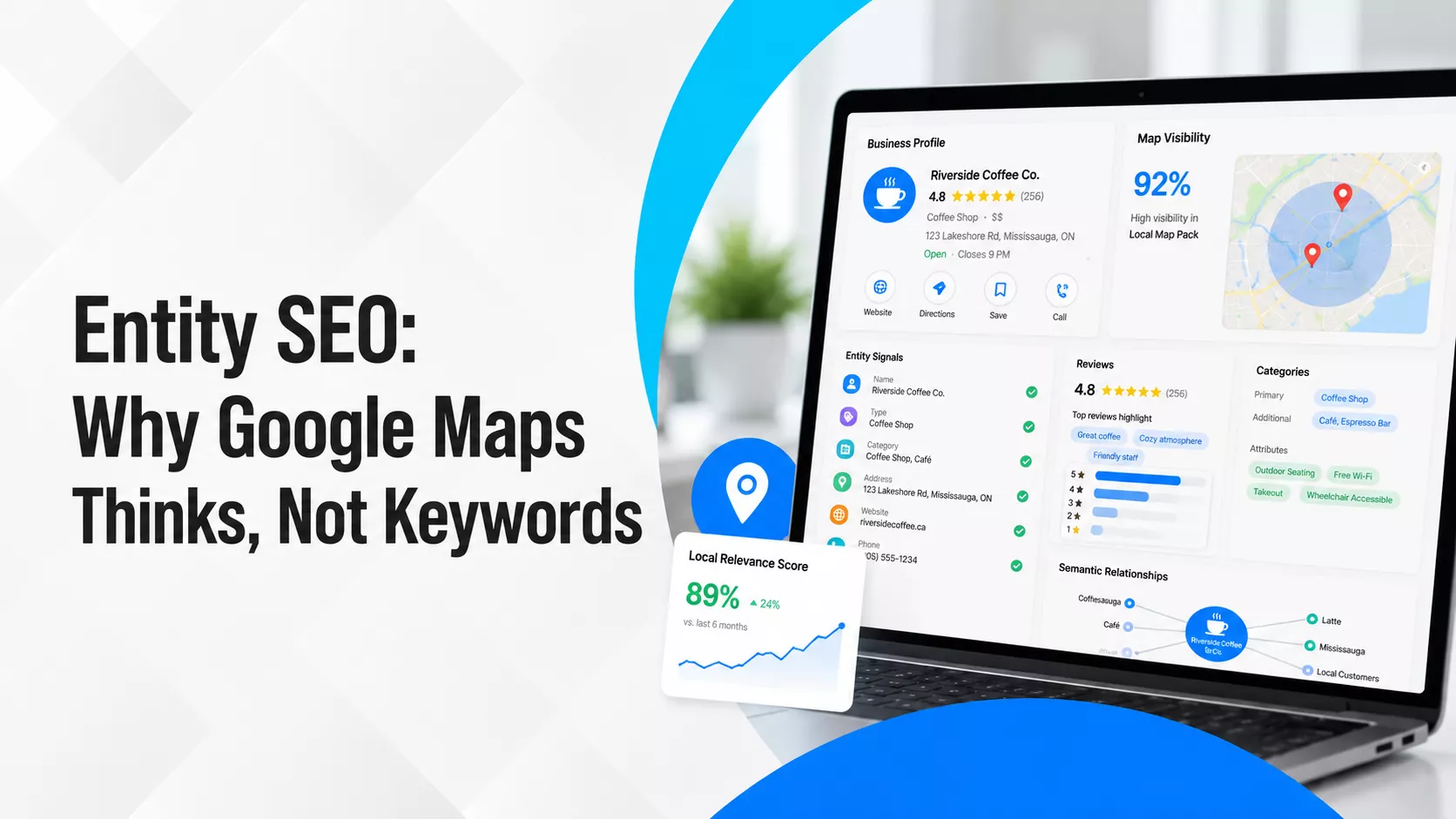
Entity SEO is the practice of optimising your website, your brand, and your off-site footprint so search engines identify you as a specific real-world thing, whether that is a company, a person, a product or a place, rather than a bag of words that happens to contain a keyword four times.
That distinction is not academic. It decides whether Google shows your brand a Knowledge Panel, cites you in an AI Overview, or quietly confuses you with a company in Ohio that shares half your name.
Here is the uncomfortable part. Most websites are still optimised for a version of Google that retired over a decade ago. They stuff "best plumber Mississauga" into an H2, sprinkle it through the body copy, and wonder why a competitor with worse content and fewer backlinks keeps appearing in the AI answer box. The answer is usually simple. Google knows who that competitor is. It is not sure who you are.
What Is Entity SEO? (The Short Answer)
Entity SEO is the process of making your brand, people, services, and topics machine-identifiable as distinct entries in Google's Knowledge Graph, so search engines rank you on meaning and verified identity rather than keyword matching.
An entity is anything uniquely identifiable and distinguishable from everything else: a person, organisation, place, product, event, or concept. Google stores each one with an internal identifier, a set of typed attributes, and relationship edges connecting it to other entities.
Keywords describe what someone typed. Entities describe what they meant.
The Day Google Stopped Reading and Started Understanding
On 16 May 2012, Google announced the Knowledge Graph with a phrase that has since been printed on roughly nine thousand SEO conference slides: the shift from "things, not strings." (Google Official Blog)
Before that, Google was essentially a very fast, very literal intern. You asked for "jaguar speed" and it matched characters. Cats, cars, and a 1990s guitar amplifier, all equally valid.
After 2012, Google started asking a better question. Which jaguar, and what does this user actually want to do with it?
The upgrades kept coming. Hummingbird taught Google to read full queries instead of fragments. RankBrain handled the never-before-seen ones. BERT understood prepositions and word order, which sounds boring until you realise "flight to Toronto" and "flight from Toronto" had been treated as near-identical for years. MUM added multimodal understanding.
By 2026, the entity model is not a trend to prepare for. It is the operating system your rankings already run on.
Why Entity Optimization Matters More in 2026 Than It Did in 2022
The stakes changed when search stopped sending traffic.
- Pew Research Center tracked the browsing behaviour of 900 US adults across 68,879 Google searches in March 2025. When an AI Overview appeared, users clicked a traditional organic link 8% of the time. On pages without one, that figure was 15%. Roughly 1% clicked a source cited inside the AI Overview itself. (Pew Research Center)
- Similarweb data indicates zero-click searches rose from 56% to 69% between May 2024 and May 2025.
- Semrush, using Datos clickstream data, recorded AI Overviews expanding from 6.49% of queries in January 2025 to 13.14% by March 2025.
- Ahrefs, analysing hundreds of millions of searches in 2025, measured a 34.5% CTR decline for position-one results when an AI Overview was present.
- GoodFirms' 2026 survey found 43% of marketers optimise for AI search, but only 14% measure it. That is an 86% blind spot.
Read those together and the conclusion writes itself. Ranking is no longer the finish line. Being named is. And AI systems name entities, because entities are the only thing they can verify.
An AI Overview does not cite "the page that used the keyword eleven times." It cites the source it has the highest confidence is a real, corroborated authority on that subject.
That confidence score is what entity optimization builds.
Authority note: Google has publicly described the Knowledge Graph as containing roughly 500 billion facts about 5 billion entities. Google has not issued an updated official count since, so treat every larger figure you see quoted online with appropriate suspicion.
How Google Entity Search Actually Works: The Four-Stage Pipeline
Most guides stop at "add schema." Here is the actual sequence.
1. Extraction. Google's natural language processing parses your page and pulls out candidate entities, assigning each a salience score, meaning how central that entity is to the page. A blog post mentioning your brand once in the footer has near-zero salience for that brand.
2. Disambiguation. Google decides which Sarah Khan, which Apex Consulting, which Mississauga. This is the stage where most brands quietly fail.
3. Corroboration. Google cross-checks your claims against independent sources such as Wikidata, LinkedIn, Crunchbase, business directories, news mentions, and industry associations. If your site says you were founded in 2014 and four other sources say 2016, confidence drops.
4. Confidence assignment. Google decides how certain it is that you are who you say you are. High confidence unlocks Knowledge Panels, brand SERP features, and AI citations. Low confidence gets you ten blue links, on a good day.
The Entity Confidence Audit: A 5-Minute Diagnostic
This is the part almost nobody publishes, so here it is free.
Before optimising anything, find out what Google currently believes about you. Run these four checks, score one point each.
Check 1. The Brand Name Test. Search your exact brand name in an incognito window. Do you own the entire first page, including a Knowledge Panel? Or does an unrelated business, a LinkedIn profile, and a directory listing outrank your homepage? One point if you dominate your own name.
Check 2. The Disambiguation Test. Search [your brand] + [your city] and then [your brand] alone. If the results differ wildly, Google has not resolved you into a single confident entity. It is hedging. One point if results are consistent.
Check 3. The Corroboration Test. Open five external profiles: Google Business Profile, LinkedIn, Facebook, your industry association, and any directory. Are the business name, address, phone number, founding year, and service description identical? Not "similar." Identical. One point for a perfect match.
Check 4. The Machine Test. Paste your homepage copy into Google's free Natural Language API demo. It shows you exactly which entities Google extracts and how salient each one is. If your own brand does not appear near the top, your homepage is not about you. One point if your brand ranks in the top three extracted entities.
Scoring: 4 means entity established. 2 to 3 means partially resolved and fixable in a quarter. 0 to 1 means Google does not know you exist as a thing, and no amount of blog volume will fix that.
Entity Disambiguation Debt (And Why Your Rebrand Broke Everything)
Here is a concept the standard guides skip entirely.
Every inconsistency you leave online accrues interest. The old address on a 2019 directory listing. The abbreviated business name on one social profile. The founder's maiden name on an old author bio. The service page you renamed but never redirected.
Individually, harmless. Collectively, they force Google to hedge, and a hedging Google defaults to not citing you.
This is why rebrands, office moves, and mergers so often cause unexplained visibility drops six to nine months later. It is not a penalty. It is accumulated disambiguation debt, and it compounds silently.
Pro tip: Before any rebrand, export every external mention of your business name and address into a spreadsheet. Update them in a single co-ordinated sprint, not gradually. Google resolves entities faster from one clean signal shift than from eighteen months of drift.
How to Do Entity Optimization: The Practical Build
Establish an entity home:
Pick one canonical URL, usually your About page, that definitively describes who you are. Every other signal points back to it.
Deploy Organization and Person schema properly:
Include name, legalName, foundingDate, address, logo, founder, and a robust sameAs array linking to your verified external profiles. Validate it with Google's Rich Results Test.
One caveat from the source:
Google's John Mueller has advised against using Knowledge Graph IDs (kgmid URLs) as sameAs values, noting those identifiers can change over time. Use stable public profiles instead. Mueller and Danny Sullivan have also both stated repeatedly that schema markup is not a ranking factor. Its value is entity resolution, not a direct rankings lever. Anyone selling you schema as a ranking hack is selling you something else.
Claim a Wikidata entry:
Wikidata is structured, machine-readable, and openly licensed, which makes it disproportionately useful for disambiguation. It does not require the notability threshold Wikipedia does.
Build genuine topical coverage:
One page on a subject makes you a participant. Twenty interlinked pages make you a node. This is where SEO and content strategy stops being two separate activities.
Name your authors and prove them:
Real bylines, real credentials, real sameAs links. This is the mechanical layer beneath E-E-A-T.
Structure internal links as clusters, not confetti:
Pillar page links out to sub-topics, sub-topics link back. Random cross-linking teaches Google nothing about relationships.
Match intent to entity type:
Informational, navigational, and transactional queries pull different entity attributes. Our breakdown of the three types of search queries maps this out.
Fix the technical floor:
Entities can only be extracted from pages that render and load. Page speed and SEO still gates everything above.
For Local and Multi-Location Businesses
Local entity SEO has an extra failure mode. Your location is an entity too, and Google is trying to link your brand entity to a place entity.
Every NAP inconsistency, every suite number formatted three different ways, and every service-area page with no distinct content actively weakens that link. Multi-location brands frequently create entity collisions, publishing five near-identical location pages that Google resolves as one confused entity rather than five confident ones.
Give each location a genuinely distinct page, its own LocalBusiness schema, its own Google Business Profile, and locally corroborated citations. If you operate across markets, the same principles apply at national scale. See our international SEO guide for the full framework.
Common Entity SEO Mistakes
- Adding schema that contradicts the visible page content.
- Using a stock logo or inconsistent brand name across profiles.
- Publishing anonymous content on an expertise-driven topic.
- Treating a Knowledge Panel as the goal rather than the symptom.
- Chasing entity work while three of your core service pages have no clear subject at all.
How to Measure Entity SEO
Traditional rank tracking will not show this. Track instead:
- Brand SERP quality: what a search for your exact name returns.
- Knowledge Panel presence and attribute accuracy.
- AI citation share: how often you are named in AI Overviews and assistant answers for your core topics.
- Branded search volume, which tends to rise as entity confidence rises.
- Entity salience on key pages, via the NLP API.
Recognition typically takes three to nine months once consistent signals are in place. Faster in low-competition niches, slower where established entities already occupy the graph.
Where This Leaves You
Backlinks get devalued. Content gets rewritten. Rankings collapse on core updates. A verified entity with consistent, corroborated signals is the most durable asset in modern search, because it is the one thing every algorithm and every language model has to agree on before it can mention you.
The work is unglamorous. Spreadsheets of profile URLs. Schema validation. Author bios. Nobody is going viral with it.
It is also the difference between being the answer and being a footnote nobody clicks.
Ready to find out what Google thinks you are?
Wide Ripples Digital runs entity audits as part of every SEO engagement. It is the same approach behind a 63% conversion lift and 159% revenue growth for one of our long-term clients.
Book a free 30-minute strategy call. We will run the four-check entity audit on your brand live and show you exactly where your signals conflict. No pitch, just the findings.
Quick FAQs
Is entity SEO replacing keyword research?
Do I need a Wikipedia page to be an entity?
Does schema markup improve rankings?
How long does entity SEO take?
Can a small local business become an entity?
Does entity SEO help with ChatGPT and Perplexity?
Disclaimer: The information provided in this blog is for general informational purposes only. For professional assistance and advice, please contact experts.
Written by Neha Ghauri
Last updated July 31, 2026