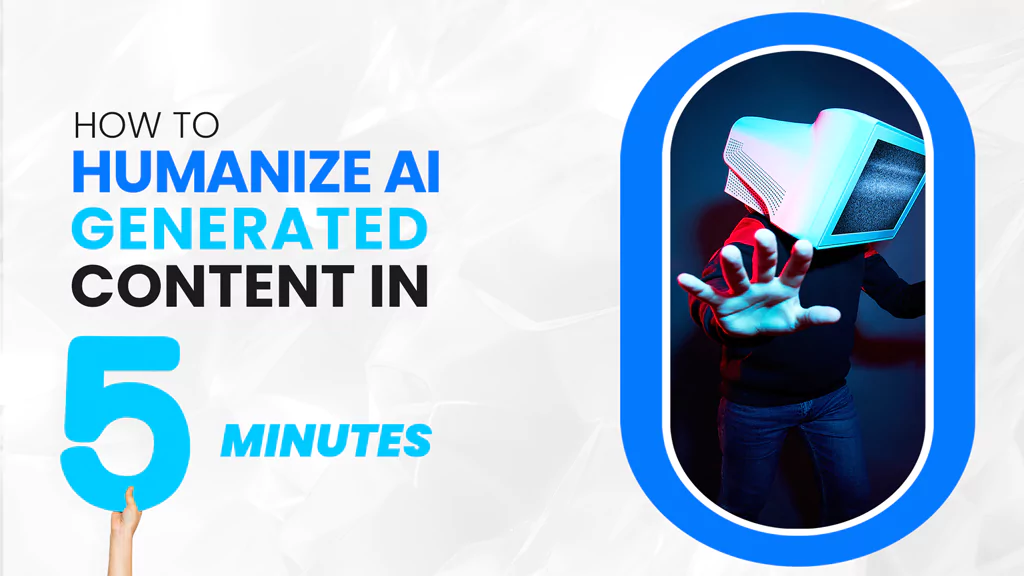
How to Humanize AI-Generated Content in 5 Minutes
AI is everywhere. It writes emails, creates blog posts, and even helps with school assignments. According to a report by the Business Data Lab, approximately 14% of Canadian businesses have already adopted generative AI technologies, with an additional 5% planning to do so in the near future. But here's the problem: most AI-generated content still sounds robotic.
It might have all the right words, but it lacks the warmth and style that real people use. If you’ve ever asked ChatGPT, “Write like a human...”, you’re not alone.
In this guide, we’ll show you how to humanize AI content quickly.
In a Hurry? Here’s a Quick Way to Humanize AI-Generated Content in 5 Minutes
- Read the content out loud. If it sounds weird, it probably is
- Break up long sentences into short, clear thoughts
- Add a casual tone. think like you’re explaining it to a friend
- Use your examples or personal notes
- Run a grammar or humanizer tool for a final polish
Now, if you’ve got a few extra minutes, let’s dive deeper into why this matters, especially in Canada, where AI use in education and business is growing fast.
Why AI Content Still Feels Robotic
Before we jump into how to fix AI writing, it helps to know why it feels off in the first place.
AI content is built using Natural Language Processing (NLP). This involves things like language modeling, semantic analysis, tokenization, and syntax correction. Sounds smart, right?
But here’s the thing. These processes focus more on structure than soul.
That means the content often:
- Repeats phrases
- Feels too formal or stiff
- Misses human emotion
- Uses strange word choices
- Sounds like a machine wrote it
Why Humanizing AI Content Matters for Assignments and Plagiarism
If you’re using AI for an assignment, be careful.
Many schools and colleges use AI content detection tools like Turnitin. These can tell if the text was created by something like ChatGPT or any other writing bot. Some even flag it as plagiarism, even if the content is original.
This is why AI content humanization is so important.
To avoid detection, your content needs:
- A human-like flow
- Real examples
- Emotion or opinion
- Fewer robotic patterns
- Personal touch
These things help make AI content more human and make sure it passes both teachers and detection tools.
Use an AI Humanizer
An AI text humanizer tool helps rewrite AI content in a natural voice. It changes sentence flow, adds variety, and removes repetition. Some tools even use contextual understanding to keep your message clear.
Here are a few types of tools you can use:
- AI content rewriting tools: These rephrase text automatically
- Grammar and tone editors: Help fix awkward sentences
- AI humanizer platforms: Special tools built to convert AI to human text
But even with tools, human review is key. Tools get you started. The final touch needs your attention. Time to add your own personal touch.
How to Humanize AI-Generated Content in 5 Minutes
1. Start by Reading Out Loud
Does it sound like something you’d say in real life?
If you find yourself stopping mid-sentence, or if it sounds too formal, mark it. These are your weak spots. They need editing.
2. Break Long Sentences
Short sentences are easier to read. They keep attention longer. To make AI content more human, cut down long thoughts into short ones.
AI version:
“The implementation of AI systems into educational settings has proven to be both beneficial and challenging due to its rapid development and varying acceptance by instructors.”
Human version: “Using AI in schools has been helpful. However, it has its own set of challenges. Some teachers love it. Others are not so sure about it.”
See the difference?
3. Add a Personal or Casual Touch
So, add a line like:
“Honestly, that surprised me.”
“I’ve tried this myself.”
“Here’s what worked for me.”
This type of tone improves user engagement. It also helps in human-like writing.
4. Fix the Tone
Here’s how:
Replace hard words with simple ones
Remove robotic phrases
Use contractions: write “you’re” instead of “you are”
Change passive to active voice
Example:
“Content personalization strategies can be implemented by utilizing advanced algorithms.”
Better:
“You can personalize content using smart tools.
5. Use Real-World Examples
They make the content feel alive.
Let’s say the AI writes:
“AI tools improve productivity across industries.”
You can humanize that by adding:
“For example, I use an AI writing tool to plan my blog posts. It saves me hours.”
Adding examples makes content feel authentic and naturalized.
Bonus: Add Errors (Yes, Really)
Throw in a minor sentence fragment. Use an informal phrase. Start with "And" or "But". Break a grammar rule, carefully.
Not every sentence needs to be textbook perfect. That’s what makes it human.
Connecting Humanization with Plagiarism Checking
Many students and content creators use AI to beat writer’s block. But if you copy-paste the output, it might show up in plagiarism scanners.
Even if it’s original, AI patterns are easy to spot.
Here’s a trick: after rewriting, run the content through a plagiarism checker. Then adjust anything that’s too similar or suspicious.
You can also do a semantic analysis. This helps you check if the meaning remains the same after editing. You don’t want to change your point while trying to hide the AI source.
Remember, humanizing AI doesn’t mean changing the message. It means changing the voice.
More Techniques for Humanizing AI Content
If you have more than 5 minutes, these extra tips help improve your content even further:
- Use Sentiment Analysis: Check if the tone matches your message. Add emotion where needed.
- Use Named Entity Recognition (NER): Add names, brands, places — these help your content feel real.
- Apply Part-of-Speech (POS) tagging: This helps tools edit sentence structure correctly.
- Improve Transitions: Make sure one sentence flows into the next. Use connectors like “Also,” “That’s why,” or “For example.”
- Check Readability: Aim for simple, everyday language. A good rule? Write like you’re talking to a 12-year-old.
Best Tools to Humanize AI-Written Text
Here are a few tools you can explore:
- Quillbot: For paraphrasing
- Grammarly: For tone and clarity
- Hemingway App: For readability
- Humanize AI Tools (like AI Humanizer Pro): Built specifically for making AI content human
These help with everything from tone to grammar to style. They also support content quality improvement and AI-generated text editing.
Final Thoughts
AI writing can be fast and helpful. But it still needs a human heart. Whether you're creating a blog post, submitting an assignment, or writing for business, your readers want content that feels real.
In just 5 minutes, you can turn any robotic draft into something warm, clear, and real.
Human-like writing isn’t about fooling tools. It’s about connecting with people.
Quick FAQs
1. How do I humanize AI content for school assignments?
2. What’s the best way to make AI-generated text sound human?
3. Can I use AI to write content and still make it human?
4. What tool can humanize AI writing easily?
5. How can I tell if AI wrote something?
6. What’s the fastest way to humanize ChatGPT content?
7. Why is it important to humanize AI text for blog posts?
8. How do I rewrite AI content without changing the meaning?
9. Is humanizing AI content good for SEO?
Disclaimer: The information provided in this blog is for general informational purposes only. For professional assistance and advice, please contact experts.
Written by Khadija
Last updated March 17, 2026