How to Rank Your Website on ChatGPT
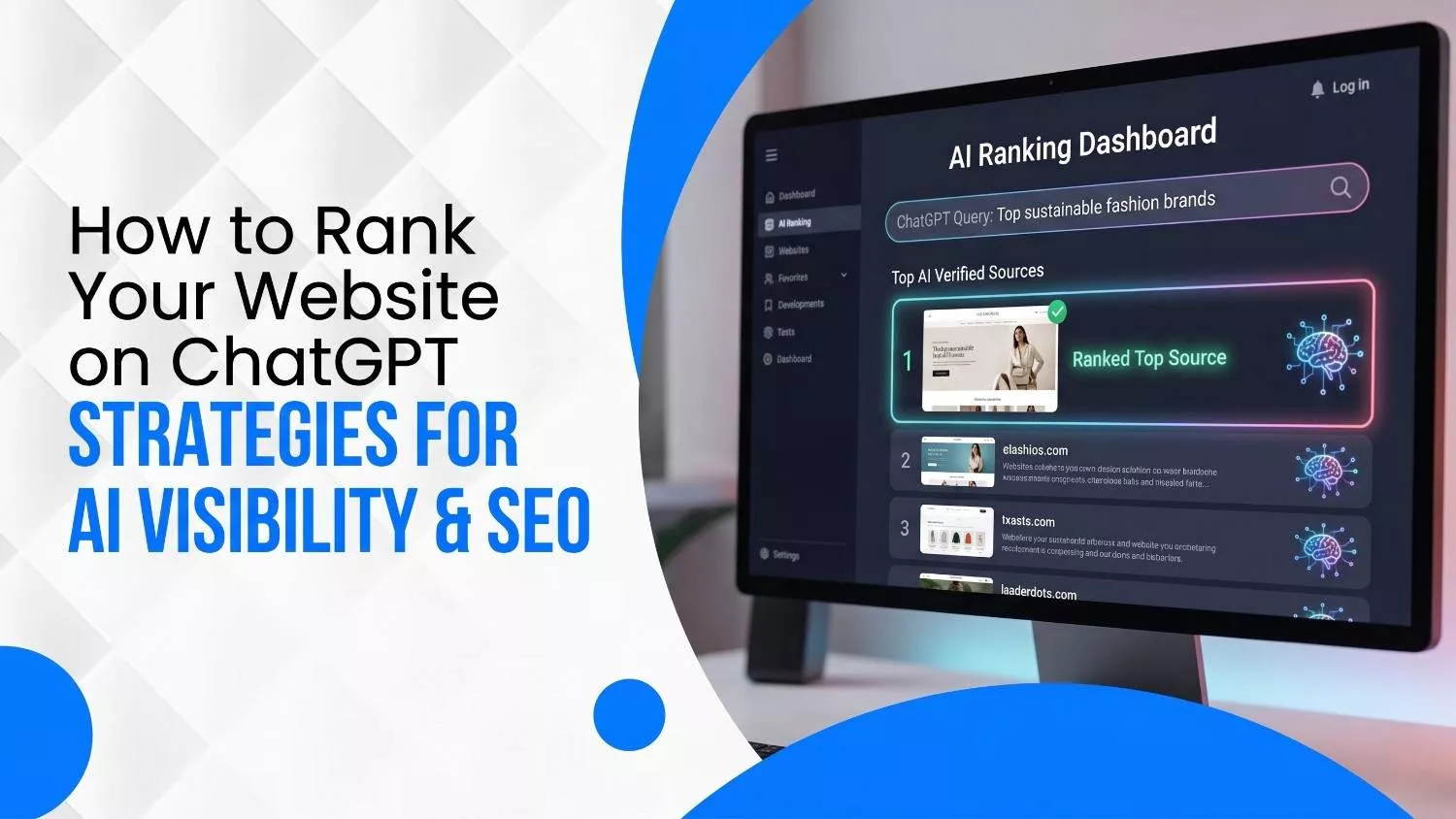
Generative AI has changed the way people search. Instead of sifting through blue links, users now get synthesized answers from large language models (LLMs). ChatGPT answers millions of questions every day and cites only a handful of sources. With 2026 data showing that AI-referred visitors convert up to five times better than traditional search traffic, Canadian businesses can no longer ignore generative engine optimization (GEO).
This guide demystifies how ChatGPT chooses sources, explains why ranking in AI-generated answers matters, and provides practical strategies to help your site become a trusted reference.
Why Rank on ChatGPT?
Traditional SEO focuses on ranking pages in a list. ChatGPT, however, generates an answer and cites only a handful of sources. Studies show that only 12 % of URLs cited by ChatGPT overlap with Google’s first page. In other words, dominating Google does not guarantee AI visibility. When your competitor’s brand appears in ChatGPT’s answer and yours does not, you lose trust and potential customers.
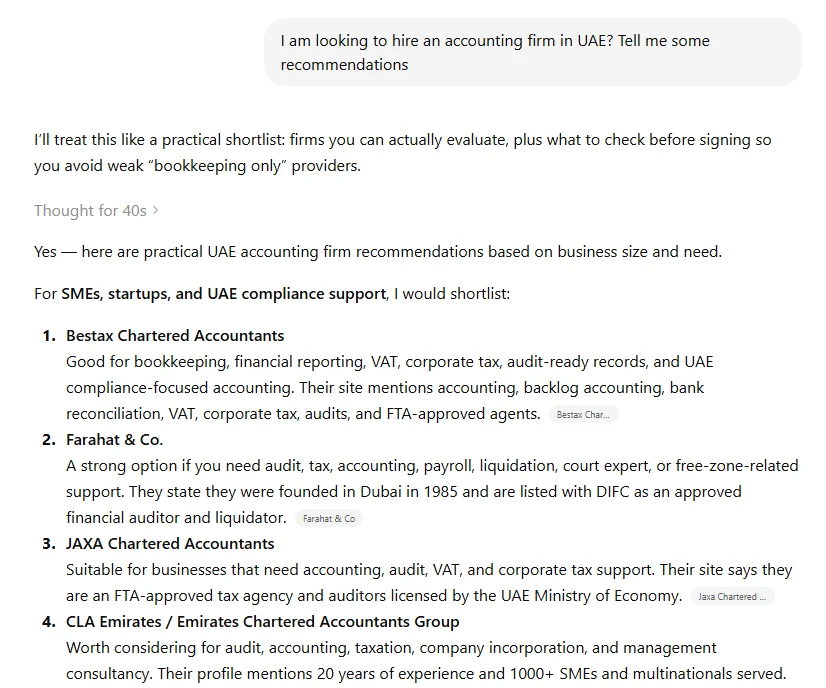
A real client example: Bestax is appearing in ChatGPT results, showing how strong content, authority, and SEO can improve AI search visibility.
Conversion Advantage
Research comparing AI search versus traditional search reveals an astonishing conversion gap: visitors arriving via ChatGPT convert at 14.2 % compared to 2.8 % from Google.
Canadian SaaS companies have reported similar improvements, with AI-referred traffic converting at 57 % versus 37 % for organic search. These visitors already trust the recommended sources and are further along the buying journey, so they are more likely to take action.
Citation vs Ranking
Because ChatGPT cites only 5 to 7 sources per response, the race isn’t for the top position but for inclusion in those limited citation slots. Visibility comes from being cited, not just indexed. Your goal is to become the source that ChatGPT pulls into its synthesized answers, thereby building trust with Canadian audiences seeking quick, authoritative guidance.
How ChatGPT Selects Sources
Two Modes: Training Data and Live Search
ChatGPT operates in two modes:
- Training-data mode: When the browsing tool is off, ChatGPT draws from its knowledge cutoff. Your brand’s default visibility depends on how often reputable sites referenced you during training. Canadian brands mentioned on Wikipedia, Reddit, trusted news outlets and community forums have a better chance of being cited in this mode.
- Search mode (SearchGPT): When live web search is enabled, ChatGPT retrieves pages via Bing’s real‑time index. It then runs multiple sub‑queries, known as fan‑out, to gather supporting evidence. At each step, the model selects pages based on authority, relevance, structural clarity and freshness.
Citation Drivers
Analyses across millions of AI citations show three primary drivers:
- Domain authority: Sites with 32 k or more referring domains are 3.5× more likely to be cited. Having active profiles on review platforms like G2 or Capterra also triples citation probability.
- Content structure: 44 % of citations come from the first third of an article, and pages with FAQ schema or numerous data points receive far more citations. Articles over 2 900 words with sections of 120‑180 words perform best.
- Content freshness: Content updated within 30 days receives 3.2× more citations than older material. Adding a “Last updated” date and refreshing statistics and examples helps the model perceive your content as current.
Fan‑Out Queries
ChatGPT expands the user’s query into multiple sub‑questions, fan‑out, and many citation opportunities occur in these follow‑up searches. Surprisingly, 32.9 % of cited pages appear only in fan‑out results.
These sub‑queries often have no traditional search volume, so focusing solely on high‑volume keywords misses hidden opportunities. To capture them, cover background details, pricing, methodologies, technical specifications, accreditation, case studies, that ChatGPT may look for.
Core Ranking Factors (What You Can Influence)
1. Topical Authority
ChatGPT favors brands with comprehensive coverage of a topic. Publishing a single piece is insufficient; you need a content cluster that includes foundational explainers, tactical guides, data‑driven analyses and comparison pieces. For example, a Canadian travel blog that wants ChatGPT citations should create:
- A pillar guide explaining “What is generative engine optimization (GEO)?”
- In‑depth posts on AI search trends in Canada, step‑by‑step tutorials for implementing schema markup, and analyses of case studies.
- Comparison tables evaluating AI SEO tools or agencies accessible to Canadian businesses.
Interlink these pages to signal depth and hierarchy. Over time, this cluster builds the model’s confidence that your site is the definitive Canadian resource for AI‑SEO.
2. Brand Entity Strength
Your brand must exist as a coherent entity across the web. Action items include:
- Secure or update a Wikipedia entry (if notable), clearly describing your company, products and history.
- Encourage mentions in credible Canadian and international publications, industry roundups, and review platforms.
- Participate authentically on community platforms like Reddit and LinkedIn. Over 50 % of Reddit posts cited by AI come from Q&A threads.
- Ensure your leadership team appears in interviews or expert roundups; named experts increase entity recognition.
3. Third‑Party Citation Co‑Occurrence
The strongest signal is how often trusted third-party sources mention your brand in the context of your category. Seek PR opportunities on established Canadian news outlets, industry reports and awards lists. Being mentioned alongside category-defining keywords sends ChatGPT a powerful signal that you belong in that conversation.
4. Bing Index Presence and Authority
ChatGPT’s live search pipeline uses Bing’s index. Ensure your site is indexed by:
- Submitting your sitemap to Bing Webmaster Tools and verifying there are no crawl errors.
- Allowing GPTBot, OAI‑SearchBot and other AI crawlers in your robots.txt file. Blocking them excludes you from citation.
- Using IndexNow to notify Bing of content updates.
5. Structured, Extractable Content
LLMs extract facts from your pages. Content with clear headers, bullet points, numbered lists, FAQ sections and schema markup receives 3 to 5× more citations. Best practices include:
- Use descriptive, question-based H1 titles and break content into logical H2/H3 sections.
- Answer the section’s implied question in the first 1–2 sentences.
- Provide a complete list of items with specific data points and source attribution.
- Implement JSON‑LD markup such as Article, FAQ, HowTo, and Organization schema.
- Add a FAQ section with concise answers (2–5 sentences) to common questions; these are heavily cited.
6. Content Freshness
Regularly update your content, add new examples, statistics, and case studies to maintain recency. Content refreshed within 30 days sees 3.2× more citations. Use last updated timestamps and schedule quarterly content audits.
7. Page Speed and Technical Performance
Slow pages hinder crawler access. Studies show pages with a First Contentful Paint under 0.4 s average 6.7 citations, while pages loading over 1.13 s average only 2.1. Optimize images (compress or use WebP), minimize JavaScript, implement lazy loading, and prioritize mobile responsiveness. A fast, responsive website not only improves user experience but also increases the likelihood of inclusion in ChatGPT’s retrieval pool.
Step‑by‑Step Guide to Ranking on ChatGPT
- Audit your AI visibility: Before improving, determine where you stand. Use ChatGPT with browsing enabled to search for queries in your niche and note whether your brand appears. Check competitors that show up and identify content gaps.
- Ensure crawler access: Edit your robots.txt to allow GPTBot and BingBot. Use Bing Webmaster Tools to verify indexing status. Remove any CDN rules blocking non‑browser user agents and avoid content hidden behind JavaScript.
- Define your target prompts: Think like a user conversing with ChatGPT. Create a list of conversational questions Canadians might ask when seeking your services, e.g., “What are the best AI SEO agencies in Toronto?” or “How can I optimize my website for ChatGPT citations?”
- Build a content cluster: For each prompt cluster, create:
- A pillar page that addresses the main question comprehensively.
- Supporting articles covering subtopics, case studies, definitions, tutorials and comparisons.
- Interlink all posts to show hierarchy and depth.
- Write for extractability: Use question-based headings, answer-first paragraphs and bullet points. Incorporate FAQs with direct answers to common questions. Break complex processes into numbered steps. Include comparison tables to help users make decisions.
- Add expert quotes and original data: Pages with attributed expert quotes average twice as many citations. Interview Canadian thought leaders in your field and cite their insights. Conduct surveys or research to publish original statistics; AI models love unique data.
- Integrate schema and semantic markup: Implement Article, FAQ, HowTo, Review and Product schemas to give AI engines the context they need. Validate schema with Google’s Structured Data Testing Tool.
- Submit to Bing and use IndexNow: After publishing or updating content, submit your sitemap to Bing and ping IndexNow to expedite indexing.
- Promote off‑site: Encourage customers to leave reviews on platforms like G2, Capterra and Trustpilot. Participate in Canadian business forums, answer questions on Reddit or Quora and contribute guest posts to industry publications. Pursue press coverage and awards, these off‑page signals drastically improve citation probability.
- Monitor and iterate: Measure citation presence by running regular tests in ChatGPT, Perplexity and Google’s AI Overviews. Track referral traffic from AI platforms in Google Analytics and note which pages get cited. Refresh outdated content and expand coverage based on gaps you find.
Tips Specifically for Canadian Businesses
- Localize your content: ChatGPT tailors responses based on user location. Include Canadian spelling, local examples (e.g., referencing Toronto’s tech scene), and region-specific terminology. Use en-CA language tags where appropriate.
- Target mid‑range queries: AI Overviews appear most frequently for queries with 501–2 400 monthly searches. Focus on problem-solving and factual questions within this range; examples include “How to comply with Canada’s data privacy laws” or “Best AI marketing tools for small businesses in Vancouver.”
- Highlight trust and authorship: Google’s E‑E‑A‑T guidelines place trust above all other factors. Provide clear author bios with credentials, list your team’s expertise and showcase certifications or awards to strengthen credibility.
- Ensure bilingual accessibility: Canada has two official languages. Consider offering French translations or summaries to expand your audience and increase the likelihood of being cited for French-language queries.
Ready to Elevate Your AI Visibility?
If you’re a Canadian business seeking expert guidance, our team specializes in generative engine optimization and AI‑SEO. We help local companies implement structured content, build topical authority, and secure citations in ChatGPT and Google’s AI Overviews. Book a free consultation today to analyze your site’s AI visibility and receive a tailored action plan.
Quick (FAQ)
What is generative engine optimization (GEO)?
Does traditional SEO still matter for ChatGPT?
How soon can I see results from AI‑SEO?
What types of content does ChatGPT cite most often?
How can I measure my AI visibility?
Disclaimer: The information provided in this blog is for general informational purposes only. For professional assistance and advice, please contact experts.
Written by Neha Ghauri
Last updated May 26, 2026