Everything You Need to Know About White Label Social Media Management
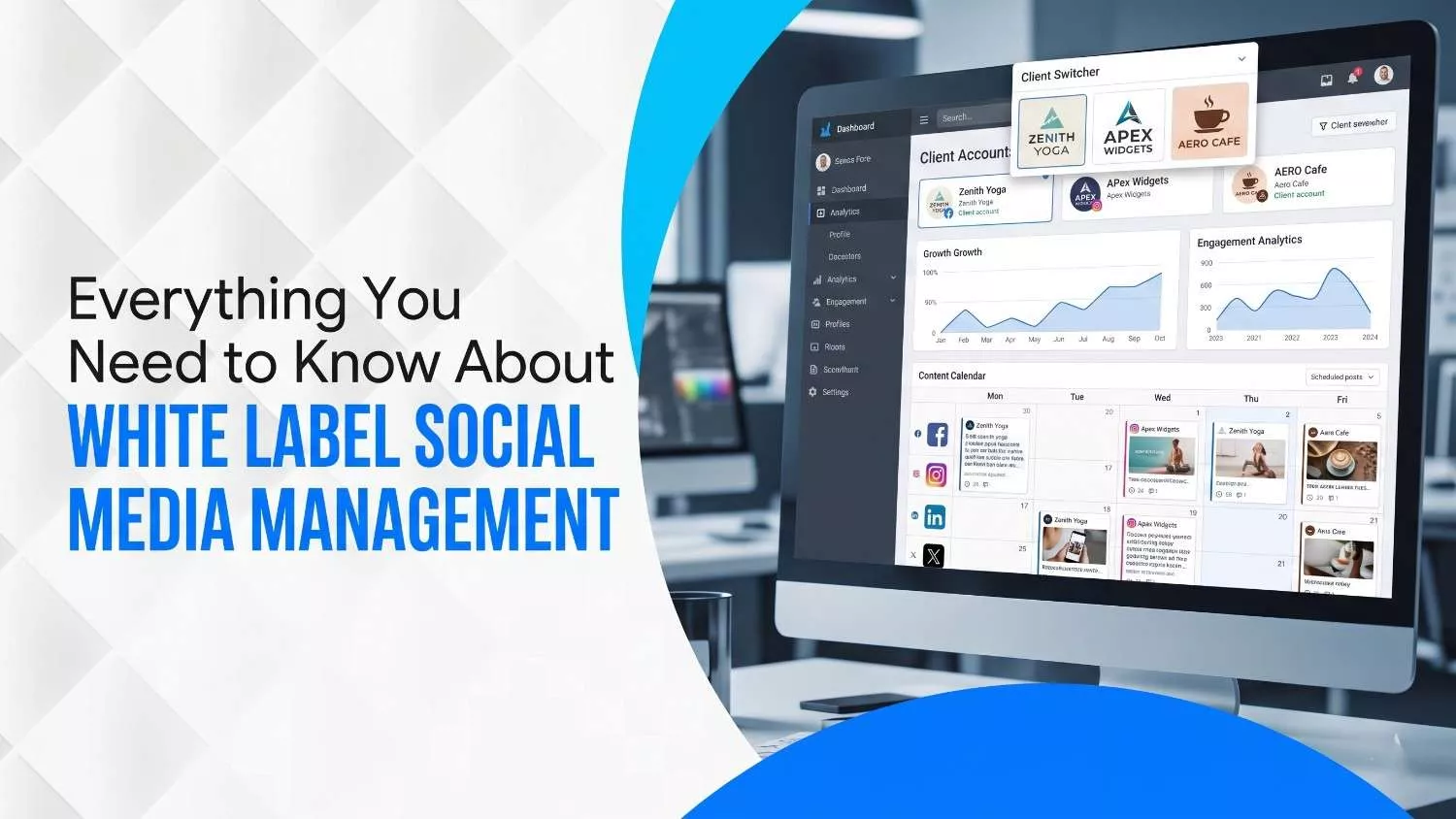
White label social media management is a service where a third-party team handles your clients’ social media, content creation, posting, engagement, and analytics, while everything is delivered under your agency’s brand. To your client, it looks like your in-house team is doing all the work.
But here’s why this matters now:
The demand for social media services isn’t just growing, it’s accelerating at a pace most agencies cannot keep up with internally.
- In Canada alone, the social media management market generated $1.8 billion in 2024 and is projected to reach $6.29 billion by 2030, growing at a 23.3% CAGR
- Globally, the market is expected to grow from $39.14 billion in 2026 to over $164 billion by 2034 (Source: Fortune Business Insights)
That’s not a trend. That’s a structural shift. White label isn’t just a service model, it’s how agencies are keeping up.
The Real Problem Agencies Are Facing
Let’s be blunt: most agencies hit a ceiling.
You start with a core service, SEO, web design, paid ads, and things go well. Clients are happy. Referrals come in. Revenue grows.
Then the requests start:
- “Can you handle our Instagram too?”
- “Do you guys manage LinkedIn content?”
- “We need someone to reply to comments and messages.”
At first, you try to patch it together internally. Maybe you assign it to a junior team member. Maybe you hire a freelancer. Maybe you attempt to build a small in-house team.
And that’s where things start to break.
Because social media is not a “side service.” It’s a full-time, multi-layered operation involving:
- Content strategy
- Graphic design
- Copywriting
- Platform-specific optimization
- Community management
- Data analysis
Trying to bolt that onto your existing team without infrastructure is how agencies burn out, miss deadlines, and deliver inconsistent results.
White label exists to solve exactly this problem.
What White Label Actually Looks Like in Practice
Most explanations stop at definitions. That’s not useful. Let’s walk through what actually happens operationally.
Step 1: You Partner with a Provider
You sign an agreement with a white label social media company. They become your invisible backend team.
Step 2: Your Client Signs With You
From the client’s perspective, nothing changes. They onboard with your agency, sign your contracts, and communicate with your team.
Step 3: Strategy Gets Translated
You gather brand guidelines, goals, tone of voice, and target audience—and pass it to your white label partner.
Step 4: Execution Happens Behind the Scenes
The provider creates content, designs visuals, schedules posts, and manages engagement.
Step 5: You Deliver the Output
Reports, updates, and results are presented under your branding.
The key point: You own the client relationship. They never interact with the provider.
This is what makes white labels fundamentally different from traditional outsourcing.
Why This Model Is Exploding Right Now
White label social media management isn’t new. But its adoption has accelerated dramatically over the past few years, and there are clear reasons why.
1. Demand Has Outpaced Hiring Capacity
Every business wants to be active on social media. But agencies cannot hire fast enough to meet that demand without destroying margins.
2. Clients Want Consolidation
Businesses don’t want five different vendors. They want one agency that can handle everything, website, SEO, ads, and social media.
If you can’t offer it, someone else will.
3. Talent Is Expensive (and Unpredictable)
Hiring in-house means salaries, benefits, onboarding, training, and turnover risk. One resignation can disrupt multiple client accounts.
White label replaces that uncertainty with a predictable cost structure.
4. Margins Become Much More Attractive
This is where things get interesting.
With white label:
- You pay a fixed wholesale rate
- You set your own pricing
- You control the margin
Most agencies operate with a 40–80% markup, depending on positioning and market. That’s not a side benefit. That’s the business model.
The Core Components of a Strong White Label Service
Not all providers are equal. If you’re going to build this into your agency, you need to understand what “good” actually looks like.
1. Content Creation That Doesn’t Feel Generic
This includes:
- Platform-specific captions
- Branded graphics
- Short-form video content
If everything looks templated, your clients will notice immediately.
2. Consistent Scheduling and Publishing
Consistency is half the battle in social media. A good provider ensures:
- No missed posting days
- Optimized posting times
- Platform-specific formatting
3. Community Management
This is where many providers fail.
Responding to:
- Comments
- Direct messages
- Reviews
…is what makes an account feel alive. Without it, content alone falls flat.
4. Analytics That Tell a Story
Raw numbers are useless unless they’re contextualized.
You need reports that explain:
- What’s working
- What’s improving
- What needs adjustment
And they must be fully branded.
5. Approval Workflows
Clients should never be surprised by what goes live.
A structured approval system ensures:
- Content is reviewed before posting
- Feedback is incorporated
- Expectations are aligned
If a provider doesn’t have this, you’re setting yourself up for conflict.
The ROI Conversation Most Agencies Avoid
Let’s talk about results, because that’s ultimately what matters.
White label social media management drives ROI in two ways:
Direct ROI
- Lead generation
- Website traffic
- Conversions
Indirect ROI
- Brand awareness
- Audience trust
- Customer retention
Social media is rarely a standalone revenue driver. It’s an amplifier.
It strengthens every other channel you’re running.
For example:
- Paid ads perform better when the brand looks active
- SEO traffic converts better when social proof exists
- Email campaigns perform better when audiences recognize the brand
Ignoring social media isn’t neutral, it actively weakens your overall strategy.
Choosing the Right Provider (This Matters More Than You Think)
A good provider makes your agency look world-class.
A bad provider makes you look incompetent.
Green Flags
- Clear, documented processes
- Real case studies (not vague claims)
- Defined timelines and deliverables
- Flexible pricing structures
- High-quality branded reporting
Red Flags
- “We handle everything” with no specifics
- No content calendar
- One-size-fits-all templates
- Long-term lock-in contracts
- Slow or inconsistent communication
Here’s a simple test:
Ask for a sample report and a sample content calendar.
If they hesitate, you already have your answer.
The 3 Biggest Mistakes Agencies Make
Mistake #1: Treating It Like a Passive System
White label doesn’t mean zero involvement.
You still need to:
- Guide strategy
- Communicate brand voice
- Align goals
Agencies that disappear after onboarding usually get mediocre results.
Mistake #2: Keeping Social Media Isolated
Social media should not operate in a silo.
It should support:
- SEO
- Paid advertising
- Website conversions
If these systems aren’t connected, you’re leaving value on the table.
Mistake #3: Prioritizing Cost Over Quality
Cheap providers create cheap-looking content.
And in social media, perception is everything.
Every post reflects your agency’s brand, not just your client’s.
How to Price White Label Social Media Services
This is where many agencies get it wrong.
You are not reselling a commodity. You are delivering a managed service.
Your pricing should include:
- White label cost
- Your account management time
- Strategy and oversight
- Profit margin
Typical pricing models include:
- Monthly retainers
- Tiered packages (basic, growth, premium)
- Platform-based pricing
As mentioned earlier, most agencies apply a 40–80% markup.
If you’re positioning yourself as a premium provider, you can go higher.
KPIs That Actually Matter
Vanity metrics will mislead you. Focus on what actually indicates performance.
Engagement Rate
Comments, shares, and saves matter more than likes.
Reach and Impressions
Are more people seeing the content over time?
Follower Growth
Are you attracting the right audience?
Conversions
Are social channels driving traffic and leads?
Retention
Are clients renewing your service?
A practical benchmark: A 3–5% engagement rate is strong. Under 1% is a red flag.
How to Introduce This to Your Clients
You don’t “explain” white label.
You present a new service offering.
Frame it as:
- A structured social media package
- Clear deliverables
- Defined outcomes
Clients don’t care how the work gets done. They care about consistency, quality, and results.
Who Should Be Using White Label Social Media Management?
This model is particularly effective for:
- Small to mid-sized agencies
- SEO-focused firms expanding services
- Web design agencies adding recurring revenue
- Paid ads agencies looking to improve brand ecosystems
If you already have clients asking about social media, you’re sitting on untapped revenue.
The Strategic Advantage Most People Miss
White label is not just about fulfillment.
It changes how your agency operates.
Instead of being limited by internal capacity, you become:
- More flexible
- More scalable
- More resilient
You can take on more clients without increasing operational complexity at the same rate.
That’s how agencies grow sustainably.
The Bottom Line
White label social media management is not a shortcut.
It’s a structural upgrade to how agencies deliver services.
It allows you to:
- Expand your offerings instantly
- Increase margins without increasing overhead
- Deliver consistent, professional results
- Compete with larger agencies
All without building a full in-house team.
In a market where clients expect more and competition is increasing, this is not just an option, it’s an advantage. The agencies that adopt this model early position themselves to scale faster, serve better, and retain clients longer. The ones that don’t? They keep turning down opportunities they could have easily captured.
Written by Khadija
Last updated May 14, 2026