Three Types of Search Queries and How to Target Them with SEO
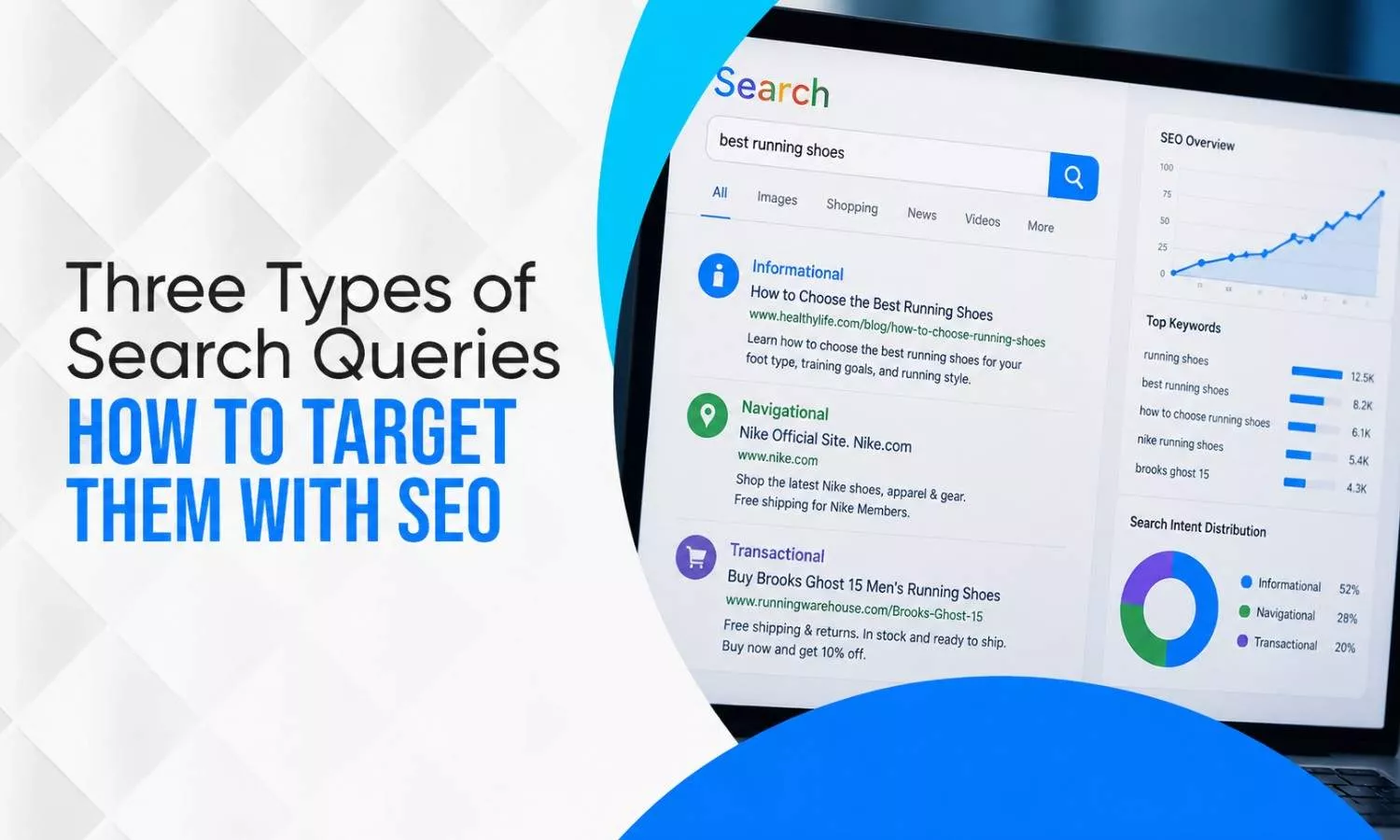
The three main types of search queries are navigational, informational, and transactional. In simple words, people search because they want to go somewhere, know something, or do something.
That is SEO in its most honest form. Not keywords wearing a fancy hat. Not stuffing the same phrase into a page until Google needs a nap. Real SEO starts by understanding what the person actually wants when they type a search query.
Think of Google like a very busy waiter. One person says, “Facebook login,” another says, “how does SEO work,” and another says, “best SEO agency near me.” All three are searching, but they are not hungry for the same thing. One wants a website. One wants an answer. One is ready to take action.
That is why understanding search queries matters. When your content matches the intent behind the query, your pages have a better chance of showing up, earning clicks, and turning visitors into leads. In this guide, we will break down each query type, show how to target it with SEO, and explain how AI and voice search are changing the way people search in 2026.
Keyword vs. Search Query: Let’s Clear the Fog
A keyword is the term you target in your SEO strategy; it’s what you plug into tools like Google Keyword Planner. A search query is what a human actually types into the search bar. Users are “completely unaware of your chosen keywords”. When someone types “best budget running shoes 2026,” the whole string is a search query.
Your target keyword might be “budget running shoes,” but slight changes to the wording (“cheap running shoes” or “running shoes under $100”) can trigger different results because the intent shifts. Understanding those differences lets you craft pages that answer the question being asked rather than the keyword you hoped they would use.
If you need more information on keyword research, check out this article.

Navigational Queries: The Straight Road
What Counts as a Navigational Query?
Navigational queries are digital teleportation spells. The user already knows where they want to go and just needs a quick route. Instead of typing a full URL, people often ask Google to take them to the site, searches like “YouTube,” “Facebook,” “Amazon,” “Gmail” and even “chatgpt” dominate the list of top global queries in 2026.
These are not opportunities to poach someone else’s traffic; they’re opportunities to ensure your own brand shows up when someone types your name.
Why Navigational Queries Matter for Brands
You can’t hijack another company’s navigational traffic (unless you fancy lawsuits), but you must own your own. Google has reduced the number of results for navigational queries to seven, squeezing organic real estate. Industry research shows that for high‑commercial‑intent searches people click paid ads almost twice as often as organic listings.
That means if your site doesn’t appear at the top, both organically and via ads, you risk losing customers to look‑alike domains or competitors bidding on your name.
Pro tips for owning navigational queries:
- Secure your brand name: ensure your domain matches or closely resembles your business name. Avoid hyphens or creative spellings that customers can’t remember.
- Optimize brand pages and local citations: include your business name, services and contact details on your homepage and contact pages. Keep your listings consistent so search engines trust your information and people can find you.
Take Charge of Your Brand
Don’t let a competitor outrank you for your own name. At Wide Ripples Digital we specialize in brand protection. We’re rated 4.8 stars by thousands of happy customers. Book a Free Consultation to make sure your brand shines whenever people search for you.
Informational Queries: Curiosity Drives
Informational Queries Explained
Informational queries, the “Know” in the Do‑Know‑Go model, make up the bulk of searches. The Search Quality Guidelines describe these as requests where users want facts or knowledge. They range from “how to fix a leaky faucet” to “Zelda timeline explained.” Search engines respond to simple informational queries with direct answers, featured snippets, People Also Ask boxes and knowledge panels.
Because these searches are hard to monetize directly, Google increasingly answers them on its own. Studies show that Google’s AI Overviews appear in roughly 13–25 % of searches and nearly 99.9 % of informational keywords trigger an AI summary. Zero‑click searches, where users don’t click any result, account for 60–83 % of queries. Zero‑click searches dominate, so structure your content to be the answer Google highlights.
How to Target Informational Queries
Informational searches are your chance to build trust and authority. Focus on two tactics:
- Create evergreen resources: produce guides, how‑to articles and tutorials that answer common questions. Long‑form content over 3,000 words earns 3× more traffic and 4× more shares than shorter posts.
- Optimize for snippets and zero‑click: structure your pages with clear headings, concise answers and schema markup so search engines can extract your answer for featured snippets and AI Overviews. Use People Also Ask questions as subtopics to ensure you cover the full conversation.
Turn Curious Readers into Loyal Fans
Ready to become the Wikipedia of your niche (without the donation banners)? Wide Ripples’ content strategists combine deep keyword research, local insights and humor to craft articles that rank and resonate. Talk to our Content Team about building a blog that educates and converts.
Transactional Queries: Show Me the Money
What Are Transactional Queries?
Transactional queries are “Do” queries, searches that signal a user is ready to take action. They often include verbs like buy, order, subscribe or modifiers like price, coupon and “near me.” Even without verbs, a phrase like “refurbished iPhone” implies purchase intent.
They come in three flavours, branded, where the query contains a brand name; unbranded, where the searcher knows what they want but not the brand; and local/vertical, where the query includes a city or industry modifier such as “plumber near me”.
Why Transactional Queries Are Gold
These searches convert. Research shows that 64.6 % of people click on ads when they’re ready to buy. Sponsored results dominate the page; ads appear in about a quarter of AI Overview results. Yet organic SEO still matters: long‑tail phrases with modifiers may not trigger ads, and ranking ensures you capture those buyers.
How to Target Transactional Queries
Here’s your blueprint for making the cash register ring:
- Optimize product and service pages: use unique titles, meta descriptions and H1 tags that include transactional modifiers. Add structured data (Product, Offer and Review schema) so search engines display prices, ratings and availability.
- Prioritize paid campaigns: run PPC ads for high‑value keywords. Sponsored results dominate the above‑fold space, so a top ad improves visibility and click‑through rates.
Identifying Query Types Quickly
To classify ambiguous queries, look for intent words:
| Intent | Trigger words |
|---|---|
| Informational | how, why, what, where, guide, tips, tutorial, manual |
| Navigational | brand names, product names, service names |
| Transactional | buy, order, purchase, coupon, discount, deal, near me, price |
If the query lacks these modifiers, consider context, does the phrase imply research (informational), a destination (navigational) or a purchase (transactional)?
Voice Search & AI: The New SERP Landscape
Why Voice Search Matters in 2026
Voice search has moved beyond novelty. There are now 8.4 billion active voice assistants and over 10 billion voice queries processed per day. Voice queries represent roughly 31 % of all searches and are growing at 18 % year over year. The average voice query is 29 words, about seven times longer than typed searches, and 40.7 % of voice answers come from featured snippets. Voice commerce is booming too, with transactions projected to reach $164 billion by 2028.
How Voice & AI Change SEO
Voice queries are conversational and often local. Combined with generative AI, this leads to more zero‑click experiences. Google’s AI Overviews show up in roughly 25 % of searches, and being cited in one can boost organic clicks by 35 % and paid clicks by 91 %. To survive this new SERP, you must optimize for both voice and AI.
Voice & AI Optimization Tips:
- Write for conversation and snippets: use natural, question‑based phrases and long‑tail keywords. Structure your content with clear headings, lists and succinct answers so search engines can feature your page as a snippet.
- Think local: maintain an up‑to‑date Google Business Profile with accurate hours, phone numbers and location details. Encourage reviews to build trust, since many voice queries include “near me.”
Putting It All Together: A Three‑Pronged SEO Strategy
- Own your brand (Go): secure your name, optimize your brand pages and run branded PPC campaigns so you dominate navigational queries.
- Educate generously (Know): produce in‑depth resources, optimize them for snippets and AI, and interlink them to your transactional pages to build authority and nurture readers.
- Capture intent to act (Do): build optimized product pages, invest in PPC for high‑value keywords and create focused landing pages that convert. Support local search with accurate business information and reviews.
Meet users at every stage, when they’re just curious, when they’re exploring options and when they’re ready to buy, and you’ll build an SEO engine that drives traffic and revenue.
Search Smarter, Not Harder
At Wide Ripples Digital, we’ve spent years studying how our local clients search, click and buy. That insight, paired with data‑driven SEO, has delivered dramatic results for our clients. Whether you’re looking to dominate local “near me” searches, become the go‑to source in your niche or launch a campaign that prints conversions, we can help. Get in touch and let’s create ripples together.
Quick FAQs
What’s the difference between a search query and a keyword?
Do I need to optimize for voice search?
Are there more than three types of search queries?
Should I invest in paid advertising?
Disclaimer: The information provided in this blog is for general informational purposes only. For professional assistance and advice, please contact experts.
Written by Khadija
Last updated July 17, 2026