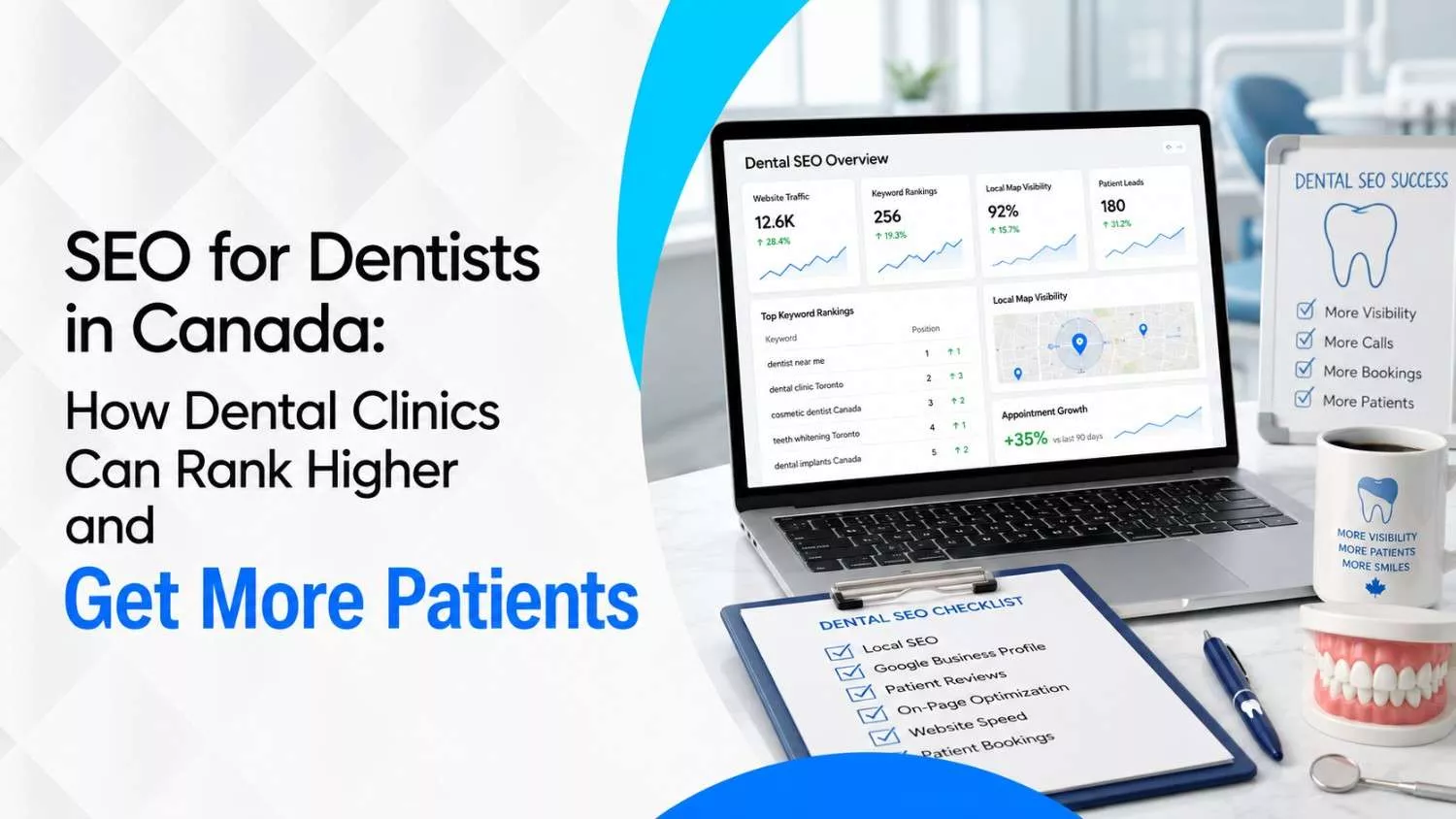
SEO for Dentists in Canada: How Dental Clinics Can Rank Higher and Get More Patients
Dental SEO is about helping real people find the right clinic at the exact moment they are comparing options, feeling nervous about cost, wondering if their insurance will behave, or trying to decide whether that tiny toothache is a tiny toothache or a dramatic little villain in disguise.
For dental clinics in Canada, the opportunity is huge, but so is the noise. The Canadian Dental Association reported about 25,500 licensed dentists and roughly 16,000 dental offices in Canada, which means most clinics are not competing with “the internet” in some vague way; they are competing with the five to twenty clinics a patient can compare from the same couch, in the same postal code, while eating something they were probably told not to bite yet.
This guide explains how dental clinics can rank higher, earn trust before the first phone call, and turn search visibility into booked appointments.
A strong SEO and content strategy should not feel like a mysterious digital ritual. It should feel like a clean treatment plan: diagnose the issue, explain the steps, fix what matters first, and keep checking the results before anyone declares victory.
Why SEO for dentists in Canada is different
Dental SEO sits in a strange little corner of marketing because it blends local search, healthcare trust, insurance questions, patient anxiety, compliance risk, and very practical booking behaviour.
A person looking for “teeth whitening near me” is not thinking the same way as a person searching “emergency dentist open Sunday,” and your website should not treat those two patients like they are the same person wearing different bibs.
The Canadian market also has a strong care-access story behind it. The CDA reported that more than two-thirds of Canadians had dental benefits covering all or part of treatment, while Canadians with benefits were more likely to visit a dentist than those without benefits.
That matters for SEO because many patients are not simply looking for the closest clinic; they are trying to understand affordability, coverage, availability, comfort, and whether your clinic will make the whole process feel less confusing.
If your website only says “we provide comprehensive dental services,” it may be technically true, but it does not answer the anxious searcher’s real question, which is often closer to “Will this hurt, can I afford it, can I book quickly, and will anyone judge me because I have not had a cleaning since the era of low-rise jeans?”
Quick Canadian dental market signals to keep in mind
| Signal | What the CDA reported | What it means for dental SEO |
|---|---|---|
| Dental competition | About 25,500 licensed dentists and roughly 16,000 dental offices in Canada. | Patients usually have choices nearby, so ranking and trust signals both matter. |
| Benefits shape demand | 67% of Canadians reported dental benefits covering all or part of treatment. | Insurance language should be clear, helpful, and updated, not buried in tiny footer text. |
| Access affects visits | Canadians with benefits were more likely to visit a dentist than those without benefits. | Content should reduce uncertainty around cost, coverage, financing, and what happens at the first visit. |
| High use of care | About 75% of Canadians saw a dental professional annually in 2018. | Routine care pages still matter, but they need a stronger local and trust angle. |
| Large private market | Dental expenditures reached $16.4 billion in 2019, with roughly 94% from the private sector. | SEO should connect visibility to bookings, not vanity traffic that never calls. |
Practical takeaway: a dental clinic does not win SEO by being louder; it wins by being clearer, more useful, more locally relevant, and easier to book than the clinic beside it.
The patient search journey: the toothache has entered the chat
Before you choose keywords, imagine the patient journey as a tiny drama with four characters: the panicked emergency patient, the practical family patient, the cosmetic researcher, and the nervous overdue patient. Each one searches differently, clicks differently, and needs a different page experience before they trust you with their mouth, their time, and their wallet.
Most dental SEO plans make the same mistake: they chase big keywords first and forget that patients often make decisions from small details. They want to know whether you take new patients, whether there is parking, whether the clinic speaks their language, whether evening appointments exist, whether the dentist explains things gently, and whether the website looks like it was last updated when everyone was still using MSN Messenger.
| Patient search mood | Example searches | Best page or asset | Conversion move |
|---|---|---|---|
| Urgent and worried | emergency dentist near me, tooth pain dentist open today | Emergency dental page with hours, call button, parking, and what to do before arrival. | Sticky phone button and “call now for urgent care” message. |
| Planning routine care | family dentist in Mississauga, dental cleaning near me | Family dentistry or dental cleaning page with new patient process and insurance notes. | Online booking link and new patient checklist. |
| Comparing options | Invisalign dentist Canada, dental implants cost, teeth whitening dentist | Detailed treatment page with candid expectations, suitability, and dentist review. | Consultation CTA and financing or coverage explanation. |
| Embarrassed or overdue | dentist after years no judgment, nervous dental patient | Comfort-focused page that explains the first visit without shaming the patient. | Warm booking CTA and “start with an exam” pathway. |
The sneaky win is to map every major service to a patient mood, not just a keyword. When you write for the mood behind the search, your page naturally becomes more helpful, your calls to action become less generic, and your front desk gets fewer calls from people who were never a fit in the first place.
Before chasing rankings, fix the chair-to-website leak
Many clinics think they have an SEO problem when they actually have a conversion leak wearing a tiny mask. A page may rank, a patient may click, and the entire opportunity may vanish because the phone button is hard to find, the contact form asks for seventeen details, the online booking tool opens slowly, or the website does not clearly say whether new patients are welcome.
Here is a helpful exercise that rarely appears in Google search results: spend one week tracking the first question every new patient asks after they land on your website or call the clinic. If the same question keeps appearing, your site is not answering it early enough, and that question deserves either a section on a service page, a dedicated FAQ, or a full blog post.
| Website leak to check | What to fix |
|---|---|
| New patients hesitate | Add “accepting new patients” near the top of key pages, not buried on the contact page. |
| People ask about insurance repeatedly | Create a plain-language insurance and payment section that explains what your clinic can confirm and what patients should verify. |
| Calls happen after hours | Add online booking, voicemail expectations, and urgent-care instructions that do not create medical promises. |
| Treatment pages get traffic but no bookings | Add suitability, process, cost factors, recovery expectations, and a gentle CTA to book a consult. |
| Mobile visitors bounce | Make click-to-call, maps, hours, and booking visible without scroll gymnastics. |
A clinic that fixes these leaks can sometimes grow patient inquiries before rankings change much, because the existing traffic finally has a clear path to action. This is where lead generation and conversion work beautifully support SEO, since more traffic only matters when the website is ready to convert attention into appointments.
Google Business Profile is your second front desk
Your Google Business Profile is often the first thing a patient sees, which means it is basically your second front desk, except it works on evenings, weekends, holidays, and those weird late-night moments when someone searches “is gum swelling bad” with the seriousness of a courtroom witness.
Google’s own local ranking guidance says local results are mainly based on relevance, distance, and prominence, and it recommends keeping business details complete and accurate, verifying the profile, updating hours, responding to reviews, and adding photos or videos. In practical clinic language, Google wants to understand what you do, where you are, whether you are trustworthy, and whether your profile gives searchers enough confidence to choose you.
- Choose accurate primary and secondary categories: Use categories that match the clinic’s real services, then support those services with matching website pages.
- Fill every useful field: Hours, phone, website, appointment link, accessibility, parking, service areas, and business description should be accurate and consistent.
- Create service entries: Add services such as dental cleaning, emergency dentistry, children’s dentistry, Invisalign, implants, dentures, or sedation where genuinely offered.
- Upload real clinic photos: Use exterior, reception, treatment rooms, team photos, parking views, and accessibility photos, because patients want to know where they are going before they arrive.
- Use Q&A like a mini FAQ: Seed helpful questions patients ask often, such as parking, new patients, languages, appointment options, and accepted payment methods.
- Keep holiday hours current: Wrong hours during long weekends can turn a searcher into a one-star reviewer before anyone even says hello.
The neighbourhood trick: rank where patients actually live
Many clinics create one generic city page and then wonder why they are invisible in neighbourhood searches. A better approach is to build useful location context into your pages: nearby landmarks, transit, parking, school or family needs, office-worker appointment windows, senior accessibility, and the real reasons someone in that area would choose your clinic instead of driving across town.
This does not mean creating thin clone pages for every neighbourhood like “dentist in Area A,” “dentist in Area B,” and “dentist in Area C” with only the map name changed. That kind of page smells like copy-paste, and patients have noses. Instead, create location content only when it gives real context, such as a clinic near a business district offering early morning hygiene appointments, a family practice near schools explaining kid-friendly scheduling, or an emergency dentist page that explains access and hours in a specific part of the city.
Wide Ripples uses this local context mindset across Canadian search campaigns, including city and neighbourhood research, local citations, service-page mapping, and content that reflects how real people search in specific communities rather than how a keyword tool thinks a city behaves.
Build treatment pages like treatment rooms, not storage closets
A dental service page should not feel like a brochure that got trapped inside WordPress. It should feel like a calm conversation with a knowledgeable team member who explains what the treatment is, who it helps, what the visit feels like, what patients usually worry about, and what the next step should be.
For example, a dental implant page that only says “we offer dental implants” is barely doing push-ups. A stronger page explains who may be a candidate, what factors affect cost, why bone health matters, how the consultation works, what timelines can vary, what alternatives exist, and when a patient should book an assessment rather than self-diagnose from search results.
| Section to include | Why does it help SEO and patients |
|---|---|
| Plain-language treatment overview | Helps Google understand the page and helps patients quickly confirm they are in the right place. |
| Who the treatment may help | Captures symptom-based searches and avoids making one-size-fits-all claims. |
| What happens during the visit | Reduces fear, especially for nervous or overdue patients. |
| Cost and insurance factors | Answers the question many patients are too polite to ask first. |
| Risks, limits, and alternatives | Builds trust because careful explanations feel more credible than miracle promises. |
| Dentist or clinician review note | Supports expertise and accountability for health-related content. |
| FAQs from real front desk calls | Targets long-tail searches and improves conversion by answering practical objections. |
| Clear next step | Moves patients from information to action without sounding pushy. |
Google’s helpful-content guidance asks whether content provides original information, complete explanations, clear sourcing, and expertise, and it also highlights that trust matters especially for topics that can affect health or safety. Dental pages should therefore be written for real patients, reviewed by someone qualified inside the clinic, and updated when services, policies, technology, or public program details change.
Content ideas that are more useful than “What is a cavity?”
There is nothing wrong with explaining cavities, but the internet is already bursting with generic dental definitions, and most of them have the personality of a waiting-room pamphlet. If you want content that brings patients and not just pageviews, write about the messy, local, decision-making questions patients actually ask before they book.
“I have not seen a dentist in five years. What happens at the first visit?”: This speaks to shame, anxiety, cost, and uncertainty, which are common reasons people delay care.
“Emergency dentist or wait until morning? A practical guide for [City] patients”: This captures urgent intent while giving safe, non-diagnostic direction and a clear call path.
“Dental insurance questions to ask before booking treatment in Canada”: This helps patients prepare without promising coverage or giving insurer-specific advice.
“How to choose a family dentist when everyone in the house has different needs”: This works well for family clinics because it connects services, scheduling, kids, seniors, and convenience.
“What to know before booking teeth whitening if you have sensitivity”: This targets cosmetic demand while setting expectations and encouraging a professional assessment.
“CDCP questions patients should confirm before booking dental care”: As the Canadian Dental Care Plan evolves, clinics can explain their intake process while linking patients to official government resources.
“A nervous patient’s guide to asking for a gentler appointment”: This is empathetic, memorable, and often more conversion-friendly than another technical treatment article.
The best content source inside a dental clinic is not always a keyword tool. It is often the receptionist’s notebook, the hygienist’s repeated explanations, the treatment coordinator’s objections, and the dentist’s chairside clarifications, because those moments reveal the exact language patients use when they are confused but interested.
Clinic content exercise: ask the front desk to save ten real questions from new patients every month, remove any personal details, group them by treatment or concern, and turn the best five into FAQ sections, blog posts, or short videos.
For clinics that want help turning those questions into content, Wide Ripples’ content marketing approach focuses on research-backed content that supports visibility, trust, and conversions rather than publishing random articles just to keep the blog calendar from feeling lonely.
Reviews: powerful, but handle them like dental instruments
Reviews can influence trust, clicks, and local visibility, but dental clinics in Canada need to treat review strategy with more care than a generic coffee shop does. Dental advertising is professionally regulated, rules can vary by province or territory, and a review request that seems normal in another industry may create risk if it feels like pressure, an incentive, a testimonial used in advertising, or a claim that cannot be supported.
Ontario’s RCDSO says dentists are responsible for advertising involving them and their clinics, including content from staff or third parties, and its guidance warns against unclear or misleading claims, superiority claims, guaranteed outcomes, incentives, and testimonials or statements based on personal feelings. Alberta’s dental regulator also notes that dentists can advertise services and fees, but must do so ethically and in line with applicable rules. The safe move is simple: before launching any review, testimonial, social, or advertising campaign, check the rules in your province or territory and have the responsible dentist approve the process.
| Risky review habit | Safer alternative | Why it matters |
|---|---|---|
| Offering discounts or gifts for reviews | Avoid incentives and ask your regulator or legal adviser before using any campaign mechanics. | Incentives can create compliance and platform risks. |
| Posting patient testimonials on service pages | Use factual service information, dentist-reviewed explanations, and general trust signals instead. | Some regulators restrict testimonials in dental advertising. |
| Replying with treatment details | Use brief, private, neutral replies that do not confirm personal health information. | Public replies can accidentally reveal sensitive information. |
| Asking every patient at checkout in a pressured way | Use a calm, optional request only where allowed, after a positive care experience, with no pressure. | Patients should never feel their care depends on public praise. |
If your clinic sends review requests, newsletters, recalls, or promotional emails, remember that Canada’s Anti-Spam Legislation applies to commercial electronic messages, and CRTC guidance says senders need consent, identification information, and an unsubscribe mechanism. In other words, your marketing follow-up should be as clean as your sterilization room, just with fewer gloves and more unsubscribe links.
Technical SEO: boring until it costs you, new patients
Technical SEO is the part everyone wants to ignore until the clinic website loads like it is being powered by a sleepy hamster. Patients are impatient on mobile, Google needs to crawl and understand your pages, and a beautiful website that is slow, confusing, or technically messy will quietly leak appointments.
Google’s SEO Starter Guide explains that SEO helps search engines understand your content and helps users find your site and decide whether to visit. Google also notes that some changes can take hours while others take months to show impact, which is why dental SEO should be treated like a consistent system rather than a one-week magic trick.
Mobile-first layout: Most patient searches happen on phones, so the top of every page should make calling, booking, hours, address, and services painfully obvious.
Fast page speed: Compress images, clean up scripts, improve hosting, and watch Core Web Vitals, because a slow site makes patients doubt the clinic before they meet the dentist.
Clear URL structure: Use simple URLs such as /dental-implants-city/ or /emergency-dentist-city/ rather than messy strings that look like a dental chart fell into the keyboard.
Local business schema: Structured data can help Google understand business details such as address, phone, hours, and service information, but it must match visible page content.
Search Console monitoring: Track indexing, search queries, page performance, and technical issues instead of waiting until traffic falls and everyone starts blaming “the algorithm.”
Accessible design: Readable fonts, contrast, alt text, logical headings, and simple navigation help patients and search engines move through the site more easily.
A strong website design and development setup matters because dental SEO does not live only in blog posts. It lives in site speed, navigation, page layouts, form design, mobile calls, accessibility, appointment tools, and the small trust cues that make patients feel like booking is safe and simple.
For deeper technical guidance, Wide Ripples also covers how page speed affects SEO and user experience and how to run SEO audits, both of which are useful starting points before a clinic invests in a full website rebuild or content campaign.
Local links and citations without acting like it is 2011
Local citations are still useful, but the old trick of blasting your clinic into every directory with a pulse is not a strategy; it is digital confetti. A better dental citation plan focuses on accuracy, relevance, and trust: your clinic name, address, phone number, hours, website URL, and services should be consistent across major directories, healthcare directories where appropriate, social profiles, association listings, and local community sources.
The “cannot be found easily on Google” move is to build local proof that mirrors real community behaviour. Sponsor a school oral-health event where allowed, publish a recap, earn a local mention, support a neighbourhood guide, create a helpful page for seniors or families in your area, and build relationships with real organizations instead of buying links from websites that look like they were assembled during a power outage.
For Canadian businesses that want a cleaner starting point, Wide Ripples has a guide to free business directories in Canada, which can help clinics think about citations as part of a wider local visibility system rather than a one-time data-entry chore.
Conversion: ranking is nice, but booking is the real job
A top ranking is exciting, but it is not the final prize; the final prize is a qualified patient who books, arrives, understands the next step, and stays with the clinic. If your SEO report celebrates impressions while your appointment book looks lonely, the campaign is measuring applause instead of outcomes.
Start by treating every high-intent page like a mini front desk. The emergency page should make urgent calling obvious, the Invisalign page should make consultation booking easy, the family dentistry page should explain new-patient flow, and the hygiene page should reduce friction for routine appointments. Each page should have one main next step, not a buffet of buttons that makes the patient wonder whether they are booking, subscribing, downloading, or joining a dental-themed scavenger hunt.
| Page type | Main CTA | Extra trust cue |
|---|---|---|
| Emergency dentist | Call now or request urgent appointment. | Same-day availability notes, parking, hours, and what to do before arrival. |
| Dental implants | Book an implant consultation. | Process timeline, eligibility factors, financing notes, and dentist review. |
| Family dentistry | Book a new patient visit. | Kid-friendly scheduling, family block appointments, insurance explanation, and accessibility details. |
| Dental cleaning | Book a hygiene appointment. | New patient checklist, what is included, and expected visit length. |
| Cosmetic dentistry | Request a smile consultation. | Before-and-after usage only if compliant, treatment options, and realistic expectation language. |
Once a patient becomes a lead, marketing funnel and CRM automation can help manage reminders, lead status, follow-up timing, and reporting, as long as the clinic handles consent, privacy, and patient communication rules carefully. The point is not to turn dentistry into a robot parade; the point is to stop good inquiries from falling between inboxes, missed calls, and sticky notes.
Track the numbers that actually matter
Dental SEO reporting often becomes a beautiful dashboard full of numbers nobody can connect to chair time. A clinic does not need more colourful charts for their own sake; it needs to know which searches, pages, neighbourhoods, and channels are producing qualified inquiries and booked appointments.
| Metric | Why it matters | What to do with it |
|---|---|---|
| Google Business Profile calls and direction requests | Shows whether local visibility is creating real patient actions. | Compare by month and connect spikes to profile updates, reviews, or seasonality. |
| Organic traffic to service pages | Shows whether treatment pages are being discovered. | Improve pages with strong impressions but weak clicks or weak bookings. |
| Call tracking by landing page | Shows which pages make people pick up the phone. | Use dynamic numbers carefully and keep NAP consistency protected. |
| Form completion rate | Shows whether forms are too long, confusing, or hidden. | Shorten forms and test stronger CTAs on high-intent pages. |
| Booked appointments from SEO leads | Shows the business outcome behind rankings. | Report SEO in patient opportunities, not only rankings. |
| No-show and cancellation notes | Shows whether SEO is bringing the wrong intent or unclear expectations. | Adjust page messaging, follow-up, and pre-appointment communication. |
Tiny dashboard that works: track calls, forms, booked appointments, source page, treatment interest, new vs returning patient, and whether the patient showed up. That one spreadsheet can teach more than a giant ranking report.
A practical 90-day SEO roadmap for a Canadian dental clinic
Dental SEO is not instant, and Google itself says search changes can take time to show impact, but clinics still need momentum early so the project does not feel like watering a plant in the dark. The first 90 days should focus on fixing foundations, improving high-intent pages, and building a repeatable content and reporting system.
| Timeline | Focus | Actions |
|---|---|---|
| Days 1-15 | Audit and tracking | Check Google Business Profile, Search Console, Analytics, site speed, indexation, top pages, calls, forms, and conversion leaks. |
| Days 16-30 | Local foundation | Fix NAP consistency, profile fields, hours, photos, appointment links, service lists, citations, and missing trust details. |
| Days 31-45 | Service page rebuild | Rewrite priority pages such as emergency dentistry, family dentistry, dental cleaning, implants, Invisalign, or whitening with stronger patient intent. |
| Days 46-60 | Technical improvements | Improve mobile layout, load speed, schema, internal links, headings, images, and booking paths. |
| Days 61-75 | Helpful content sprint | Publish patient-question content from front desk logs, treatment coordinator notes, and high-impression Search Console queries. |
| Days 76-90 | Measure and refine | Review calls, forms, bookings, rankings, clicks, and page performance, then decide what to expand, merge, update, or retire. |
If you need a broader framework, the Wide Ripples guide on how to rank higher on Google is a useful companion because it covers search fundamentals that can be adapted to clinic pages, local landing pages, content planning, and technical cleanup.
Common dental SEO mistakes that quietly bite
- Using the same service copy on every location page: Google and patients both notice when pages are basically clones wearing different postal codes, so each location page should include real local context, unique clinic details, and useful patient information.
- Writing content nobody at the clinic would say out loud: If your hygienist would never tell a patient “our clinic delivers comprehensive oral-health solutions,” rewrite it until it sounds human, clear, and clinically responsible.
- Ignoring emergency intent: Emergency searches are some of the highest-intent dental searches, but the page must be careful, practical, and clear about availability without promising outcomes.
- Treating Google reviews like a trophy case: Reviews need ethical handling, and some jurisdictions restrict how testimonials are used in advertising, so your process should be regulator-aware from the start.
- Sending every visitor to the homepage: A patient searching for implants, whitening, braces, or urgent care should land on a page that answers that exact need, not on a homepage that makes them go hunting.
- Ranking without a booking system: Traffic without conversion is like owning a dental chair nobody can schedule, which is expensive, impressive, and not very useful.
Final thoughts: Google likes helpful clinics, and so do patients
The best SEO for dentists in Canada does not try to trick Google, overwhelm patients, or make every clinic sound like the “leading trusted premier family cosmetic emergency implant Invisalign dental solution provider” of the entire known universe. It makes the clinic easier to understand, easier to trust, easier to find, and easier to book.
Start with the patient’s real question, build pages that answer it better than anyone nearby, keep your Google Business Profile accurate, handle reviews and advertising with professional care, fix technical problems before they become silent appointment killers, and measure success by booked patients instead of ranking screenshots alone.
When dental SEO is done properly, it feels less like marketing noise and more like good patient communication at scale. That is the sweet spot: useful enough for people, clear enough for Google, careful enough for healthcare, and practical enough to make the phone ring for the right reasons.
Want a clinic SEO plan that does more than chase rankings?
Wide Ripples Digital helps Canadian businesses with SEO, content strategy, website development, lead generation, and automation built around measurable growth. Explore SEO and Content Strategy or book a consultation.
Quick FAQs
What is SEO for dentists in Canada?
How long does dental SEO take?
Does every dental clinic need a blog?
Can dentists ask for Google reviews in Canada?
What dental pages should be optimized first?
What makes dental SEO different from regular local SEO?
Disclaimer: The information provided in this blog is for general informational purposes only. For professional assistance and advice, please contact experts.
Written by Neha Ghauri
Last updated July 3, 2026