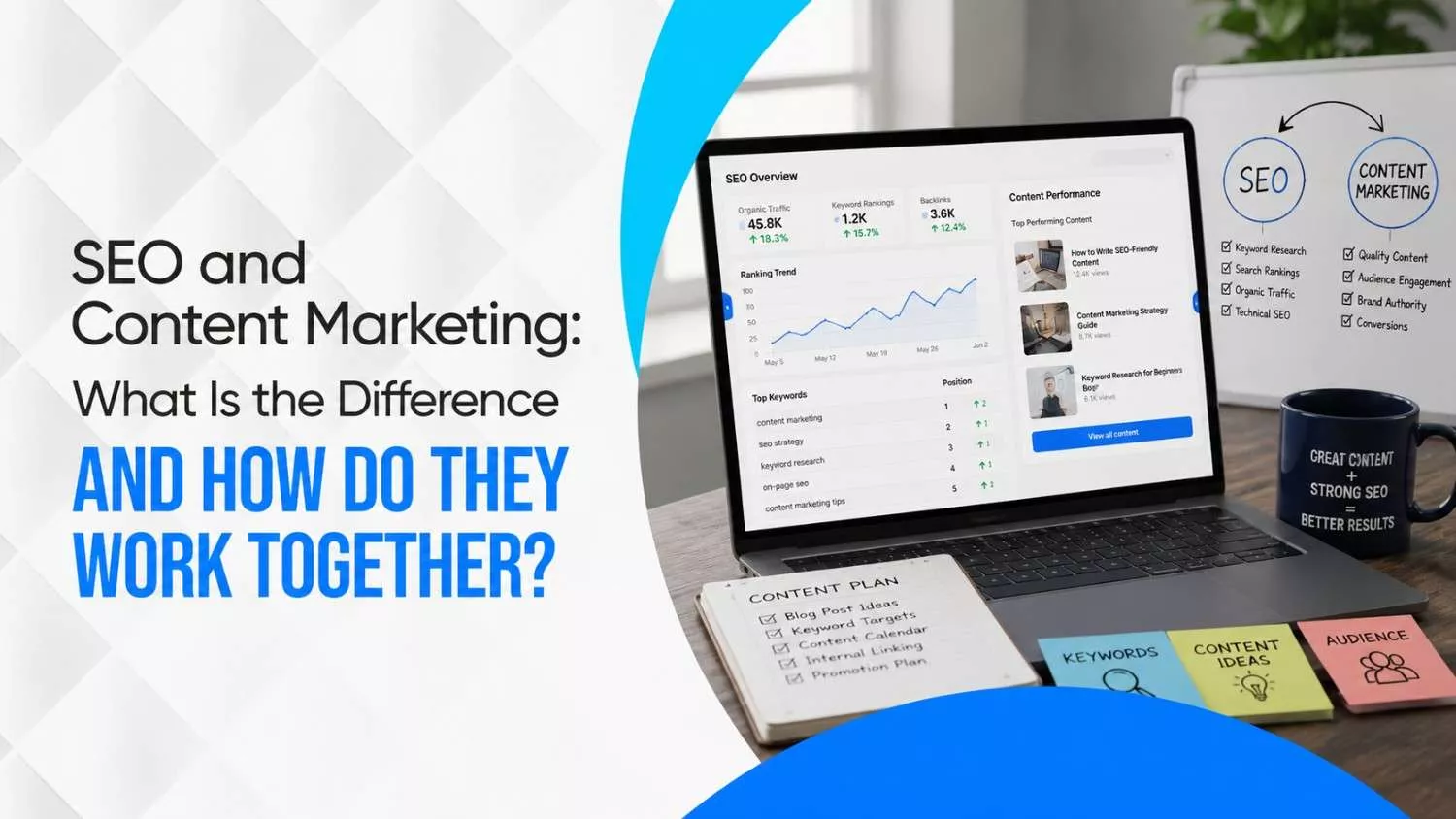
SEO and Content Marketing: What Is the Difference and How Do They Work Together?
If you have ever typed something into Google and clicked the first result, you experienced SEO and content marketing doing exactly what they were built to do, together.
Most business owners hear both terms constantly but treat them like they're the same thing.
They're not.
And mixing them up leads to one of the most common mistakes in digital marketing: spending money on content nobody finds, or ranking for keywords nobody cares about.
This blog breaks down the real difference between SEO and content marketing, so stay tuned!
What Is SEO? (And What It Is Not)
SEO (Search Engine Optimization) is the process of making your website visible to search engines like Google. It covers the technical and structural work that helps your pages rank when people search for something relevant to your business.
Think of SEO as the architecture of your online presence. It includes:
- Keyword research: identifying what your audience is actually searching for
- On-page optimization: titles, headers, meta descriptions, and internal linking
- Technical SEO: site speed, mobile-friendliness, crawlability, and structured data
- Off-page SEO: building backlinks from trusted, authoritative websites
- Local SEO: helping your business appear in location-based searches (e.g., "accountant in Mississauga")
SEO is not about tricking Google. It is about giving search engines clear signals that your content is trustworthy, relevant, and valuable to real people. When done right, it gives you visibility that compounds over time without paying for every click.
Stat to know: According to Ahrefs, over 53% of all website traffic comes from organic search, making SEO one of the highest-ROI channels available.
What Is Content Marketing? (And Why It Matters More Than Ever)
Content marketing is a strategy focused on creating and distributing valuable, relevant content to attract, educate, and convert a specific audience. It is less about algorithms and more about people.
Content marketing includes:
- Blog posts and long-form guides
- Email newsletters
- Social media content
- Videos and podcasts
- Case studies and whitepapers
- Infographics and visual explainers
The core idea is simple: instead of interrupting your audience with ads, you give them something genuinely useful. Over time, that builds trust, authority, and preference for your brand.
Stat to know: An older Demand Metric stat, widely cited by CMI, found content marketing costs 62% less than traditional marketing while generating 3x more leads.
In Canada specifically, the content marketing landscape is growing fast. Canadian businesses across sectors from professional services to e-commerce are investing more heavily in blog writing, email sequences, and educational content to build lasting audience relationships.
According to HubSpot, websites, blogs, and SEO ranked among the top channels driving ROI for B2B brands in 2024.
The Real Difference Between SEO and Content Marketing
Here is where most guides overcomplicate things. Let's keep it plain:
| SEO | Content Marketing | |
|---|---|---|
| Focus | Search engine visibility | Audience engagement and trust |
| Goal | Rankings and organic traffic | Leads, loyalty, and conversions |
| Tools | Keywords, backlinks, technical fixes | Blog posts, videos, email, social |
| Timing | Ongoing technical maintenance | Consistent content creation |
| Measures success by | Rankings, impressions, CTR | Engagement, leads, conversions |
The clearest way to think about it:
SEO gets people to your door. Content marketing makes them want to come in.
One without the other creates a gap. Great content with no SEO sits unread. Strong SEO with thin, unhelpful content ranks briefly, then falls. Google's Helpful Content updates since 2022 have made this even clearer: the algorithm now actively rewards content that genuinely serves the reader, not just pages stuffed with keywords.
Why the "Content Marketing vs SEO" Debate Is Outdated
The framing of content marketing vs SEO misses the point entirely. These are not competing strategies; they are interdependent systems.
Here is how they rely on each other:
SEO needs content to exist. Keywords have no home without blog posts, landing pages, and guides. Technical optimization means nothing if there is nothing valuable for visitors to read.
Content needs SEO to be found. A well-written guide that nobody searches for is just a document sitting on a server. Without keyword strategy, metadata, and backlinks, even your best content stays invisible.
This is why the most successful Canadian businesses, from law firms in Mississauga to e-commerce brands in Vancouver, are no longer asking "SEO or content marketing?" They are asking, "How do we do both well?"
How SEO and Content Marketing Work Together: A Practical Breakdown
Step 1: Keyword Research Drives Content Planning
Every strong piece of content starts with knowing what your audience is searching for. SEO keyword research tells your content team what topics to cover, what questions to answer, and what language your audience actually uses.
Without this step, you are writing what you want to say, not what your audience is looking for.
Step 2: Content Fills the Keyword Gaps
Once you have a list of target keywords, content marketing creates the material that satisfies those searches. A blog post answering "how to choose an accountant in Canada" serves both the reader (genuinely helpful) and the search engine (relevant to the query).
Step 3: Quality Content Earns Backlinks
One of the strongest SEO signals is having other credible websites link to yours. Consistently publishing high-quality, original content is the most reliable way to earn those links naturally, without outreach campaigns that feel spammy.
Step 4: SEO Data Improves Content Performance
After content goes live, SEO analytics (Google Search Console, Ahrefs, Semrush) show you how it performs. Which pages are ranking? What queries are they showing up for? Where are people dropping off? This data tells your content team exactly what to update, expand, or restructure.
This is the feedback loop most businesses miss. Publishing content and never revisiting it is one of the biggest mistakes in web content marketing. A quarterly content refresh cycle, updating stats, improving structure, and adding new FAQs, can significantly recover or improve rankings.
What a Combined SEO Content Strategy Looks Like in 2025–2026
The most effective approach today uses topic clusters, a model where one comprehensive "pillar" page covers a broad topic, and multiple supporting blog posts cover specific subtopics and link back to the pillar.
For example, a Canadian accounting firm might build:
- Pillar page: The Complete Guide to Accounting Services in Canada
- Cluster posts: How to choose an accountant, tax tips for small businesses, bookkeeping vs accounting, CRA audit what to expect, etc.
This structure signals topical authority to Google and gives readers a logical path through your content, both of which improve rankings and reduce bounce rates.
At Wide Ripples Digital, our SEO & Content Strategy service is built exactly around this model. We research keywords, plan topic clusters, write the content, and track performance, so you are not guessing what is working.
A New Angle Nobody Is Talking About: The Intent Gap
Here is something most guides on SEO and content marketing skip entirely: search intent alignment.
Every search query has an intent, what the person actually wants to accomplish. Google categorises these as:
- Informational: "What is content marketing"
- Navigational: "Wide Ripples Digital"
- Commercial: "best SEO agency Canada"
- Transactional: "hire SEO agency Mississauga"
Most businesses produce only informational content. They write blogs, explain concepts, and build awareness, but never create the commercial or transactional content that converts ready buyers.
The gap between informational and transactional content is where revenue is lost.
A fully integrated SEO content strategy maps content to every stage of the buyer's journey:
- Top of funnel: Educational blogs, guides, FAQs (attract)
- Middle of funnel: Case studies, comparisons, how-to content (engage)
- Bottom of funnel: Service pages, testimonials, landing pages (convert)
This is why the Wide Ripples approach, as seen in the Bestax case study where a structured strategy delivered a 159% increase in revenue and 2,780 leads over two years, combines content that ranks with content that converts. It is not just about traffic. It is about the right traffic at the right stage.
Common Mistakes Businesses Make With SEO and Content Marketing
- Mistake 1: Writing content without keyword research. You may be creating excellent material that your audience simply never finds. Always start with what people are actually searching for.
- Mistake 2: Optimizing for keywords but ignoring the reader. Keyword-stuffed pages rank poorly in 2025. Google's algorithms have become sophisticated enough to identify and penalize content that does not genuinely serve the reader.
- Mistake 3: Treating SEO as a one-time setup. SEO is ongoing maintenance. Algorithms change, competitors update their pages, and new keywords emerge. Monthly attention keeps your rankings stable.
- Mistake 4: Publishing and forgetting. Content that ranked well in 2023 may have slipped. A regular audit, checking which pages have lost traffic and updating them, is one of the highest-ROI tasks in content marketing.
- Mistake 5: No internal linking strategy. Every piece of content you publish should link to related pages on your site. This helps search engines understand your site structure and keeps readers engaged longer.
What to Prioritize First: SEO or Content Marketing?
Honestly, both, but in the right order.
- Start with SEO fundamentals: ensure your site is technically sound, loads quickly, and is mobile-friendly. Fix any crawl errors and set up Google Search Console.
- Then build your content strategy around keyword research: identify 10–20 high-value topics your audience searches for and begin creating genuinely useful content around each one.
- As traffic grows, monitor and refine: update underperforming pages, expand posts that rank on page two, and build internal links across your content library.
Ready to Stop Guessing and Start Growing?
If your content is not ranking, or your SEO is not converting, the issue is almost always that the two strategies are not working together. That is the gap Wide Ripples Digital closes for Canadian businesses.
Our clients, from accounting firms to plumbing companies to law practices, have seen real, measurable results when SEO and content finally align.
One client, Bestax Chartered Accountants, went from inconsistent visibility to 88,000+ active users, a 63% jump in conversions, and 159% revenue growth, all built on a combined SEO and content strategy.
Book a free strategy call with Wide Ripples Digital, no pressure, no jargon, just a clear look at where your SEO and content strategy stands and what it would take to grow.
Quick FAQs
What is the main difference between SEO and content marketing?
Can I do content marketing without SEO?
Can I do SEO without content marketing?
How long does it take to see results from SEO and content marketing together?
What is content marketing in Canada specifically?
What is a good SEO content strategy to start with?
How do I know if my SEO and content marketing are working?
Disclaimer: The information provided in this blog is for general informational purposes only. For professional assistance and advice, please contact experts.
Written by Neha Ghauri
Last updated June 30, 2026