How to Optimise Your Website for International SEO (2026 Guide)
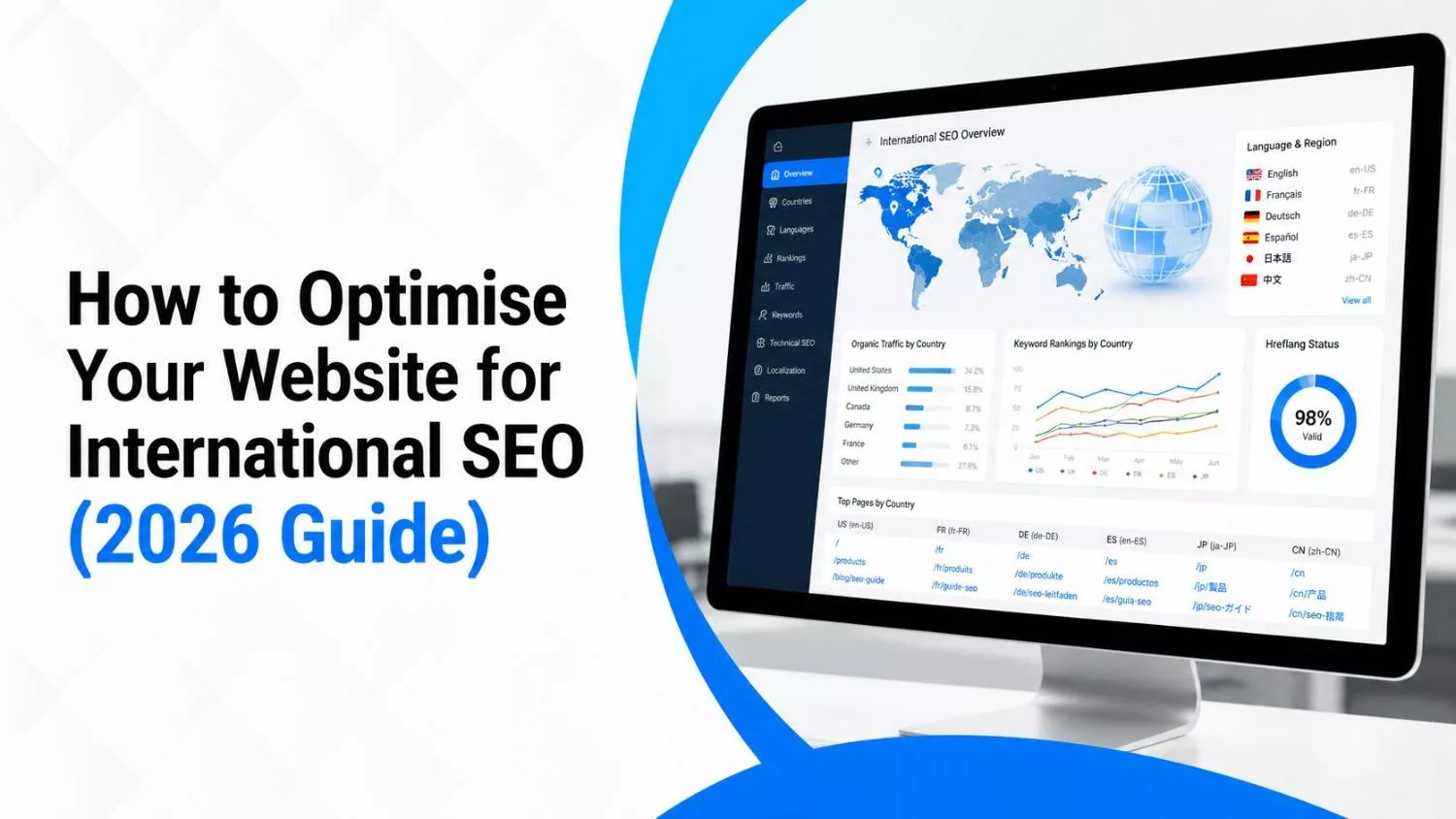
International SEO is the practice of optimising your website so search engines serve the right language and country version of your pages to the right people, wherever they happen to live.
You pull it off with a clear site structure, hreflang tags, locally researched keywords, and content that's genuinely localised, not run through Google Translate at 2 a.m. and shipped with a prayer.
That's the short version. The long version involves fewer prayers and slightly more technical work, which is exactly what this guide is for.
Here's the thing nobody warns you about: going global online is a bit like throwing a dinner party in a country whose language you don't speak.
You can have the best food on the planet, but if your invitations are unreadable, your address is wrong, and you accidentally told everyone the party is "informal" when you meant "elegant," your guests are going to RSVP to someone else's house.
International SEO is how you write a clear invitation, give the correct address, and make sure the right people show up.
And there are a lot of people who could show up.
Why International SEO Is Worth the Effort (The Boring-But-Important Numbers)
Let's start with the size of the room. Roughly 6 billion people, about three-quarters (74%) of the world's population, were online in 2025, up from 5.8 billion the year before (International Telecommunication Union [ITU], 2025). The world's online population grew by more than 240 million people in a single year. That is not a niche audience. That is most of the species.
But, and this is the part that makes marketers sit up, those billions are not evenly online, and they are very much not all reading in English. Internet use ranges from 88–93% across Europe, the Americas, and the Commonwealth of Independent States, but drops to 77% in Asia-Pacific, 70% in the Arab States, and just 36% in Africa. Different regions are at different stages, which means the "global market" is really dozens of distinct local markets wearing a trench coat.
Now here's the opportunity, served on a silver platter. Of all the websites whose content language is identified, just under half, about 49.7%, are in English, with Spanish a distant second at 6.1%, German at 6.0%, Japanese at 5.0%, and French at 4.6% (W3Techs, 2026). Read that again. Half the web speaks English to an audience that is overwhelmingly not native English-speaking. That gap between "where the people are" and "what language the content is in" is where international SEO prints money.
People are also buying in those rooms. In the EU alone, the share of internet users who bought goods or services online climbed from 62% in 2015 to 78% in 2025 (Eurostat, 2026). Translation: your future customers are abroad, they're online, and they have their wallets out. They're just waiting for someone to speak their language. Literally.

First, Know What Kind of "International" You Actually Are
Before you touch a single line of code, you need to answer one question that trips up roughly everyone: are you going multilingual, multi-regional, or both? Google draws a clear line between the two, and getting this wrong is like packing for a beach holiday and landing in Antarctica.
A multilingual website offers content in more than one language, for example, a business with English and French versions of the same site. Google tries to match the language of the searcher.
A multi-regional website explicitly targets users in different countries, say, a manufacturer that ships to both Canada and the United States, where the language might be identical but the shipping, pricing, and currency differ. Google tries to serve the right locale version.
And then there are the overachievers who are both: a site with separate USA and Canada versions, and French and English versions of the Canadian content. This is fine. It just means you have more rooms to keep tidy.
Why does this distinction matter? Because a French speaker in Montréal, a French speaker in Paris, and a French speaker in Dakar may want very different things, different prices, different products, different cultural references, even though they share a language.
SEO international success comes from respecting those differences instead of lumping everyone into one beige "international" bucket.

How to Optimise Your Website for International SEO in 7 Steps
Step 1: Do Real Keyword Research, Not Google Translate Roulette
Here is the single most common rookie mistake in global SEO: taking your English keywords, feeding them into a translation tool, and assuming the locals search the same way you do. They don't.
Direct translation misses intent. The classic example: someone hunting for love songs in Spanish searches "baladas románticas," not the word-for-word translation of "romantic ballads." Same meaning, completely different phrase, wildly different search volume. If you only target the literal translation, you're optimising for words nobody types.
So treat each market like its own kingdom. Use a keyword tool to research the actual search volume and phrasing in that language and region, look at the intent behind those queries, and build your content around how real humans in Lyon or Lima or Lahore actually phrase things. This is also where a good international SEO consultant earns their fee; they catch the cultural and linguistic nuances that a spreadsheet of translated keywords never will.
Bonus humour: machine translation has come a long way, but it still occasionally produces sentences that read like they were assembled by a committee of robots who've only heard about humans secondhand. Which brings us neatly to the next pitfall.
Step 2: Choose a Site Structure That Doesn't Make Googlebot Cry
Once you know which markets you're entering, you need somewhere to put all that lovely localised content. You've got three main options, and choosing between them is the SEO equivalent of deciding where to live.
- Country-code top-level domains (ccTLDs), like example.fr or example.de. These send the strongest geographic signal and feel very official, but they're the digital equivalent of buying a separate house in every country: expensive to maintain, and each one starts its SEO authority from zero.
- Subdirectories, like example.com/fr/ or example.com/de/. All your content lives under one roof, sharing the authority of your main domain. They're generally easier to manage and more technically efficient, which is why they're a popular, sensible default for most growing businesses.
- Subdomains, like fr.example.com. A middle path, though search engines sometimes treat them as semi-separate sites.
There's no single "correct" answer for everyone, but for most businesses scaling internationally, subdirectories keep things simple, consolidate your hard-won authority, and don't require you to babysit a dozen domains. Whatever you pick, Google recommends choosing a URL structure that makes it easy to geotarget your site or parts of it. Pick one approach and commit; flipping-flopping between structures later is a migration headache, and you'll want our website migration SEO checklist bookmarked if you ever go down that road.
Step 3: Implement hreflang Tags (Yes, the Scary One)
Say hello to hreflang, the eight-letter word that strikes fear into the hearts of SEOs everywhere. It sounds intimidating. It's actually just a polite note you leave for search engines saying, "Hey, this page also exists in these other languages and regions, please show the right one to the right person."
Here's how it works, minus the jargon. You add hreflang annotations that tell Google which version of a page belongs to which language and region. The format is a language code (from the ISO 639-1 standard) optionally followed by a region code (from ISO 3166-1 Alpha 2), so de means German content for German speakers anywhere, while en-GB means English content aimed at users in the UK. One small but ego-bruising rule: you can't specify a country code on its own, because Google won't guess the language from the country.
A few things that will save you from the classic hreflang headaches:
- Give every language version its own URL. Google recommends separate URLs for each language rather than swapping content based on cookies or browser settings.
- Add an x-default. This is your fallback page for visitors whose language doesn't match any of your versions, the "if all else fails, send them here" option, ideal for a language-selector page.
- Determine language with visible content. Google figures out a page's language from the actual words on the page, not from lang attributes or the URL, so don't put four languages side by side and expect a clean result.
And one giant flashing warning sign: do not automatically redirect users (or Googlebot) based on their IP address. Google's crawlers mostly originate from the United States and don't go globe-trotting to discover your regional variations, so location-based redirects can hide half your site from the very search engine you're trying to impress.
Googlebot, charmingly, does not have a passport. Use explicit signals like hreflang, locale-specific URLs, and visible "choose your region" links instead.
Step 4: Localise, Don't Just Translate
Translation swaps your words. Localisation makes your site feel like it was built by someone who lives there. The difference is enormous, and it's where automated tools quietly fall apart.
Translation plugins (the Weglot-style tools that many WordPress sites use) are genuinely useful for spinning up multilingual pages quickly and managing costs based on word count. Use them, but never let the robot have the last word. Human proofreading for cultural and linguistic nuance is what keeps your automated translations from sounding like a tourist phrasebook (and occasionally, an accidentally hilarious one).
Real localisation also means getting the details right: local currencies and price formats, date and address conventions, units of measurement, payment methods people actually trust, idioms that land instead of confuse, and imagery that resonates locally rather than screaming "stock photo from another continent." A multi-regional page that says "Free shipping within the United States, prices in USD" should become "Free delivery within the UK, prices in GBP" for British visitors, and that's the easy part (Google, n.d.-b). The hard part is tone, humour, and trust, which is why this stays a stubbornly human job.
Step 5: Get the Technical Foundations Right (Everywhere)
International SEO doesn't get a pass on the basics, if anything, the basics matter more when you're juggling several markets, because every mistake gets multiplied by the number of versions you run.
A few non-negotiables that travel well across borders:
- Speed. A slow site loses visitors in every language. Page speed affects rankings and user experience worldwide, and a sluggish load time is universally annoying, see our breakdown of how page speed affects SEO and rankings.
- Mobile. Much of your new international audience will meet your brand on a phone first, especially in fast-growing mobile-led markets. Our mobile SEO best practices apply globally, not just locally.
- Clean foundations. Solid titles, structured data, sensible URLs, and proper canonical tags help search engines understand each regional version. When you have similar content in the same language across regions (say, German on example.de/ and example.com/de/), pick a preferred version and use canonical and hreflang tags so the right URL is served (Google, n.d.-b).
- Credibility. Expertise and trust signals, what the industry calls E-E-A-T, don't stop at the border. If anything, a stranger in a new market needs more reasons to trust you. Here's how subject-matter experts strengthen E-E-A-T and rankings.
Step 6: Build Local Trust Signals in Each Market
You can't just airdrop a website into a new country and expect Google, or customers to trust it overnight. You build credibility the same way humans do: by showing up consistently in the right places.
That means building citations and brand mentions in each region: local business directories, region-relevant social profiles, and a properly optimised Google Business Profile if you have a physical presence or serve specific cities. These trust signals give search engines early confidence that you're a real, relevant business in that market.
(Starting at home? Our list of free business directories to list your business is a handy template for the kind of foundational presence every market needs.)
Consistency is the secret ingredient. The same business name, address, and details, repeated reliably across trusted local sources, quietly tells search engines you're legitimate — in any language.
Step 7: Remember What Your Search Result Actually Looks Like
Here's a sobering thought: you can do everything above and still lose the click if your result looks unappealing in the search results page. So it helps to know what a standard Google result is actually made of, because every piece is something you can influence.
A typical "blue link" result has a few core parts. The title link is the big, clickable headline, usually pulled from your page's title element or headings, and the most prominent thing the searcher sees. The text snippet is the little summary underneath, designed to tell people what they'll get; if your on-page content is thin, Google may grab text from elsewhere, like a meta description.
Then come the attribution features, your favicon, site name, and visible URL (including breadcrumbs), which you can shape through structured data, URL structure, and a tidy favicon. Google may also tack on additional features like a byline date or a cluster of related site links.
Why does this matter for international SEO? Because a German searcher needs a German-language title and snippet that reads naturally and signals "this is for you." A relevant, well-localised title and snippet is the difference between a click and a shrug. Optimise the content, and you're also optimising how you appear at the exact moment of decision.
And while we're talking about decision moments, search itself is changing. More people now ask AI assistants instead of scrolling through links, and that shift crosses borders too. If you want to stay visible as the rules evolve.
The Greatest Hits of International SEO Mistakes
Save yourself some pain. The most common ways businesses faceplant on the global stage:
- Translating instead of localising: Technically correct, emotionally robotic.
- IP-based auto-redirects: Accidentally hiding your site from Googlebot, who lives in the US (Google, n.d.-b).
- Broken or missing hreflang: Telling Google nothing, then wondering why the French see the English page.
- One structure today, a different one next quarter: Every switch is a migration risk.
- Ignoring local search behaviour: Optimising for words real people in that market never use.
- Forgetting the basics: A slow, clunky, untrustworthy site is unimpressive in every language at once.
When to Bring in an International SEO Agency
You can do a lot of this yourself, especially for one or two markets. But international SEO has a way of multiplying complexity fast, every new language and region adds keyword research, technical implementation, localisation, and ongoing optimisation. At some point, the smart move is to bring in help.
A good international SEO company or international SEO consultant earns their keep by handling the messy, multiplied work: structuring your site correctly the first time, getting hreflang right (the part that breaks most often), running real keyword research per market, coordinating localisation, and tracking what's actually working.
Whether you call it global SEO services, an international SEO service, or simply a search engine optimisation agency that won't make Googlebot cry, the value is the same: fewer expensive mistakes, faster results, and a partner who treats each market like the distinct opportunity it is.
That's exactly how we think at Wide Ripples Digital. We're a data-led SEO and content strategy team that has earned a 4.8-star rating by doing the unglamorous work properly, no tricks, no fluff, just clear strategy and honest, simple reporting. It's the same obsessive approach that has doubled revenue for clients and turned steady traffic into real, measurable growth.
If you're ready to take your business beyond one market, book a free strategy call, a 30-minute, pressure-free session where we review your site, compare competitors, and hand you fixes you can use right away. No sales pitch. Just clarity, and maybe one or two bad jokes.
Quick FAQs
What is international SEO in simple terms?
How is international SEO different from local SEO?
Do I need a separate website for each country?
What are hreflang tags and do I really need them?
Is it okay to just use Google Translate for my whole website?
Should I use a ccTLD, subdomain, or subdirectory for international SEO?
How long does international SEO take to show results?
Does international SEO work for small businesses?
How much does international SEO cost, and is hiring an agency worth it?
Can I do international SEO myself, or should I hire a consultant?
Does international SEO help me show up in AI search like ChatGPT?
What's the single biggest mistake people make with international SEO?
Disclaimer: The information provided in this blog is for general informational purposes only. For professional assistance and advice, please contact experts.
Written by Khadija
Last updated June 23, 2026