Top B2B Lead Generation Strategies for Canadian Companies in 2026
If there’s one thing Canadians care about more than hockey (well, almost), it’s making sure that our marketing dollars go toward finding the right prospects. Generating qualified leads has always been a top priority for B2B companies, but the stakes are higher in 2026. Competition is global, audiences are distracted, and budgets are scrutinised.
According to 2026 lead generation report, 61 % of marketers say generating quality leads is their top challenge. Meanwhile, 49 % of B2B marketers cite lead generation as their biggest priority. Yet 79 % of leads never convert into sales due to poor nurturing. In other words, we’re all fishing, but too many of us are throwing back the catch before we realise it’s dinner.
This guide breaks down the most effective B2B lead generation strategies for Canadian companies in 2026.
Understanding B2B Lead Generation: From MQLs to SQLs
Before we decide which channels deserve budget, let’s clarify what we mean by B2B lead generation. In simplest terms, it’s the process of attracting and converting strangers into prospects your sales team wants to talk to. Those prospects move through stages:
- Lead / Subscriber (the curious passer‑by) Someone who downloaded a guide, filled out a form, or joined a webinar.
- Marketing Qualified Lead (MQL): A lead that matches your ideal customer profile and shows some engagement (e.g., visited pricing pages or downloaded multiple assets).
- Sales Qualified Lead (SQL): An MQL that has been vetted and is ready to speak with sales.
Statistics show that nurturing leads through these stages requires discipline.
Only 56 % of B2B companies verify or validate leads before passing them to sales. No wonder about 79 % of leads never convert.
Adding insult to injury, MQL‑to‑SQL conversion rates have dropped from 13 % in 2024 to 9.8 % in 2026 as more teams send unqualified contacts to sales.
The result? Salespeople waste time chasing ghosts while marketing pats itself on the back for generating “volume.”
Quality Over Quantity (The Canadian Perspective)
Canadian companies face unique constraints. The Canadian Anti‑Spam Legislation (CASL) is stricter than the U.S. CAN‑SPAM laws. CASL requires opt‑in consent; implied consent from a business relationship only lasts 24 months after a purchase and six months after an inquiry. Cold emailing strangers without proof of consent can trigger fines up to CAD $10 million per organisation. That makes verifying and qualifying leads even more important. Add in Quebec’s language laws (French text must occupy twice the visual space of English when targeting Quebec), and you quickly see why “spray and pray” doesn’t fly here.
Finally, note that only 2 % of B2B website traffic converts into a lead. In other words, 98 % bounce. If you’re not nurturing and retargeting those visitors, you’re leaving almost everyone behind.
Canadian Cost Benchmarks: Prospeo’s Canada‑specific study suggests budgets of CAD $200 to $500 per lead, depending on channel. In Canada, SEO and cold email reside at the lower end of that range, while PPC, LinkedIn Ads, and trade shows can exceed $500 per lead.
Use these numbers as a guide, but remember that cheap leads aren’t always a cheap pipeline. The channels with higher CPL often deliver warmer prospects and larger average contract values (ACV), ABM, webinars, and referrals, for instance, convert leads into opportunities more efficiently than programmatic display ads.
Strategy #1: Content Marketing and SEO
Content marketing remains the #1 ROI‑generating channel for B2B marketers. 59 % of B2B marketers believe SEO has the largest impact on lead generation goals, and companies that blog actively generate 13 × more leads. What’s more, content marketing produces three times more leads at 62 % lower cost than many traditional outbound channels. And with the rise of AI search engines like ChatGPT and Gemini, being visible in answer engines is becoming just as important as ranking on Google.
Steps for Canadian Businesses
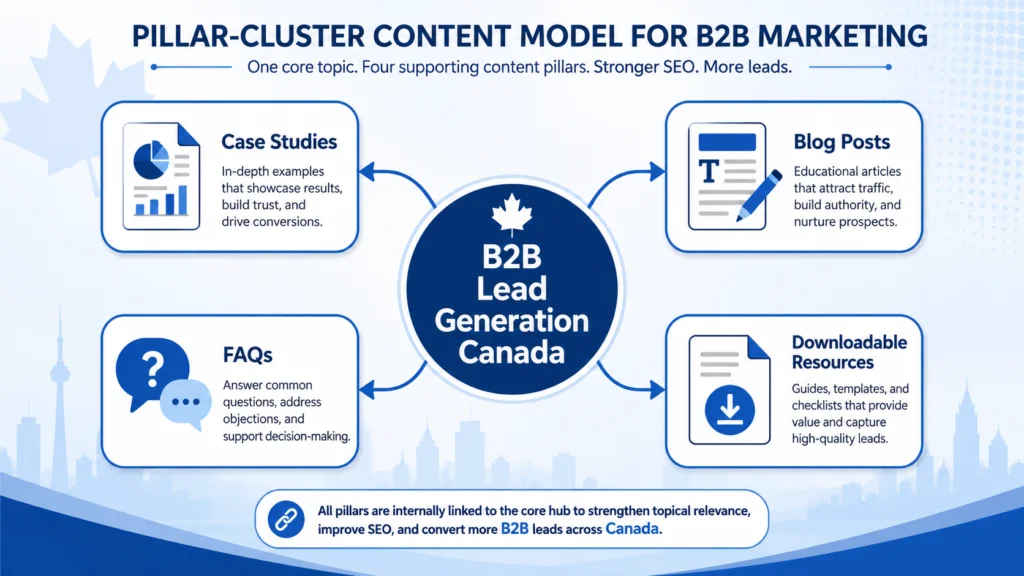
- Create a Pillar‑Cluster Strategy: Research high‑intent search queries like “B2B lead generation Toronto,” “AI email marketing Canada,” or “Best webinars for accountants in Calgary.” Build a comprehensive pillar page around the core topic and link out to cluster content (case studies, how‑to guides, and comparisons) to signal topical authority.
- Optimise for People and Robots: Use question‑based headings, answer‑first paragraphs, bullet lists and tables. This structure not only improves user readability but also increases the chances of your content being featured in AI‑powered results and Google’s generative search.
- Localise and Bilingual: If you’re targeting Quebec, ensure French content is “markedly predominant” – French text should occupy at least twice the visual space of English. Use region‑specific keywords (e.g., “lead generation services Vancouver”) and highlight local laws or industry nuances.
- Focus on Quality Backlinks: Partner with credible industry associations (e.g., ITAC or the Canadian Marketing Association) to earn authoritative links. This reinforces your domain’s credibility and helps your pages rank higher.
- Optimise for Speed and User Experience: Page speed influences both SEO and lead conversion. Studies show that a one‑second delay can drop traffic by 11 % and drastically reduce conversions. Use tools like Google PageSpeed Insights to keep load times under three seconds.
- Build Conversion Paths: 68 % of B2B businesses use strategic landing pages for lead capture. Don’t send blog traffic to your homepage; send them to landing pages with clear offers, like free consultations or downloadable reports.
Strategy #2: Email Marketing & Nurturing
Email remains a powerhouse: Email marketing delivers an average return of $36 to $42 per $1 spent. According to Verified.email’s 2025–2030 benchmark report, the median B2B open rate sits between 36.7 % and 42.35 % with click‑through rates of 2 % to 4 %.
Top performers achieve 50 %+ opens and 10 %+ CTR through segmentation and personalization. Email still outranks every other digital channel for ROI.
However, there’s a catch: open rates have become unreliable because Apple Mail preloads tracking pixels. Cold email campaigns now focus on reply rates, with good reply rates at 5 % to 10 % and excellent campaigns hitting 10 % to 15 %. Deliverability is critical; spam filters are stricter and CASL fines are harsh.
Steps for Success in Canada
- Build Consent‑First Lists: Use opt‑in forms, trade show sign‑ups and content downloads to collect consent. Remember: implied consent under CASL expires after 24 months for customers and six months after an inquiry.
- Verify and Clean Data: Use verification services to maintain high deliverability. Verified. Email notes that top programs achieve 98 %+ delivery rates. Bounces and spam complaints can tank your sender reputation quickly.
- Segment by Persona and Region: Create segments for industry, job role, language (English vs French), and stage in the funnel. Tailored emails produce 30 % higher opens and 50 % higher CTR.
- Adopt AI Personalisation: 64 % of marketers now use AI to personalise emails, and those campaigns see 41 % revenue increases and 13.44 % CTR (versus 3 % for non‑AI campaigns).
- Multi‑Touch Nurture: Top performers run 11‑touch nurture sequences over 90 days; they produce 50 % more sales‑ready leads at 33 % lower cost. Don’t just send one email; create a series of valuable messages that answer objections and offer insights.
- Warm Up & Authenticate: Use a warm‑up period for new email domains and authenticate with SPF, DKIM, and DMARC. Cold email guides suggest keeping send caps under 100 emails per inbox per day.
- Measure What Matters: Track reply rates, meetings booked, and pipeline generated. Cold email cost per meeting is about $152.73, significantly cheaper than phone calls or trade shows.
Strategy #3: LinkedIn & Social Selling
LinkedIn remains the king of B2B social media. Martal reports that 89 % of B2B marketers use LinkedIn and that it drives 80 % of all B2B social media leads. However, Famelab’s analysis points out that this 80 % figure refers to LinkedIn’s share of social media‑generated leads, not total leads.
Overall, LinkedIn typically accounts for 15 % to 40 % of total B2B leads, though for social‑selling‑heavy companies it can reach 50 % to 60 %. Translation: LinkedIn is indispensable, but it works best alongside other channels.
Steps to Optimise LinkedIn
- Optimise Profiles: Your personal and company profiles are digital billboards. Clearly state your value proposition, use professional photos, and include targeted keywords (e.g., “B2B AI lead generation in Canada”).
- Create and Curate Thought Leadership: Use LinkedIn’s algorithm to your advantage by posting educational content and industry news. Follow the 80/20 rule – 80 % educational or entertaining, 20 % promotional. Consistency beats frequency.
- Use Sales Navigator & Filters: Leverage Sales Navigator’s advanced search to filter by geography (province, city), industry, company size and seniority. It’s particularly helpful for connecting with decision‑makers in markets like Toronto’s financial sector or Montreal’s tech scene.
- Engage in Comments and Groups: Don’t just broadcast – respond thoughtfully to comments, join niche groups (e.g., Canadian Manufacturing Leaders) and send personalised connection requests. Social selling is about building relationships, not spamming.
- Leverage LinkedIn Ads Strategically: While LinkedIn Ads’ average cost per lead is around $187, they can be effective for high‑value offers such as executive webinars or whitepaper downloads. Use lead gen forms to reduce friction.
- Measure With UTM Parameters: Track LinkedIn’s contribution by tagging your links (UTM source=LinkedIn). Famelab suggests using multi‑touch attribution models to understand LinkedIn’s true impact.
Strategy #4: Webinars & Interactive Content
Webinars are not new, but their popularity continues to rise. 73 % of marketers say webinars produce their best quality leads, and Martal notes that the average cost per lead for webinars is about $72.
Digital Applied’s analysis shows webinar leads cost $362 on average but convert at 14.2 %, resulting in high cost, high quality. Meanwhile, interactive content such as calculators, quizzes or interactive infographics generates twice as many conversions and five times more pageviews.
How to Run Webinars that Canadians Will Love
- Choose Niches That Matter: Pick topics relevant to your industry and region. For example, “How AI is Transforming Supply Chain Management in Ontario” or “Understanding CASL & Quebec’s Bill 96 for Marketers.”
- Promote Across Channels: Use SEO, LinkedIn and email to promote your webinar. Offer bilingual registration pages if targeting Quebec.
- Incorporate Interactive Elements: Use polls, Q&A, breakout rooms and surveys during the session. Interactive sessions boost engagement and provide invaluable data.
- Follow Up Quickly: Send the recording and a summary to attendees within 24 hours. For no‑shows, provide a “sorry we missed you” email with a link to the recording and a CTA (e.g., book a consultation).
- Repurpose Content: Turn webinars into blog posts, podcasts, short clips or slide decks. Each repurposed asset becomes another lead magnet.
Strategy #5: AI & Automation
Artificial intelligence has moved from science fiction to the sales team. Businesses using AI for lead generation report a 50 % increase in sales‑ready leads and up to 60 % lower customer acquisition costs.
Ways to Harness AI Responsibly
- Conversational Chatbots & AI Assistants: Add chatbots to your website to answer common questions, qualify visitors and schedule demos. Integrate them with your CRM so sales reps receive context.
- Predictive Lead Scoring: Use AI to analyse historical data and score leads based on fit and behaviour. This ensures your sales team spends time on prospects most likely to convert.
- AI‑Powered Email Personalisation: Tools like GPT can generate personalised subject lines and body copy at scale. Verified.email reports that AI‑driven personalisation boosts email CTR to 13.44 % compared to 3 % for non‑AI campaigns.
- Intelligent Scheduling & Follow‑Ups: Automate meeting scheduling, follow‑up reminders and even agenda preparation. AI SDR platforms have reduced cost‑per‑meeting from $312 to $94.
- Monitor & Iterate: AI is a tool, not a magic wand. Periodically review your AI’s decisions to ensure it isn’t favouring the wrong prospects or generating spammy messages.
Strategy #6: Account‑Based Marketing (ABM) & Hyper‑Personalisation
Account‑Based Marketing focuses on targeting high‑value accounts rather than casting a wide net. ABM leads cost $487 each but convert at 19.8 %. While the upfront cost is higher, ABM often delivers better pipeline efficiency for enterprise deals. Here’s how to apply ABM in Canada:
- Define Your Ideal Account Profile: Identify accounts with high lifetime value and a good fit (industry, company size, budget, technology stack). For example, an AI software vendor might target mid‑market financial institutions in Toronto or Vancouver.
- Research Each Account Thoroughly: Understand their recent news, growth challenges and decision‑makers. Use insights to craft personalised value propositions.
- Personalise Outreach Across Channels: Combine direct mail (yes, physical mail still exists), personalised email, LinkedIn messages and targeted ads. Use French content for Quebec prospects when appropriate.
- Align Marketing & Sales: Create shared account plans with clear roles. Marketing nurtures relationships with multiple stakeholders while sales engages decision‑makers.
- Measure Account Engagement: Track metrics such as account penetration (how many stakeholders engaged), marketing‑attributed pipeline and deal velocity.
Strategy #7: Partnerships & Referral Programs
People trust recommendations from their peers more than any marketing campaign. Here’s how to tap into that trust:
- Create a Formal Referral Program: Offer incentives such as discounts, gift cards or donations to a charity of the referrer’s choice. Make it easy for customers to refer via a simple form or one‑click email.
- Partner With Complementary Businesses: Collaborate with non‑competitive firms serving the same audience. For example, an HR software provider can partner with a payroll company to exchange leads.
- Leverage Industry Associations: Participate in Canadian associations such as the Canadian Manufacturers & Exporters (CME) or ICTC (Information and Communications Technology Council). Speaking at events or sponsoring webinars positions your brand as a trusted resource and opens referral doors.
- Showcase Testimonials and Case Studies: When potential clients see their peers’ success stories, they’re more likely to engage. Highlight results (“50 % increase in sales‑ready leads”) and include quantifiable outcomes.
Strategy #8: Events, Trade Shows & Networking
While digital channels dominate, face‑to‑face interactions remain invaluable for big deals. Here’s how to maximise that investment:
- Choose Local & Relevant Events: Focus on Canadian conferences and trade fairs where your ideal customers gather: Collision Conference (Toronto), AI & Big Data Expo (Vancouver), Canada Gas & LNG Exhibition (Vancouver) or BIXI Innovation Summit (Montreal) for tech, manufacturing or energy sectors.
- Pre‑Book Meetings: Use your CRM to identify contacts attending the event. Send personalised invites offering to meet for coffee or a short demo.
- Design an Engaging Booth: Offer interactive demos, mini‑workshops or giveaways that encourage visitors to stay longer. Use bilingual signage if targeting Quebec.
- Capture and Qualify on the Spot: Use mobile forms or QR codes to collect data quickly. Qualify leads with a few key questions (budget, timeline, authority).
- Follow Up Fast: According to research, contacting a lead within an hour increases conversion odds by up to seven times. After the event, send personalized thank‑you emails and schedule demos.
Strategy #9: Data, Lead Scoring & Qualification
Remember the statistics: 61 % of marketers struggle to generate quality leads and 56 % of companies don’t verify leads. Without proper qualification, your pipeline becomes a junk drawer. Here’s how to tidy it up:
- Define Qualification Criteria: Establish what makes a lead marketing‑qualified (budget, authority, need, timeline) and what signals sales readiness. Align marketing and sales on these definitions to prevent friction.
- Implement Lead Scoring: Assign points based on demographic fit (company size, industry), behavioural signals (webinar attendance, page visits) and engagement level. Use AI to adjust scores dynamically.
- Validate Contact Data: Use verification tools to ensure email addresses, job titles and phone numbers are accurate. Prospeo emphasises 98 % email accuracy and daily data refreshes.
- Automate Lead Routing: Once a lead meets your score threshold, route it to the correct sales rep. Use notifications to ensure timely follow‑up.
- Regularly Audit Your CRM: Remove stale or duplicate records. With CASL, you must process unsubscribe requests within 10 business days. Keeping accurate records protects you from fines.
Strategy #10: Measure, Analyse & Optimise
If you’re not measuring, you’re guessing. Lead generation isn’t a set‑and‑forget activity; it’s an ongoing experiment. Here’s how to iterate:
- Track Funnel Metrics: Monitor cost per lead, cost per opportunity, lead‑to‑opportunity conversion rate, and opportunity‑to‑closed‑won ratio. The median B2B cost per lead in early 2026 is $213. Compare your performance to benchmarks.
- Analyse by Channel & Persona: Identify which channels and personas convert better. Maybe your webinars attract more qualified leads from the healthcare sector but not from manufacturing. Allocate budget accordingly.
- Test & Refine Content: Use A/B testing for headlines, CTAs, landing pages and emails. Tweak one variable at a time to isolate what’s driving improvements.
- Pay Attention to Lead Velocity: If your lead‑to‑opportunity time is increasing (the 2026 median increased 18 % year‑over‑year), investigate whether prospects are receiving timely follow‑ups or if messaging needs to be more compelling.
- Keep Up with AI Search: With nearly 24 % of marketers updating their SEO strategies for generative AI, monitor how AI‑powered answer engines display your brand. Optimise your content to appear in ChatGPT, Bing’s AI Overviews and Google’s SGE.
- Share Insights Across Teams: Regularly align marketing and sales on what’s working and where leads stall. Collaboration ensures marketing isn’t judged solely on volume and sales isn’t chasing unqualified prospects.
Final Thoughts: Bringing It All Together
As you implement these strategies, remember that marketing is both a science and an art. The statistics and benchmarks in this guide give you the scientific foundation. The art comes from understanding your audience, injecting a little humour and personality (yes, Canadians have jokes!) and adapting as the market evolves.
Need help? Wide Ripples partners with Canadian businesses to build AI‑optimised lead generation strategies that comply with CASL and deliver real pipeline. Let’s turn those 98 % of visitors who bounce into conversations and conversions.
Quick FAQs
What is B2B lead generation?
How much does B2B lead generation cost in Canada?
What is a good conversion rate for B2B leads?
Is LinkedIn really the best platform for B2B leads?
How can I stay compliant with CASL?
What role does AI play in B2B lead generation?
Disclaimer: The information provided in this blog is for general informational purposes only. It is not legal advice and should not be relied on as such.
Written by Neha Ghauri
Last updated June 5, 2026