How Long Does SEO Take to Show Results? A 2026 Guide for Mississauga Businesses
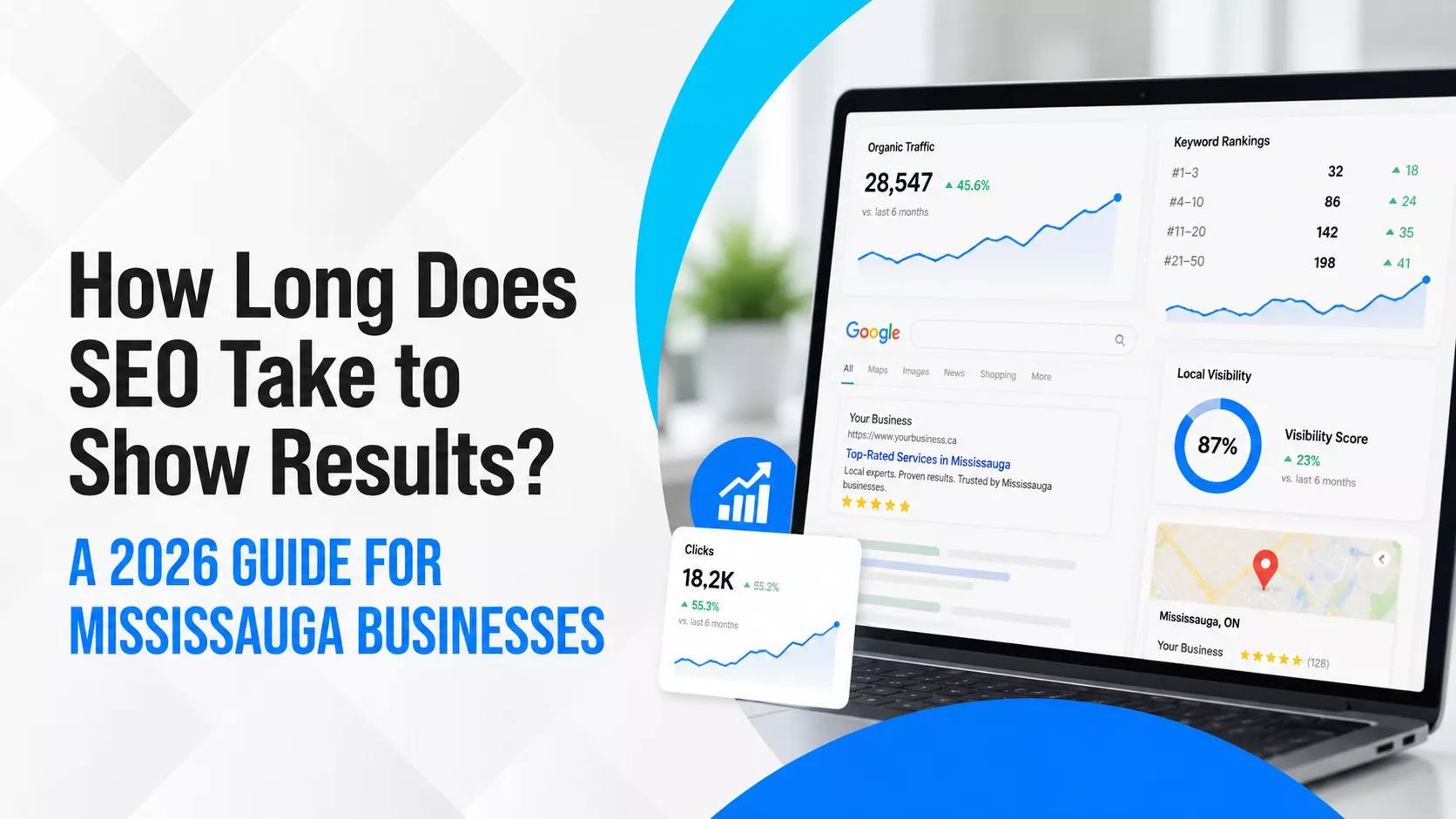
If you have ever asked, “How long does SEO take to show results?”, you are already asking the right question.
You are also probably hoping the answer is “next Tuesday.”
Sadly, SEO is not a microwave. It is more like a gym membership that actually works when you show up, follow a plan, and stop checking the mirror every 11 minutes.
For most businesses, SEO takes 3 to 6 months to show early movement and 6 to 12 months to show stronger, revenue-focused results. In competitive markets like Mississauga, Toronto, Brampton, Oakville, and the GTA, results can take longer because you are not ranking in an empty room. You are ranking against dental clinics, law firms, contractors, real estate teams, accountants, restaurants, med spas, and every business owner who suddenly decided “we should do SEO” after watching one YouTube video at midnight.
Google also confirms that SEO changes can take time to reflect in Search. Some changes may appear in a few hours, while others may take several months, and Google generally recommends waiting a few weeks before judging whether your changes helped.
So, let us break this down properly.
No vague promises. No “rank #1 overnight” fairy tales. No SEO magic beans.
Just a practical timeline.
Why SEO Results Take Time
SEO takes time because Google has to:
- Crawl your website
- Understand your pages
- Compare your content with competitors
- Evaluate trust signals
- Process technical changes
- Observe user behaviour
- Reassess rankings over time
Think of Google like a very busy librarian with trust issues.
You do not just publish one blog and instantly become the most trusted answer in Canada. Google wants proof. Your customers want proof too.
In 2026, that proof includes:
- Helpful content
- Website speed
- Mobile experience
- Local relevance
- Reviews
- Backlinks
- Brand mentions
- Google Business Profile strength
- Clear service pages
- Consistent business information
- Real expertise
For Mississauga businesses, this matters even more. The City of Mississauga’s 2025 Business Directory includes almost 14,600 businesses across sectors like retail, services, healthcare, manufacturing, professional services, real estate, and more. That means your website is not just trying to exist. It is trying to stand out in a very crowded digital plaza.
And yes, “crowded digital plaza” is a nicer way of saying “everyone is fighting for page one.”
The Honest SEO Timeline
Here is a realistic SEO timeline for most small to mid-sized businesses.
Month 1: Research, Audit, and Fixing the Mess
The first month is usually not glamorous.
Nobody throws a party because your sitemap is fixed.
But this stage matters.
During month one, an SEO team usually works on:
- Website audit
- Keyword research
- Competitor gap review
- Technical SEO fixes
- Google Search Console setup
- Google Analytics setup
- Local SEO audit
- Page speed review
- Content planning
- Google Business Profile review
This is the “open the hood” stage.
Sometimes we find small issues. Sometimes we find a website held together with plugins, hope, and one unpaid intern from 2019.
What you may see in month 1:
- Better indexing
- Cleaner tracking
- Fixed errors
- Keyword map
- Improved site structure
- No major ranking jump yet
Must-know tip: Month one is about building the foundation. If someone promises huge organic growth in the first 30 days, ask them if they also sell flying carpets.
Month 2 to 3: Early Ranking Movement
This is when things start waking up.
Google begins noticing updated pages, new content, improved internal links, and technical fixes. You may see movement for low-competition keywords first.
For example, a Mississauga dental clinic may not rank quickly for “dentist near me,” but it may start ranking for:
- Emergency dentist in Mississauga
- Invisalign consultation Mississauga
- Dental cleaning cost Mississauga
- Family dentist near Square One
That is how SEO grows. Not with one giant keyword. With many small search wins that build traffic and trust.
What you may see in months 2–3:
- More impressions in Google Search Console
- Some keywords moving from page 5 to page 2 or 3
- More visibility for long-tail keywords
- Better local map views
- More indexed pages
- Early blog traffic
This is the stage where business owners often panic and say, “We are getting impressions but not many clicks.”
That is normal.
Impressions are like people seeing your shop sign while driving. Clicks happen when the sign, location, offer, and trust all improve.
Month 3 to 6: Traffic Starts Becoming Useful
This is where SEO begins to feel real.
By months 3 to 6, you should start seeing clearer improvements if the strategy is done properly.
Not “we added keywords to the footer” properly.
Actually properly.
That means:
- Service pages are optimized
- Blog content answers real customer questions
- Internal links support key pages
- Google Business Profile is active
- Reviews are growing
- Location pages are useful
- Technical issues are reduced
- Content is updated regularly
For a local Mississauga business, this is when SEO can start producing meaningful leads.
What you may see in months 3–6:
- More organic traffic
- More local keyword rankings
- Better Google Business Profile actions
- More calls and form fills
- More page-one long-tail rankings
- Higher visibility in nearby areas
Canada is a strong digital market. DataReportal reported 38.2 million internet users in Canada by the end of 2025, with 95.1% internet penetration, which means your customers are already searching online before they call, visit, or book.
In other words, SEO is not about convincing people to use Google.
They already are.
You are just trying to show up before your competitor does.
Month 6 to 12: Stronger Rankings and Better Leads
This is the stage where SEO often becomes a serious growth channel.
By now, your website has more content, better structure, stronger trust signals, and more search history. Google has had time to process your improvements.
This is where competitive keywords may begin moving.
Examples:
- SEO services Mississauga
- Accountant in Mississauga
- Personal injury lawyer Mississauga
- Kitchen renovation Mississauga
- Local SEO company Mississauga
- Best dentist in Mississauga
These keywords take longer because everyone wants them.
It is like trying to find parking at Square One on a Saturday. Technically possible, but you need patience, strategy, and emotional strength.
What you may see in months 6–12:
- Page-one rankings for more important keywords
- More consistent leads
- Stronger local map visibility
- Better conversion rates
- More branded searches
- More content ranking
- More backlinks and authority
Google dominates search in Canada. StatCounter shows Google held about 85.72% of Canada’s search engine market share in June 2026, with Bing at about 9.79%.
So yes, optimizing for Google still matters.
A lot.
What Affects How Fast SEO Works?
SEO timelines are not the same for every business.
A new website and an established website do not move at the same speed. A bakery and a law firm do not face the same competition. A business with 200 real reviews and a clean website has a different starting point from a business whose homepage still says “Welcome to our website” like it is 2006.
Here are the biggest factors.
1. Your Website’s Current Condition
If your website is slow, confusing, thin, or not mobile-friendly, SEO takes longer.
Technical SEO problems can block growth even when your content is good.
In 2024, Google’s Core Web Vitals changed when Interaction to Next Paint, or INP, replaced First Input Delay as a Core Web Vital. This made real user responsiveness even more important for website experience.
Pro tip: A slow website is like a salesperson who takes 12 seconds to say hello. People leave.
2. Your Competition
SEO is relative.
You are not just trying to be good. You are trying to be better than the websites already ranking.
If your competitors have:
- Better content
- More reviews
- More backlinks
- Better service pages
- Stronger local authority
- Faster websites
Then your SEO will take more time.
This is common in Mississauga because local businesses compete not only with other Mississauga companies but also with Toronto, Brampton, Oakville, Etobicoke, and broader GTA brands.
3. Your Content Quality
Thin content does not rank well for long.
A service page that says “We offer quality service at affordable prices” is not enough.
Everyone says that.
Even suspicious basement businesses say that.
Your content should answer real questions like:
- How much does it cost?
- How long does it take?
- Who is this service for?
- What problems does it solve?
- What should customers know before booking?
- What makes your process different?
- What happens after someone contacts you?
Good SEO content should make the reader feel smarter, safer, and closer to a decision.
4. Your Local SEO Strength
For local businesses, Google Business Profile matters a lot.
Google says local results are mainly based on relevance, distance, and prominence. Relevance means how well your business matches the search. Distance means how close you are to the searcher or location. Prominence means how well-known and trusted your business appears online.
That means local SEO is not only about your website.
It also includes:
- Google Business Profile categories
- Business description
- Services
- Photos
- Reviews
- Review responses
- Local citations
- Name, address, and phone consistency
- Location pages
- Local backlinks
Must-know tip: If your Google Business Profile is neglected, your local SEO is trying to run with one shoe.
5. Your Budget and Consistency
SEO speed also depends on how much work is done each month.
A business publishing one weak blog every two months will not move like a business improving service pages, publishing useful content, building links, fixing technical issues, and improving local signals every month.
SEO rewards consistency.
Not random bursts of activity followed by silence.
Google does not love abandoned websites. Neither do customers.
How Long Does Local SEO Take?
Local SEO can often show early results faster than national SEO.
For a Mississauga business, local SEO may show signs in 2 to 4 months, especially for lower-competition services or specific neighbourhood keywords.
Examples:
- Tax accountant near Port Credit
- Web design company Mississauga
- Physiotherapy clinic near Erin Mills
- Wedding photographer Mississauga
- Restaurant near Streetsville
However, stronger local rankings usually take 4 to 8 months, especially if your competitors already have strong reviews, content, and links.
Local SEO Timeline
- Month 1: Audit, Google Business Profile cleanup, citation fixes
- Month 2: Service updates, photos, posts, review strategy
- Month 3: Local content, location signals, early map movement
- Month 4–6: More calls, direction requests, local rankings
- Month 6+: Stronger map visibility and lead growth
Pro tip: Local SEO is not only about ranking. It is about looking trustworthy when people find you.
A customer may see three businesses in Google Maps. If your profile has blurry photos, five reviews, and no recent updates, they may choose someone else faster than you can say “but our prices are competitive.”
SEO Results You Should Track
Do not only track rankings.
Rankings are useful, but they are not the full story.
Track these instead:
- Organic traffic
- Keyword impressions
- Click-through rate
- Form submissions
- Phone calls
- Bookings
- Google Business Profile calls
- Direction requests
- Local map views
- Ranking improvements
- Conversion rate
- Revenue from organic leads
The best SEO reports connect rankings to business outcomes.
Because ranking for a keyword that brings no leads is like winning a trophy for a sport nobody plays.
Nice. But not useful.
Why Some SEO Campaigns Fail
SEO usually fails because of one of these reasons:
- No clear strategy
- Poor technical setup
- Weak content
- No local SEO work
- No conversion tracking
- Unrealistic expectations
- Stopping too early
- Copying competitors blindly
- Ignoring website experience
- Publishing generic AI content
That last one matters.
In 2026, generic content is everywhere. Your content needs actual examples, local context, expert input, helpful structure, FAQs, and clear answers.
A blog that could apply to any business in any city is not enough.
A Mississauga business should sound like it understands Mississauga customers, GTA competition, Ontario search behaviour, and local buying decisions.
That is where authority is built.
Something Most SEO Blogs Do Not Tell You
SEO does not only work when people click.
SEO also works when people remember.
A buyer may search today, compare you tomorrow, see your blog next week, check your reviews later, and contact you after payday.
This is especially true for higher-value services like:
- Legal services
- Accounting
- Home renovation
- Dental treatment
- Real estate
- B2B services
- Marketing
- Consulting
- Medical clinics
That means SEO has two jobs:
- Get you found.
- Make you trusted before the first call.
Most businesses only focus on job one.
That is a mistake.
The better question is not only “How long does SEO take to show results?”
The better question is:
“How long does it take for SEO to make customers trust us enough to contact us?”
That is where content, reviews, case studies, service pages, and local authority matter.
When Should You Expect Leads from SEO?
Here is a practical answer.
If your website already has some authority, you may see early leads in 2 to 3 months.
If your website is new, weak, or has technical issues, expect 4 to 6 months for useful lead movement.
If your industry is very competitive, expect 6 to 12 months for stronger results.
For brand-new websites in competitive industries, SEO may take 12 months or more to become a major lead source.
That does not mean nothing happens before then.
It means SEO builds in layers.
Like a snowball.
Or like laundry.
Ignore it long enough and suddenly it becomes a mountain.
How to Make SEO Work Faster
You cannot force Google to trust you overnight.
But you can remove delays.
To speed up SEO results:
- Fix technical errors first
- Improve page speed
- Build strong service pages
- Use local keywords naturally
- Add FAQs to important pages
- Update Google Business Profile weekly
- Get real customer reviews
- Respond to reviews
- Publish helpful blogs
- Add internal links
- Build local backlinks
- Track conversions
- Refresh old content
- Add schema markup
Must-know tip: The fastest SEO wins usually come from improving pages that already have impressions but low clicks.
That means Google already sees the page. It just needs a better title, better content, stronger answer, or clearer CTA.
Final Answer: How Long Does SEO Take?
SEO usually takes 3 to 6 months to show early results and 6 to 12 months to show stronger results.
For local Mississauga businesses, local SEO may show early movement in 2 to 4 months, but competitive rankings usually need 4 to 8+ months.
The timeline depends on your website, competition, content, reviews, local SEO, technical health, and consistency.
SEO is not instant.
But when done properly, it becomes one of the most valuable long-term marketing channels your business can build.
Paid ads stop when the budget stops.
SEO keeps working.
Like a good employee.
Except it does not ask for vacation days.
At Wide Ripples Digital, we help Mississauga and Canadian businesses build SEO strategies that are practical, measurable, and built for long-term growth. From technical SEO and content planning to local SEO, Google Business Profile optimization, and conversion-focused service pages, we help businesses turn search visibility into real leads.
If your website is getting traffic but not leads, or if your competitors keep showing up before you, it may be time for a proper SEO audit.
Quick FAQs
How long does SEO take to show results for a new website?
Can SEO show results in 30 days?
How long does local SEO take?
Why is my SEO taking so long?
Is SEO worth it for small businesses in Mississauga?
Should I do SEO or Google Ads first?
Disclaimer: The information provided in this blog is for general informational purposes only. For professional assistance and advice, please contact experts.
Written by Khadija
Last updated July 21, 2026