Automotive SEO: Complete Guide to SEO for Car Dealerships in 2026
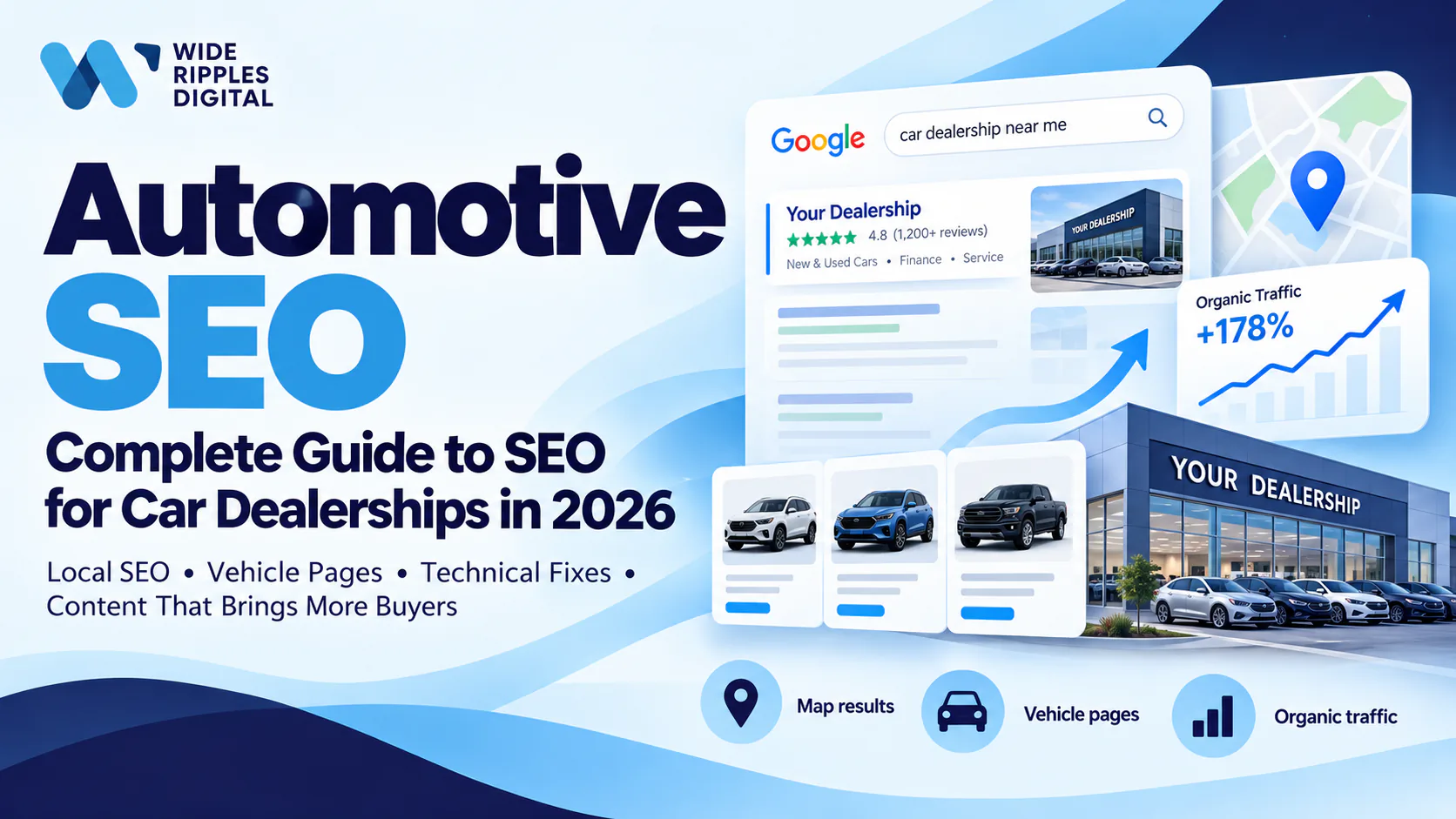
Automotive SEO helps your car dealership show up on Google when local buyers search for a car. Most buyers start online, and they decide which dealers to visit before they leave home.
In 2025, US car buyers spent about seven hours researching and shopping online, according to the Cox Automotive Car Buyer Journey study. Only 7% bought the car fully online. Everyone else still came to a dealer.
So the question is simple. When a buyer near you searches, does your dealership appear? This guide shows you how to make that happen, step by step.
What is automotive SEO?
SEO means search engine optimization. Automotive SEO is SEO for businesses that sell or service vehicles.
The goal is to rank higher on Google for searches that bring buyers to you. Some examples:
- "used Toyota Camry near me"
- "Ford dealer in Dallas"
- "best SUV for families 2026"
- "car service center open now"
Paid ads stop working the day you stop paying. SEO keeps bringing visitors after the work is done. Good rankings also build trust, because many buyers trust the top results more than ads.
You will also see other names for the same work: car dealership SEO, car dealer SEO, dealer SEO and SEO for car dealerships. They all mean one thing: getting a dealership found on Google.
Why SEO for car dealerships matters in 2026
Three changes make SEO more important for dealers this year.
Buyers compare more before they call
Shoppers visit several websites, read reviews and check prices before they contact anyone. If your pages do not show up, you are not on their list.
Google shows AI answers at the top
Google's AI Overviews now answer many questions above the normal results. These answers pull facts from websites that are clear, accurate and trusted. Good SEO makes your site a likely source.
Local results decide the visit
Car buying is local. Most buyers want a dealer within a short drive. The map results on Google often get more clicks than any website link below them.
The four parts of automotive SEO
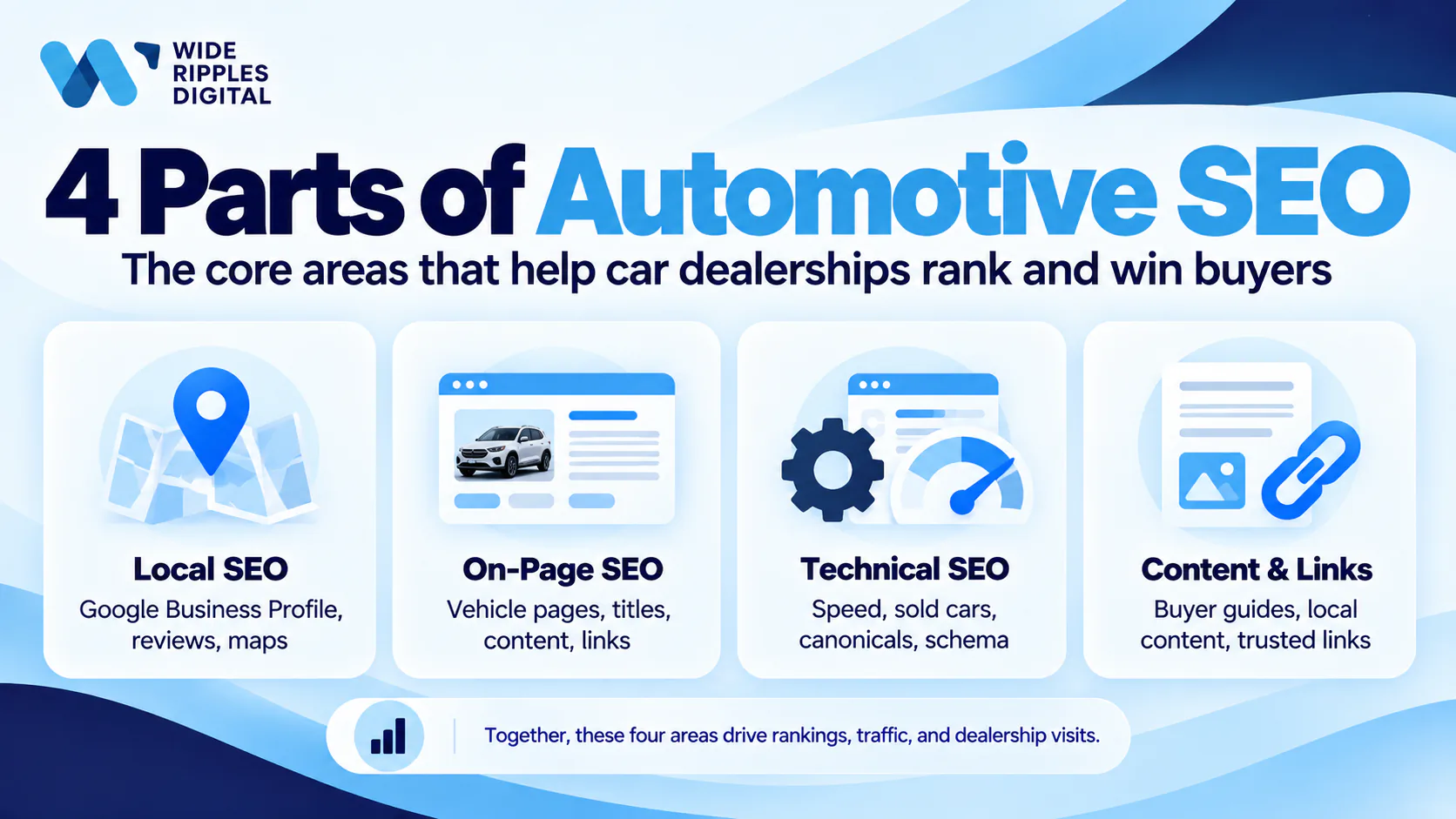
Automotive SEO has four main parts. Local SEO gets you into map results. On-page SEO makes each page easy to find. Technical SEO keeps your site fast and readable for Google. Content and links build trust. The next sections cover each part.
Automotive local SEO: win the "near me" search
Automotive local SEO puts your dealership in Google Maps and the map box at the top of search results. For most dealers, local SEO is the fastest win.
Set up your Google Business Profile correctly
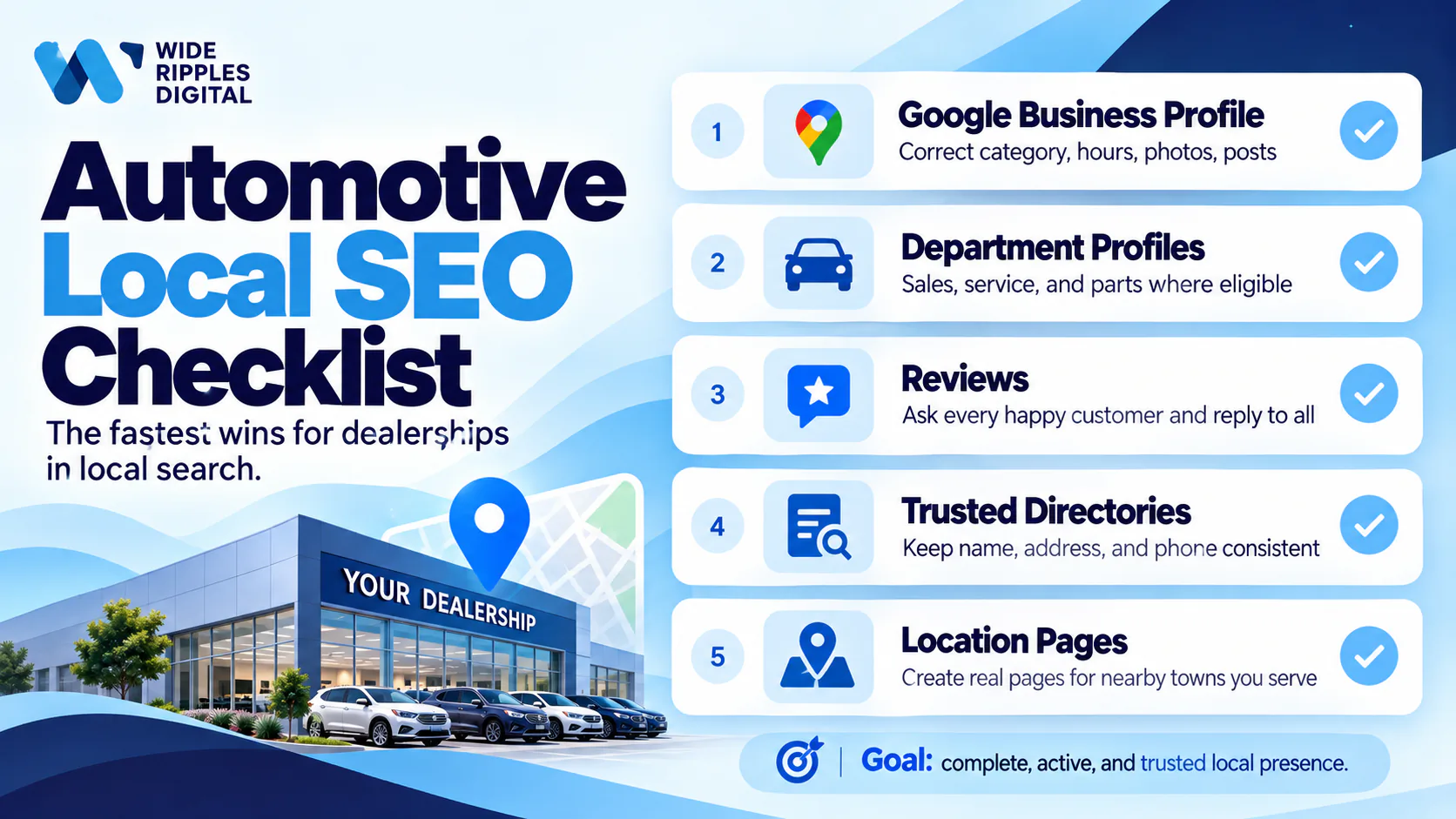
Your Google Business Profile is the box with your name, map, hours and reviews. Buyers often see it before they see your website.
Check these items:
- Categories: Pick the main category that fits best, such as "Car dealer" or "Used car dealer". Add other categories only if they are true, such as "Ford dealer" or "Electric vehicle dealer".
- Name, address and phone: Use the exact same details everywhere online.
- Hours: Keep sales and service hours correct, including holidays.
- Photos: Add real photos of your showroom, lot, team and service area. Update them every month.
- Posts: Share new arrivals, offers and events. Many top dealers post a few times a month.
Goal: a complete, active profile. Google shows active profiles more often. Our Google Business Profile optimization checklist covers every field.
Create separate profiles for each department
Many dealerships have a sales department, a service department and a parts department. Google allows separate profiles for these departments.
Separate profiles help each team rank for its own searches. A buyer searching "oil change near me" should find your service profile, not your sales profile.
Note: In November 2025, Google removed the free "Vehicles for Sale" section from dealer profiles. Your cars now need to rank through your own website pages, or appear through paid Vehicle Listing Ads.
Get more reviews and reply to every one
Reviews are one of the strongest local ranking signals. They also help buyers choose between two dealers.
Ask every happy customer for a review. Send the link by text or email on the day of the sale or service. Reply to every review, good or bad, within a few days.
Keep replies short and polite. For a bad review, say sorry, give a phone number and move the talk offline. Our guide on how to reply to Google reviews has examples you can adapt.
List your dealership in trusted directories
Directories are websites that list businesses, such as Yelp, Cars.com, CarGurus and Edmunds. Google checks these sites to confirm your details.
Make sure your name, address and phone match on every listing. One wrong phone number can confuse both Google and buyers.
Build location pages
If you serve nearby towns, create a page for each one. A page like "Used Cars for Sale Near Plano, TX" helps you rank in that town.
Give each page real local value: driving directions, local reviews and the cars that buyers there choose most. Do not copy the same text and change only the town name. Google may ignore copied pages.
On-page car dealership SEO: make every page easy to find
On-page car dealership SEO means improving the words and layout of each page so Google understands it. Start with the pages that bring in buyers.
Know your key page types
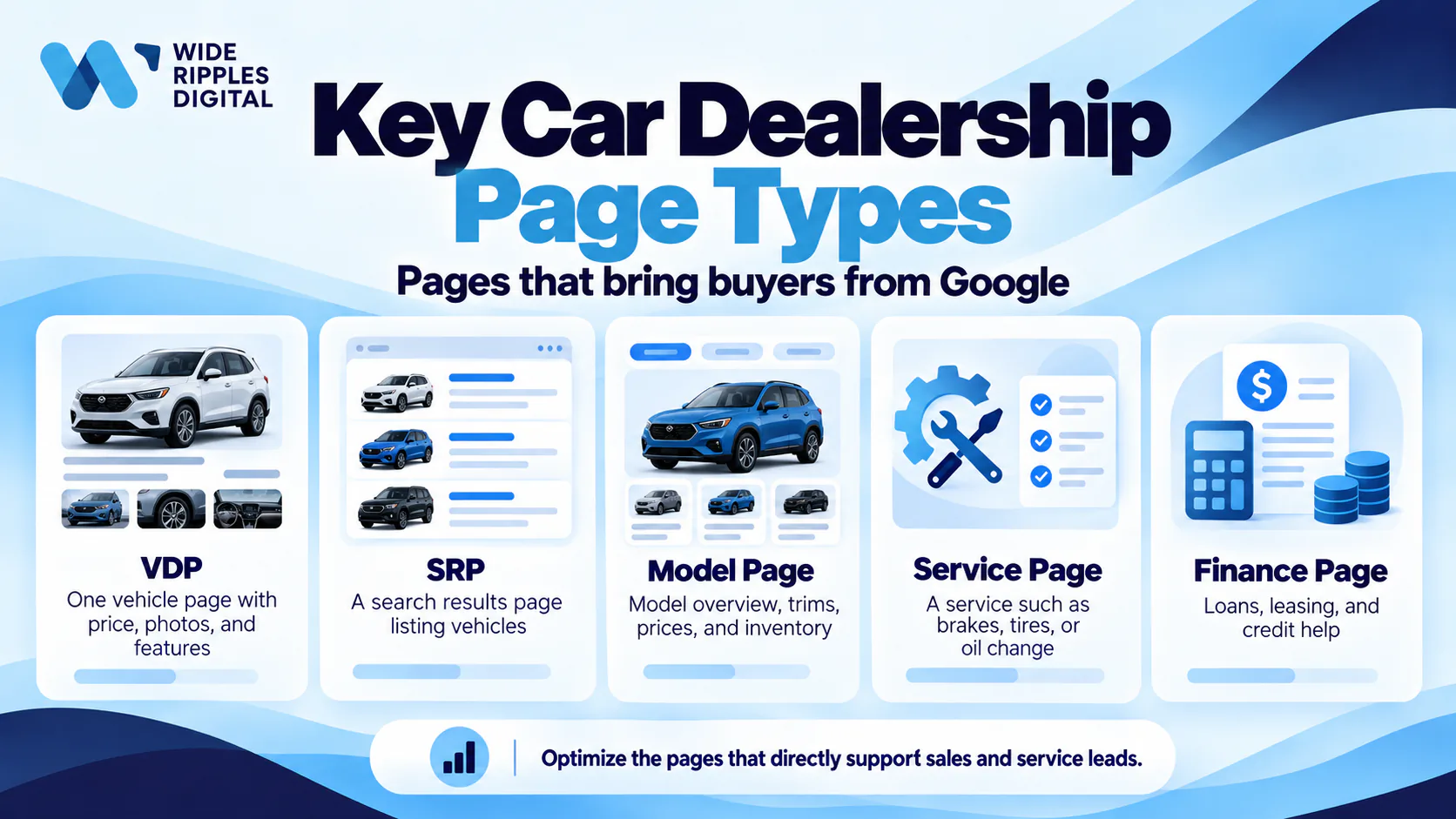
| Page type | What it shows | Example search it can rank for |
|---|---|---|
| Vehicle detail page (VDP) | One car, with price, photos and features | "2024 Honda CR-V EX-L for sale" |
| Search results page (SRP) | A list of cars, such as all used SUVs | "used SUVs in Houston" |
| Model page | One model, with trims, prices and stock | "new Toyota RAV4 Hybrid Phoenix" |
| Service page | One service, such as brakes or tires | "brake repair near me" |
| Finance page | Loans, leasing and credit help | "bad credit car loans Atlanta" |
Write clear titles and descriptions
The page title is the blue link people click on Google. Put the most important words first: year, make, model and city.
Example title: Used 2023 Ford F-150 XLT for Sale in Dallas, TX | Your Dealer Name
The meta description is the short text under the link. Use it to give a reason to click, such as a price, warranty or test drive offer.
Add your own vehicle descriptions
Most dealer websites use the same maker text as hundreds of other dealers. Google sees this as copied content and has little reason to rank it.
Add a few lines of your own to each vehicle page. Mention the condition, service history, local value and why the car is a good buy. Short, unique text beats long, copied text.
Use good photos with alt text
Buyers want many clear photos of the real car. Google also reads photos through their alt text.
Alt text is a short description added to each image. Write it plainly, for example: "2023 Ford F-150 XLT front view, silver". Keep image files small so pages load fast.
Link your pages together
Internal links are links from one page on your site to another. Link model pages to matching stock, and link service pages to your booking form.
Internal links help buyers move around your site. They also help Google find and understand all your pages.
Technical dealer SEO: keep your site fast and clean
Technical dealer SEO fixes the parts of your website that buyers do not see but Google does. Dealer sites have special problems, because cars arrive and sell every day.
Make pages load fast on phones
Most car shoppers search on their phones. A slow page makes them leave before they see a single car.
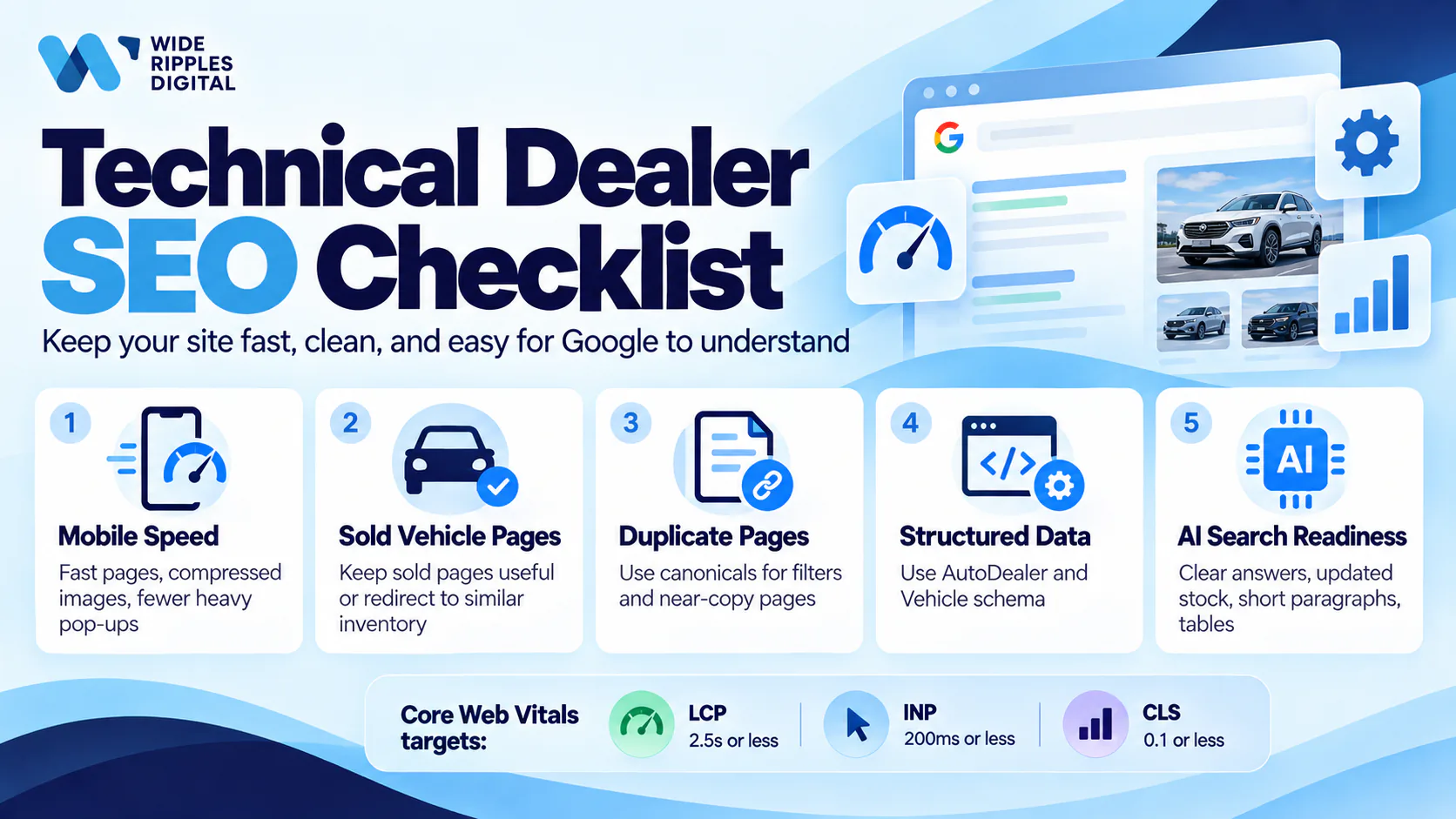
Google measures page experience with three scores, called Core Web Vitals:
| Score | What it checks | Simple meaning | Good score |
|---|---|---|---|
| LCP (Largest Contentful Paint) | How fast the main content appears | Does the page show up quickly? | 2.5 seconds or less |
| INP (Interaction to Next Paint) | How fast the page reacts to a tap or click | Does the page respond quickly? | 200 milliseconds or less |
| CLS (Cumulative Layout Shift) | How much the layout jumps while loading | Does the page stay still? | 0.1 or less |
You can check these scores for free in Google Search Console and PageSpeed Insights. Large photos and too many chat or pop-up tools are the most common causes of slow dealer sites. Our Core Web Vitals guide explains how to improve each score.
Handle sold vehicles the right way
When a car sells, its page often disappears. Buyers who click an old link then see an error page and leave.
Choose one clear rule for sold cars:
- Keep the page for a short time with a "Sold" label and links to similar cars.
- Or send the visitor to a matching model or search page.
- Or remove the page fully if no similar cars exist.
Whatever you choose, apply it to every sold car. Ask your website provider how your system handles this today.
Stop duplicate pages
Filters for price, color and mileage can create thousands of near-copy pages. Google wastes time on these pages instead of your important ones.
Ask your developer to set canonical tags on filter pages. A canonical tag tells Google which version of a page is the main one.
Add structured data
Structured data, also called schema, is hidden code that labels your content for Google. Use it for your dealership details and each vehicle.
Useful schema types include AutoDealer for your business, and Car or Vehicle for each listing. Schema can help your pages show extra details in search results.
Get ready for AI search
AI tools such as Google's AI Overviews and ChatGPT now answer car questions directly. They work best with websites that are clear, accurate and easy to read.
To help AI tools use your content:
- Answer common buyer questions in plain words on your pages.
- Keep prices, hours and stock up to date.
- Use clear headings, short paragraphs and tables.
- Keep the same business details on every website.
Car dealer SEO content and links: build trust
Content answers buyer questions. Links from other websites show Google that people trust you. Car dealer SEO needs both.
Write content buyers search for
Think about the questions your sales team hears every day. Each one can become a page or blog post.
Good topics for dealers:
- Model comparisons, such as "Honda CR-V vs Toyota RAV4"
- Buying guides, such as "How to buy a used car with bad credit"
- Local guides, such as "Best family SUVs for Chicago winters"
- Ownership tips, such as "How often to change tires"
Short videos also help. Many buyers watch walkaround videos before they visit. Add these videos to your vehicle and model pages.
Earn links from local websites
A link from another trusted website works like a vote for your site. Local links help most for dealer SEO.
Ways to earn local links:
- Sponsor a school team, charity run or local event.
- Join your local chamber of commerce.
- Share news with local newspapers, such as a new showroom or a community drive.
- Partner with local businesses, such as insurance agents or driving schools.
Avoid buying links. Google can ignore them or lower your rankings. Our link building strategies guide covers safe ways to earn more.
SEO for automotive businesses beyond dealerships
The same steps work for other car businesses. Repair shops, tire centers, body shops, detailers, parts stores and rental companies all compete in local search.
Each business needs a slightly different focus:
| Business type | Main focus | Example search |
|---|---|---|
| Repair shop | Service pages and reviews | "transmission repair near me" |
| Body shop | Photos of past work and insurance details | "collision repair Orlando" |
| Parts store | Product pages with part numbers | "brake pads for 2019 Civic" |
| Car rental | Location pages and prices | "car rental near Miami airport" |
| Detailing service | Before-and-after photos and packages | "ceramic coating near me" |
Whatever your business, good SEO for automotive businesses starts with the same base: a complete Google Business Profile, a fast website and pages that answer real buyer questions.
How to measure your automotive SEO results
Rankings are only part of the picture. You need to know if SEO brings calls, forms and showroom visits.
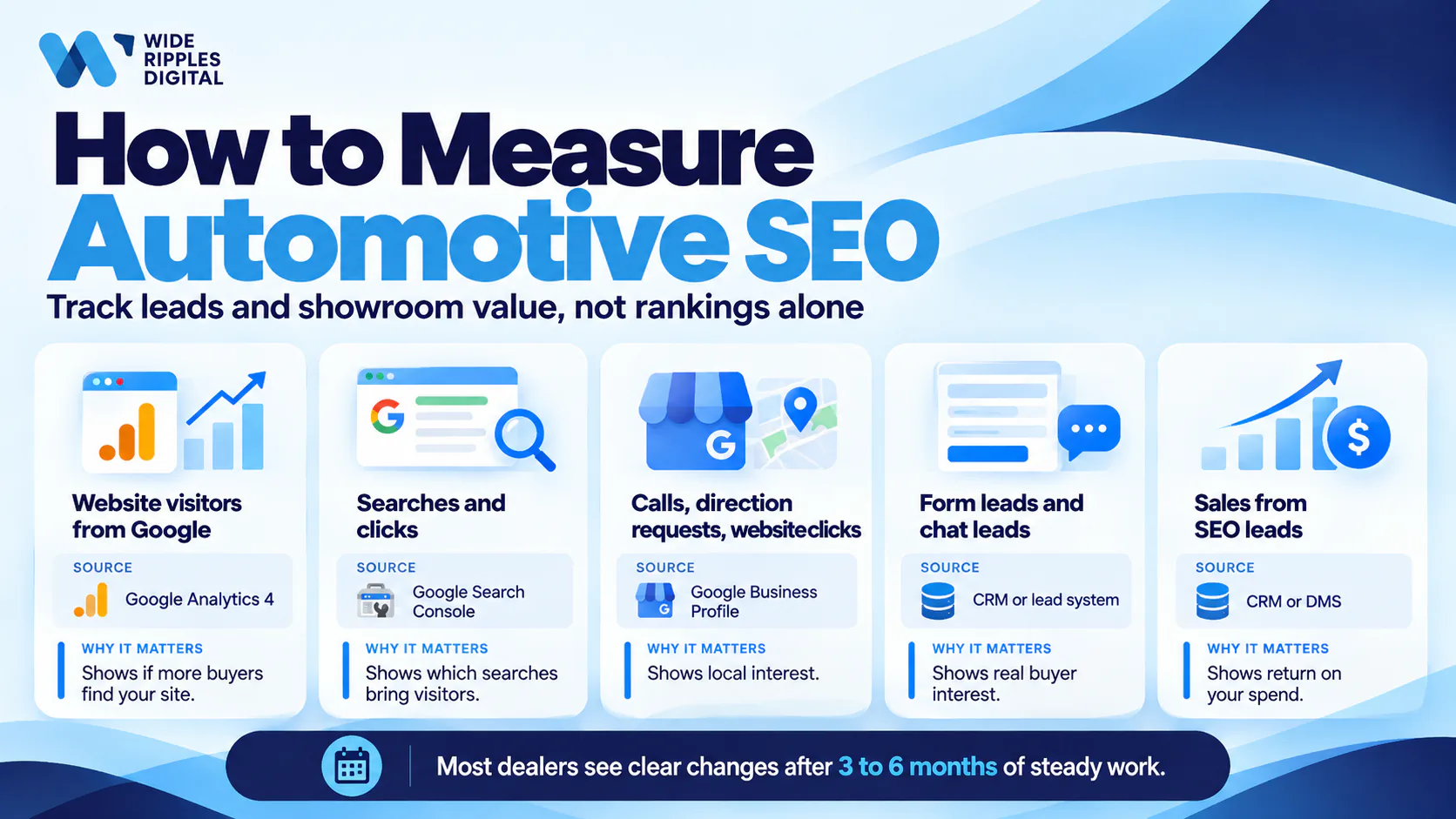
Track these numbers every month:
| What to track | Where to find it | Why it matters |
|---|---|---|
| Website visitors from Google | Google Analytics 4 | Shows if more people find your site |
| Searches and clicks | Google Search Console | Shows which searches bring visitors |
| Calls, direction requests and website clicks | Google Business Profile performance | Shows local interest |
| Form leads and chat leads | Your CRM or lead system | Shows real buyer interest |
| Sales from SEO leads | Your CRM or DMS | Shows return on your spend |
If you are new to analytics, GA4 for beginners explains what to set up first.
SEO takes time. Most dealers see clear changes after three to six months of steady work. Local profile fixes often show results sooner.
Common car dealership SEO mistakes
Avoid these mistakes, which hold back many dealer websites:
- Copying maker descriptions. Your pages look the same as hundreds of other dealers.
- Ignoring reviews. Unanswered reviews look like no one is listening.
- Wrong details online. Old phone numbers or hours send buyers to the wrong place.
- Slow pages. Heavy photos and too many pop-ups make buyers leave.
- Broken sold-car pages. Error pages waste visitors who were ready to buy.
- No tracking. Without data, you cannot tell what works.
Start winning more car buyers from Google today
Automotive SEO does not need to be complex. Start with your Google Business Profile and reviews. Then fix your vehicle pages, speed and sold-car pages. Add helpful content and local links over time.
Buyers still visit dealers to buy. SEO makes sure they visit you first.
Want a team to do this work for you? Wide Ripples Digital is a digital marketing agency in Mississauga, serving businesses in Canada, the USA and the UAE. We handle SEO, local SEO, Google Business Profile management, review generation, fast website builds and Google ads, all under one plan.
You get one senior contact and a monthly report in plain language. We report on cost per qualified lead, not just rankings. Your accounts, profiles and website always stay in your name, and there is no lock-in contract.
Every project starts with a free two-week audit of your rankings, website speed, reviews and tracking. You keep the findings, whether you hire us or not. Call +1 416-668-6969 or book your free audit.
Automotive SEO FAQs
How long does automotive SEO take to show results?
Most dealers see clear changes in three to six months. Google Business Profile fixes and new reviews can help sooner, often within a few weeks. Content and links take longer but keep working for years.
Should my dealership do SEO or paid ads first?
You can do both. Paid ads bring visitors right away but stop when you stop paying. SEO builds slowly and keeps bringing visitors for free. Many dealers use ads for quick sales and SEO for long-term growth.
Can I do car dealership SEO myself, or do I need an agency?
You can handle the basics yourself: your Google Business Profile, reviews and simple page updates. Technical work, such as speed, schema and sold-car pages, usually needs a developer or an SEO agency. Many dealers do the local basics in-house and hire help for the rest.
Is the SEO from my dealer website provider enough?
Usually not on its own. Most providers give every dealer the same templates and maker text, so many sites look alike to Google. Add your own vehicle descriptions, local pages and content to stand out.
Does SEO work for small independent used car dealers?
Yes. Local search often helps small dealers most, because Google shows nearby businesses first. A strong profile, steady reviews and clear vehicle pages can help a small lot compete with large dealer groups in its own area.
Disclaimer: The information provided in this blog is for general informational purposes only. For professional assistance and advice, please contact experts.

Written by Umer Kureshi
Search and Performance Lead
Umer leads search and performance at Wide Ripples Digital and heads SEO and marketing at Bestax. His work covers technical SEO, content strategy, internal linking and local search, and he builds each plan around the gaps in a client’s niche rather than a copied playbook. On one campaign that approach took a site from 30 clicks a day to 12,953 in a single day.
Reviewed by Usman Shafique, Organic Growth Strategist
Last updated October 24, 2026 · Umer Kureshi on LinkedIn