What Is Anchor Text? Internal & External Link Best Practices for 2026

Anchor text is the clickable wording inside a link. It tells readers and search engines what to expect after the click. In 2026, good anchor text is less about stuffing keywords into blue words and more about making your website feel like a smart tour guide instead of a confusing shopping mall map.
That sounds small, but it is not. One vague link can hide a useful page, while one clear link can move a reader from curiosity to confidence. Search engines also use links to discover pages and understand how they relate to each other, which is why anchor text SEO still matters when it is handled with care, context and common sense.
Think of every link as a tiny signpost. If the sign says "click here", nobody knows whether they are heading to a pricing guide, a service page, a recipe for banana bread, or a suspicious corner of the internet where pop-ups wear sunglasses. If the sign says "SEO and content strategy services", the reader knows what is behind the door before they open it.
What is anchor text?
When people ask "what is anchor text", the simple answer is this: it is the visible, clickable part of a hyperlink. In HTML it sits between an opening and closing anchor tag, and the destination sits inside the href attribute. MDN describes the HTML anchor element as the element that, with its href attribute, "creates a hyperlink to web pages, files, email addresses, locations in the same page, or anything else a URL can address." Google calls the same wording anchor text or link text.
Take the sentence "Read our SEO services for Canadian businesses." The clickable phrase could be "SEO services for Canadian businesses". That phrase is the anchor in text. The destination is the page the reader lands on after clicking it.
The big mistake is treating anchor text as a magic spell. It is not a spell. It is a label. A good label says what is inside the box. A bad label says "stuff" and hopes everyone claps.
| Type | Example | Why it works or fails |
|---|---|---|
| Clear anchor | local SEO services in Canada | Specific, natural, and gives the reader a fair preview. |
| Vague anchor | click here | Says nothing about the destination, so the surrounding sentence has to do all the work. |
| Overcooked anchor | best anchor text optimisation keyword anchor text seo agency 2026 | Reads like a robot fell into a keyword bucket. |
| Branded anchor | Wide Ripples Digital | Useful when the brand itself is the destination or the context. |
Why anchor text still matters in 2026
Anchor text helps three groups at once: readers, search engines, and your future self when you are auditing a website at 11:43 p.m. with cold coffee and eight browser tabs open.
Google's link best practices, last updated 10 December 2025, say Google uses links "as a signal when determining the relevancy of pages and to find new pages to crawl." The same page asks for crawlable links and anchor text that is "descriptive, reasonably concise, and relevant to the page that it's on and to the page it links to."
Here is the practical translation. If your website has ten blog posts about SEO but none of them clearly point readers to your main SEO service page, you have built a library with no librarian. The information exists, but the next step is buried. Good internal anchors fix that by showing readers where to go next and showing search engines which pages matter most.
We see this on our own site too. Services, industries, blog posts, portfolio work and newer search topics like GEO all live in separate sections. The job is not to sprinkle links everywhere like confetti. It is to connect the right pages using the language a real buyer uses while comparing options, checking proof and deciding whether to ask for help. From this article, the natural destinations are our SEO and content strategy services, our content marketing services, the Wide Ripples portfolio and our generative engine optimisation services.
The four jobs of a good link
A strong link has four jobs. Failing one does not make it terrible, but it is probably leaving clarity on the table.
- It tells the reader what they will get after clicking.
- It helps search engines understand the topic relationship between two pages.
- It moves people from information to action without making them feel pushed.
- It supports site architecture by connecting supporting content to money pages, proof pages and next-step pages.
The most underrated job is the third one. Internal links are not just for rankings. They are for momentum. A reader who has just learned the basics of anchor text is rarely ready to book a call, but they might be ready to read a service page, check a portfolio example or see how content strategy is handled. That path matters.
The grocery aisle rule. If the link label would make sense as an aisle sign in a store, it is probably good. If it would make shoppers stop and say "what is that supposed to mean?", rewrite it. Google puts the same test more formally: good anchor text makes sense when you read only the anchor text, out of context. MDN gives the same advice for accessibility, because screen reader users often jump through a list of every link on the page.
Types of anchor text you should use without making it weird
Most anchor text guides list the types and then disappear into theory. Here is the version you can actually use when writing or auditing a page.
| Anchor type | Example | Best use | Watch out for |
|---|---|---|---|
| Exact match | anchor text | When the exact phrase is natural and matches the page topic. | Repeating it every time like a parrot with a spreadsheet. |
| Partial match | how anchor text affects SEO | Often the most natural option in blog content. | Padding. Keep it readable. |
| Branded | Wide Ripples Digital | Brand mentions, citations, case studies and home page links. | Weak when the reader needs topic context. |
| Descriptive | SEO services for local businesses | Service pages and comparison sections. | A destination that does not really cover the promise. |
| URL anchor | wideripples.com | Occasional references, printed material, simple citations. | Usually less helpful inside blog body copy. |
| Generic | learn more | Button labels where the heading and copy around them explain the action. | Google lists "click here" and "read more" as examples to avoid, and repeated generic links with different destinations confuse everyone. |
| Image anchor | Alt text on a linked image | Linked logos, banners and visual CTAs. | Missing alt text. Google uses the image's alt attribute as the anchor text. |
Internal anchor text optimisation: build roads, not spaghetti
Internal links go from one page on your website to another page on the same site. This is where most businesses have the biggest easy win, because you control the wording, the destination, the placement and the purpose. External links are useful too, but internal linking is your own house, so stop letting the furniture block the hallway. It is also a core part of on-page SEO, not an afterthought.
A practical internal anchor system starts with page roles. Every page should know whether it is a service page, a support article, a proof page, a comparison page, a local page or a contact page. Once each page has a role, anchor text gets easier, because links can point readers to the logical next step.
| Page role | Best anchor style | Example from our site |
|---|---|---|
| Blog post | Educational anchor that deepens the topic | internal linking strategy for SEO blogs |
| Service page | Commercial anchor that clarifies the offer | SEO and content strategy services |
| Portfolio page | Proof-based anchor | see real SEO and web projects |
| GEO page | Future search anchor | AI visibility and GEO services |
| Contact page | Action anchor | book a free audit |
Here is the part you will not find in most generic advice: do not build internal links only by keyword. Build them by reader anxiety. Someone reading about anchor text is quietly wondering "am I damaging my SEO?", "should I link to service pages from blogs?", "how many links are too many?" and "what words can I use without sounding spammy?" Your anchors should answer those hidden worries.
So a better internal link is not always "anchor text seo". It might be "fix weak internal links before publishing another blog" if the destination explains an SEO audit or content strategy service. That phrase connects to a real problem, not just a keyword.
External anchor text optimisation: be natural or be nervous
External links go from your site to another website, or from another website back to yours. For outbound links the rule is simple: link to official, useful and trustworthy sources when they make the reader smarter. For inbound links the rule is less glamorous: you do not fully control how other sites link to you, and trying too hard to control it can slide from strategy into spam.
Google's spam policies define link spam as links intended to manipulate rankings, and the examples specifically include "links with optimized anchor text in articles, guest posts, or press releases distributed on other sites." In plain English, paying for a pile of guest posts that all use the same perfect commercial anchor is not a clever treasure map. It is a flare gun.
A healthy backlink profile usually looks mixed. Some anchors are branded. Some are page titles. Some are plain URLs. Some mention the topic. That is normal, because real people link in different ways. When every external anchor looks like it was written from the same SEO spreadsheet, the pattern itself becomes suspicious. If you want links that hold up, our guide to link building strategies that still work in 2026 covers the earning side, and our off-page SEO services handle it for you.
External link gut check. If you would be embarrassed to explain how a link was placed, do not build your strategy around it. Good link earning should survive daylight, a client review and a slightly grumpy quality rater.
Anchor text optimisation keyword strategy without keyword stuffing
The phrase "anchor text optimisation keyword" is awkward, but the idea behind it is useful: you want anchor wording to support keyword relevance without stuffing exact-match phrases into every link. The best approach is a controlled anchor vocabulary for each important page.
For each target page, agree five to eight approved anchor variations. Writers get choices, and the site stays consistent. A page about SEO services might use "SEO and content strategy services", "technical SEO support", "local SEO plan", "SEO services for Canadian businesses" and "content strategy that supports rankings". The anchors are related, but they do not all shout the same phrase into the void.
This is where anchor planning becomes useful for teams. Instead of telling writers to "add internal links", give them a mini map: the target page, the link's purpose, the allowed anchors and the pages that should link to it. That turns linking from guesswork into an editorial system.
| Target page | Main purpose | Anchor examples | Avoid |
|---|---|---|---|
| SEO service page | Turn educational readers into service prospects | SEO services in Canada; content strategy for organic traffic; technical SEO help | best cheap SEO agency everywhere |
| Content marketing page | Move readers from blog advice to content support | content marketing services; blog strategy that produces enquiries; content planning support | write blogs fast |
| Portfolio page | Add proof when readers need trust | see Wide Ripples projects; real SEO and web work; portfolio examples | amazing results here |
| GEO page | Connect modern search topics to AI visibility | GEO services; AI search visibility; structure content for answer engines | rank in ChatGPT instantly |
The 2026 anchor text SEO checklist
Run through this before publishing a blog, service page or landing page. It is simple enough for writers and strict enough for SEO teams.
- Every important page has a few relevant internal links pointing to it from related pages.
- The clickable wording explains the destination without relying on the sentence before it.
- Exact-match anchors appear only where they sound natural.
- No page repeats links to the same destination with the same anchor over and over.
- Important links are crawlable HTML
<a>elements withhrefattributes, not JavaScript-only click events. - Linked images have useful alt text, because the alt text becomes the anchor when there is no visible text.
- Outbound links point to official or genuinely useful sources, not thin filler pages.
- Sponsored, paid, affiliate or user-generated links carry the right
relvalue (sponsored,ugcornofollow). Our guide to checking dofollow and nofollow links shows how to audit them. - Internal links support the buyer journey, not just keyword targeting.
- Buttons and generic CTAs make sense because the copy around them explains the action.
Where to place links inside a blog
Placement matters because people scan before they commit. A link buried after ten paragraphs can still work, but it will not help the reader who needed the context early. In most helpful posts, links belong in three zones.
- Early context link: one internal link near the beginning, when it genuinely helps the reader understand the topic or the next step. Do not force a sales page into the first paragraph because someone said links near the top are magic.
- Middle support link: links inside explanations, where the reader is learning and comparing. This is the best spot for guides, service details, examples and case studies.
- End action link: a clear CTA once the article has earned trust. A reader who has reached the end deserves a useful next step, not a vague "contact us" tossed in like a napkin.
For this article, a natural end CTA would be: "Need help fixing internal links, content structure and rankings? Explore our SEO and content strategy services or claim a free audit." Clear, helpful and tied to the reader's problem.
Common anchor text mistakes that make websites feel lost
- Using "click here" everywhere. Google names it as an example of anchor text to avoid, and a page with five "learn more" links forces readers and search engines to guess what each one does.
- Linking the same page too often in one article. Repeating the same link every few paragraphs feels desperate. One strong contextual link and one CTA usually beat six anxious links wearing different hats.
- Using the same exact-match anchor across the whole site. It makes your internal linking look unnatural and boring. Vary anchors with the sentence, the reader's intent and the page's role.
- Linking to weak destination pages. Anchor text cannot save a thin page. If the destination does not deliver what the link promised, the anchor becomes a tiny betrayal.
- Forgetting old content. Many sites keep publishing while older posts sit quietly with no links to newer service pages. Refreshed and relinked, old content becomes a traffic bridge.
- Treating external anchors like remote controls. You can suggest how partners cite you, but a natural backlink profile should not look perfectly choreographed. Real web references are messy in a healthy way.
A practical anchor text workflow for service businesses
Here is the workflow I use when a website has plenty of content but the internal linking feels like someone threw noodles at a wall and called it architecture.
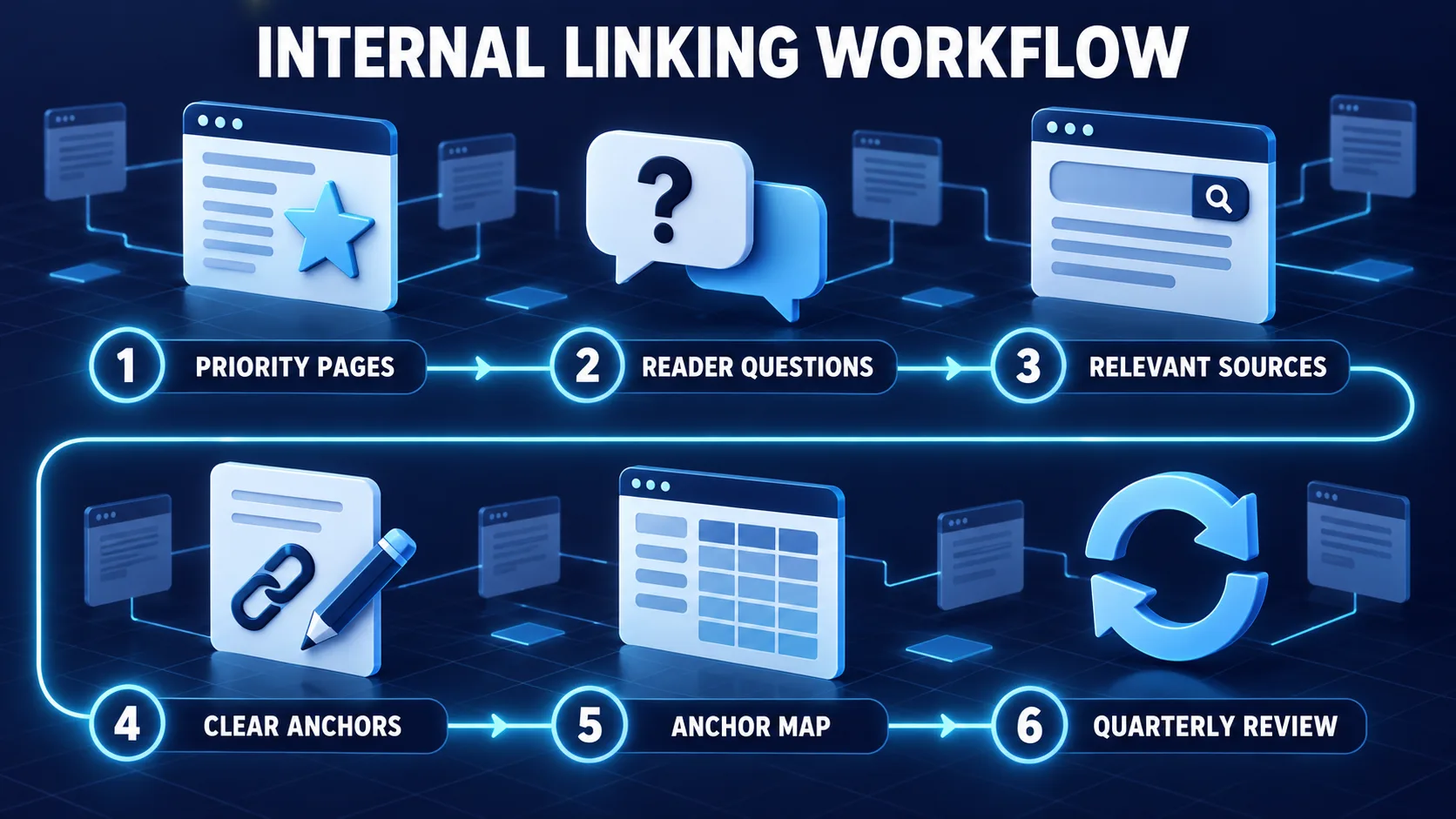
- Pick the pages that make money or build trust. Usually service pages, location pages, portfolio pages, comparison pages and strong lead magnets. They deserve more internal support than random old posts.
- List the reader questions each page answers. Do not start with keywords. Start with decisions. What does the reader need to believe before this page is useful?
- Find existing pages where those questions come up. Search your own site for related terms. A post about local SEO might naturally link to Google Business Profile support, campaign tracking or content strategy.
- Write anchors as promises. The anchor should promise exactly what the destination delivers. Case study? Use proof language. Service page? Use solution language.
- Keep a small anchor map. A simple spreadsheet with the target URL, page role, approved anchors and source pages stops messy duplication as the site grows.
- Review quarterly. Anchor text is not a one-time job. New pages change the map, old pages gain authority, and some links go stale as offers change.
A tip you will not find in most guides. Use anchor text to connect emotional stages, not only topics. Early-stage anchors should educate, middle-stage anchors should compare, and late-stage anchors should reduce risk with proof, pricing, process or consultation links.
Mini examples: bad anchor, better anchor, best anchor
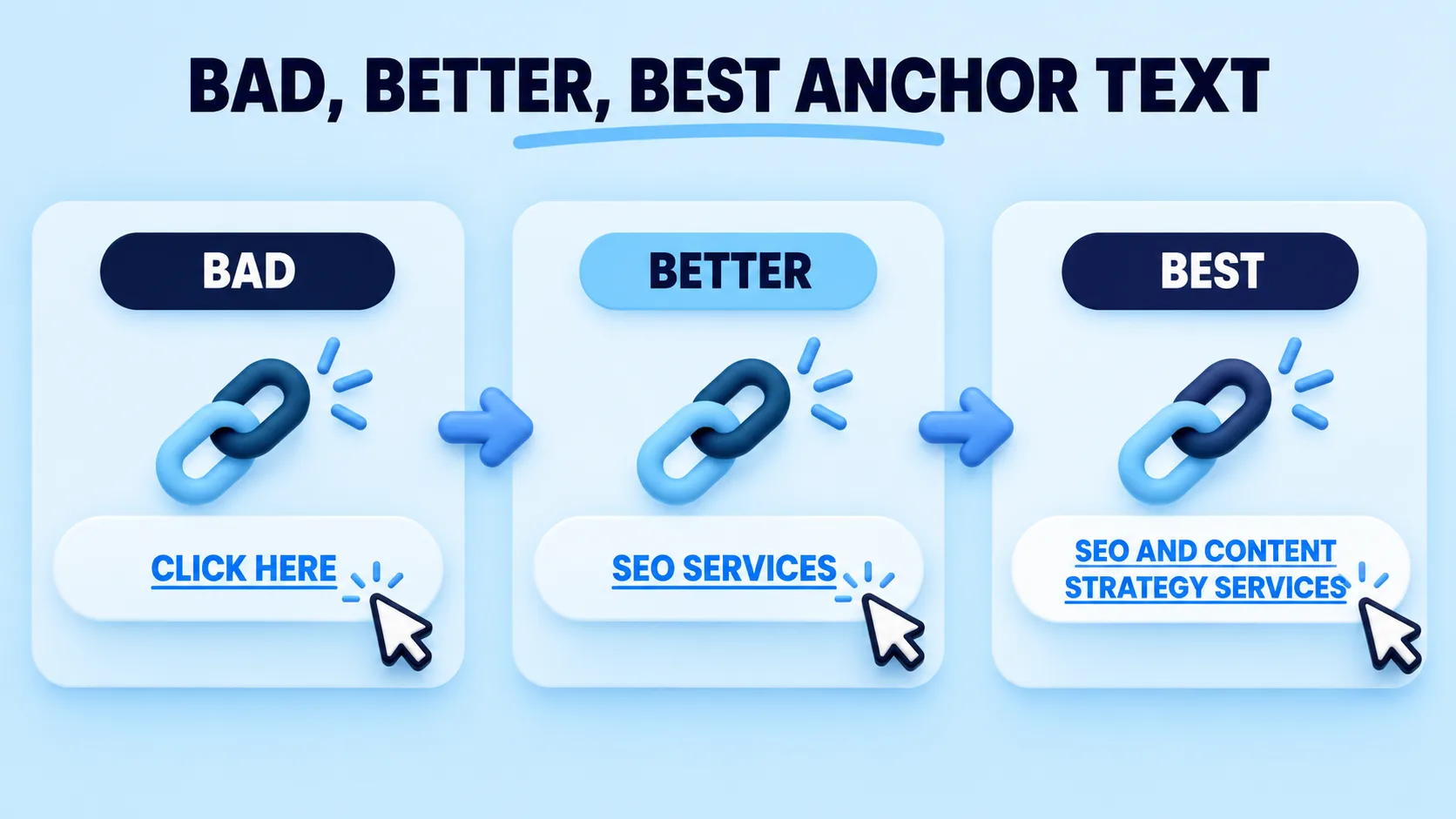
| Scenario | Bad | Better | Best |
|---|---|---|---|
| Linking from a blog to an SEO service page | click here | SEO services | SEO and content strategy services for Canadian businesses |
| Linking to a case study page | results | our portfolio | see real SEO and web projects from Wide Ripples |
| Linking to a GEO page | AI stuff | GEO services | structure your content for AI search visibility |
| Linking to a contact CTA | submit | contact us | claim a free website and SEO audit |
How many internal links should a page have?
There is no universal number. A 700-word service page and a 3,000-word guide should not share a linking pattern. The better question is: how many links help the reader without interrupting them?
As a working rule for service business blogs, include a small number of highly relevant internal links rather than one in every paragraph. A short article might need three to five. A detailed guide might need eight to fifteen. The exact count matters less than relevance, clarity and whether each link supports the article's purpose.
If a page looks like a Christmas tree made of blue underlined words, pull back. If a page explains a topic beautifully but gives the reader no next step, add links. Balance wins.
How to measure whether your anchor text is working
You do not measure anchor text by staring lovingly at the links. Measure it through behaviour and search outcomes.
- Use Google Search Console to see whether target pages gain impressions and clicks after stronger internal linking.
- Use analytics to check whether readers click from blog posts to service, portfolio and contact pages.
- Track assisted conversions, because a blog link rarely gets full credit even when it started the journey.
- Review crawl reports for orphan pages, broken links, redirect chains and important pages with too few internal links. Our SEO audit guide covers what to check first.
- Check whether your most-linked pages match your business priorities. If your weakest old blog gets more internal support than your main service page, your website is voting for the wrong mayor.
We run into the same problem in our campaign tracking and reporting work: the risk of measuring the wrong actions. If you count page views but ignore calls, form submissions and assisted journeys, you will undercount what internal links are really worth.
Anchor text for AI search and voice search
In 2026, link clarity also matters because search is no longer just a list of ten blue links. AI answers, voice results and search summaries favour content that is easy to understand, easy to cite and easy to connect. Clean anchors help reinforce those relationships.
That does not mean writing anchors for robots. It means using consistent names for your services, topics, locations and proof pages. If one page calls the service "SEO", another calls it "organic growth magic" and a third calls it "search fairy dust", you have created a branding comedy show. Fun, yes. Clear, no.
For AI visibility, descriptive anchors help connect entities. A page about content marketing can link to "SEO and content strategy services", while a page about generative engine optimisation can link to "AI search visibility and structured content". Those anchors help people and machines see how your topics fit together. Our guide on how to structure content for AI answers goes further.
Final thoughts: anchor text is small copy with big responsibility
Anchor text looks tiny until you realise it guides users, helps search engines, supports site architecture and nudges readers toward the next useful page. The goal is not to make every clickable phrase perfect. It is to make every link honest, clear and helpful.
For 2026 the formula is simple: use crawlable links, write natural anchors, avoid spammy repetition, connect pages by reader intent, and keep your internal linking map aligned with your business goals. Do that, and your links stop being decoration. They become a quiet sales team working in the background, without a name tag or a commission.
Need help with your internal links?
We help Canadian businesses turn messy websites into cleaner search systems through SEO, content strategy, GEO, tracking and conversion-focused web support. See how we approach it on our SEO and content strategy services page.
Not sure which links on your site are helping and which are just decoration? Claim a free SEO audit and we will start with the links your site already has.
Frequently asked questions about anchor text
What is anchor text in SEO?
Anchor text is the visible, clickable wording in a hyperlink. In SEO, it helps readers and search engines understand what the linked page is about before the click happens.
What is anchor text in simple words?
Anchor text is the word or phrase you click to open another page. If the link says "local SEO services", those words are the anchor text.
Is anchor text still important in 2026?
Yes. Google still uses links to find pages and judge relevance, and its link guidance asks for descriptive, concise anchor text. It works best when it is natural and useful rather than stuffed with keywords.
What is the difference between internal and external anchor text?
Internal anchor text links to another page on your own website. External anchor text links to a different website, or appears when another site links back to yours.
How do I choose the best anchor in text for a blog?
Choose wording that matches the reader's next question and clearly describes the linked page. The best anchor in text reads as part of the sentence, not as a forced SEO insert.
Should I use exact match anchor text?
You can when it sounds natural, but do not use the same exact phrase every time. Mix exact, partial, branded and descriptive anchors.
What is anchor text optimisation keyword planning?
It means creating a set of natural anchor variations for each important page, so writers link consistently without repeating the same keyword too often.
How many internal links should a blog post have?
As many as genuinely help the reader. A short post might need three to five internal links, while a long guide might need eight to fifteen if each one supports the reader's journey.
Is "click here" bad anchor text?
It is weak. Google's link best practices list "click here" and "read more" as examples to avoid, because they say nothing about the destination. Descriptive anchors tell users and search engines what the linked page covers.
Can too much anchor text hurt SEO?
Repeated or manipulative anchors can look unnatural and make pages harder to read. Google's spam policies specifically name links with optimized anchor text in distributed articles, guest posts and press releases. Relevance and variety are safer than repetition.
What is anchor text SEO for service businesses?
It means linking helpful blogs, location pages, service pages, proof pages and contact pages with clear wording that guides people toward the right next step.
Should external backlinks use my exact keyword?
Not all of them. A natural backlink profile includes branded anchors, page titles, URLs, partial topic anchors and the occasional exact match. Too much control looks suspicious.

Written by Umer Kureshi
Search and Performance Lead
Umer leads search and performance at Wide Ripples Digital and heads SEO and marketing at Bestax. His work covers technical SEO, content strategy, internal linking and local search, and he builds each plan around the gaps in a client’s niche rather than a copied playbook. On one campaign that approach took a site from 30 clicks a day to 12,953 in a single day.
Last updated September 21, 2026 · Umer Kureshi on LinkedIn