Google Adds More Links to AI Mode and AI Overviews: What It Means for Your Traffic
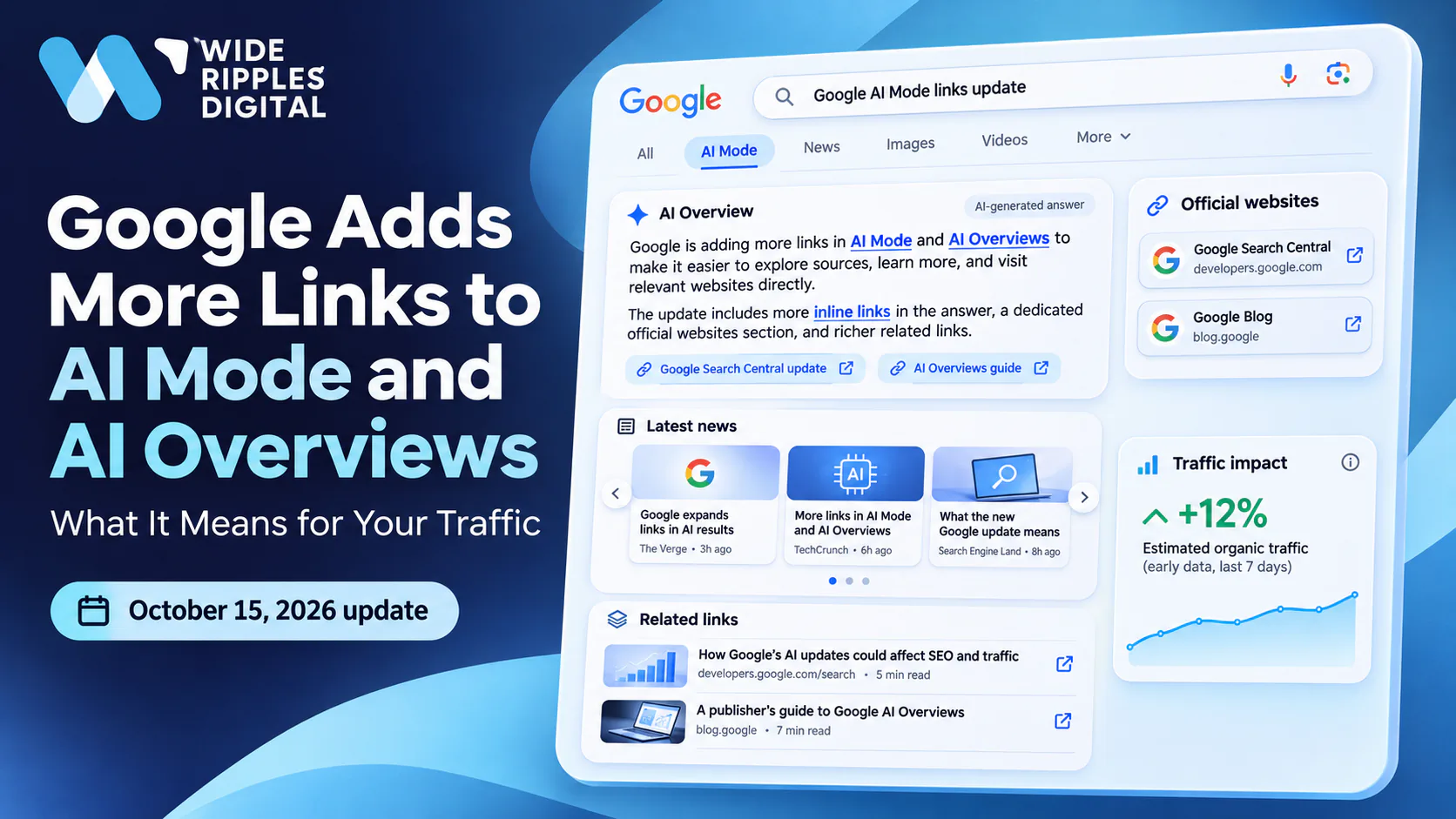
Google AI Mode links are about to become easier to see and click. On October 15, 2026, Google announced five changes that put more links, and more visible links, inside AI Mode and AI Overviews.
The update moves inline links higher in AI answers. It also tests a new section for official websites, expands news carousels and adds thumbnails to related links.
For site owners, the timing matters. Studies have linked AI answers to fewer clicks to websites since they launched. The October update is Google's latest attempt to send some of that traffic back, though it will not help every site equally.
What changed in Google AI Mode links
Google's VP of Product Management, Hema Budaraju, set out the changes in a post on Google's Keyword blog. Some are live now. Others are still tests.
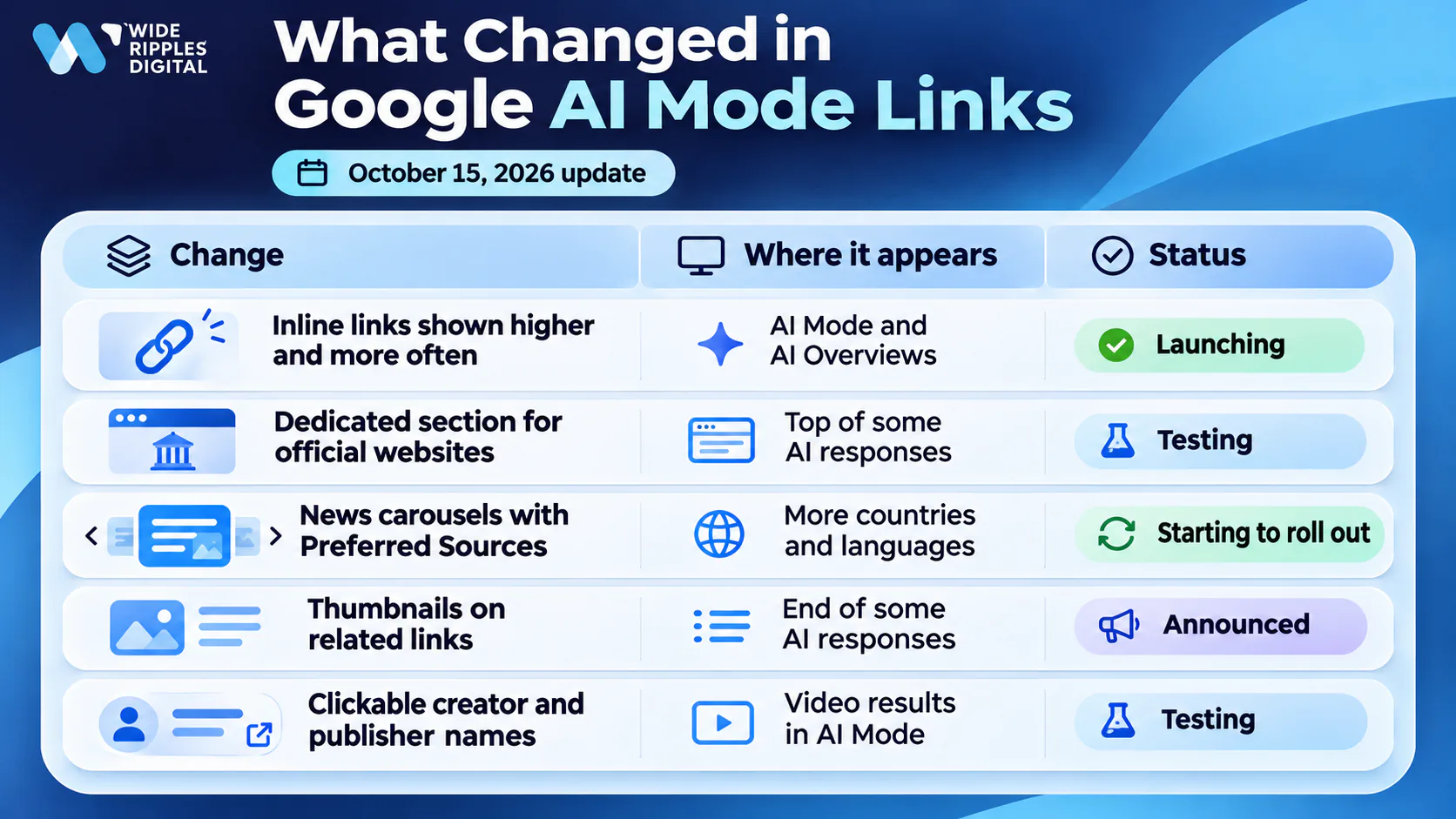
| Change | Where it appears | Status on October 15, 2026 |
|---|---|---|
| Inline links shown higher and more often | AI Mode and AI Overviews | Launching |
| Dedicated section for official websites | Top of some AI responses | Testing |
| News carousels with Preferred Sources | More countries and languages | Starting to roll out |
| Thumbnails on related links | End of some AI responses | Announced, no status given |
| Clickable creator and publisher names | Video results in AI Mode | Testing |
Inline links in AI Mode move higher
Inline links are links placed on words or phrases inside an AI answer. Where a link sits matters. A link near the end of a response often appears after the reader already has the answer they came for.
Google says it has made "continued and substantial increases" to inline links. The new update shows them higher in responses and more often, so key sources are clickable when the reader reaches them.
Google has not published how much higher the links sit, or how many more appear. Expect the change to vary by query.
A new section for official websites
Some questions have one right destination. Renewing a passport, checking a bank's fees or booking with a specific airline all end on an official site.
For these tasks, Google is testing a section at the top of the AI response that lists the official pages. Each link comes with context on why it is useful.
If your business is the official answer to a task, such as your own product, booking or support page, the test could place that page above the AI summary wherever Google shows the section.
News carousels, thumbnails and creator names
News carousels highlight timely articles inside AI answers. Google is rolling them out to more locations and languages. They also highlight Preferred Sources, the news sites a user has chosen to see more often.
Google says the number of people using Preferred Sources has grown more than 7x since the start of 2026. For publishers, a reader who adds you as a Preferred Source is more likely to see you in AI answers. Google does not guarantee a place in every answer.
Two smaller changes complete the update. Related links at the end of some answers gain image thumbnails and a more clickable design. In AI Mode video results, Google is testing clickable creator and publisher names that open their Google Search profiles.
How the update fits Google's 2026 AI search changes
The October update follows several changes for site owners in AI search this year, including an earlier set of link updates in May 2026. Each one gives publishers more visibility or control:
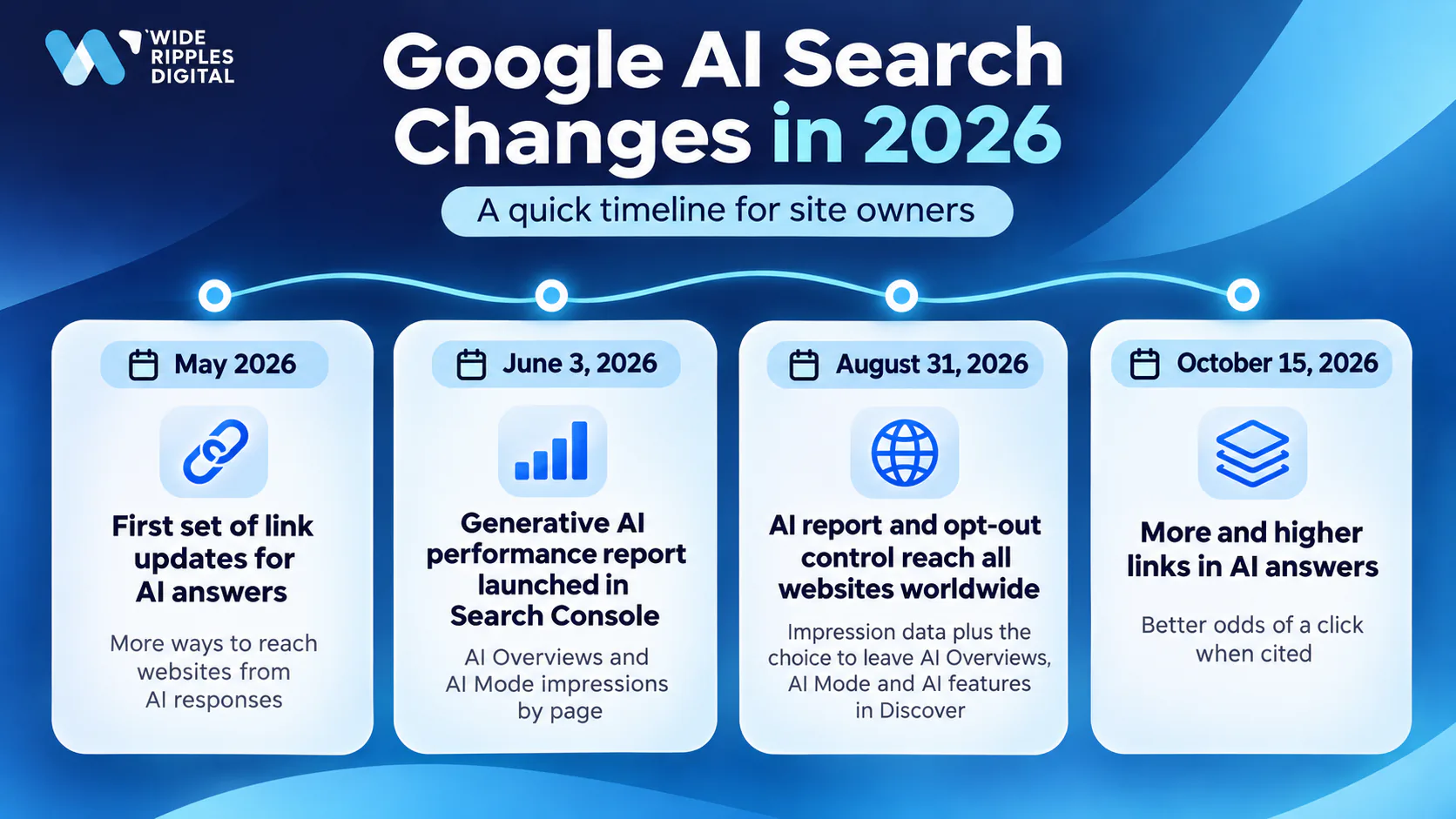
| Date | Change | What it gave site owners |
|---|---|---|
| May 2026 | First set of link updates for AI answers | More ways to reach websites from AI responses |
| June 3, 2026 | Generative AI performance report launched in Search Console | AI Overviews and AI Mode impressions by page |
| August 31, 2026 | AI report and opt-out control reach all websites worldwide | Impression data, plus a choice to leave AI Overviews, AI Mode and AI features in Discover |
| October 15, 2026 | More and higher links in AI answers | Better odds of a click when cited |
Our reading of the pattern: Google wants websites to stay invested in AI Search while regulators and publishers watch the traffic numbers.
What Google AI Mode links mean for your traffic
More links do not automatically mean more clicks. The update improves your odds, but only if your page is the one Google chooses to cite.
Why Google is adding more links now
AI answers are linked to fewer clicks to websites. An Ahrefs study published in February 2026, using December 2025 data, linked AI Overviews to a 58% lower average click-through rate for the top-ranking page.
Publishers and regulators have questioned what AI answers do to website traffic. Nick Fox, Google's SVP of Knowledge and Information, said on X the updates "help you find links to click out and dive deeper."
In our view, the change is commercial as much as editorial. Google needs websites to keep publishing the content its AI answers rely on.
Who gains from the new AI Overviews links
Four types of sites stand to benefit most:
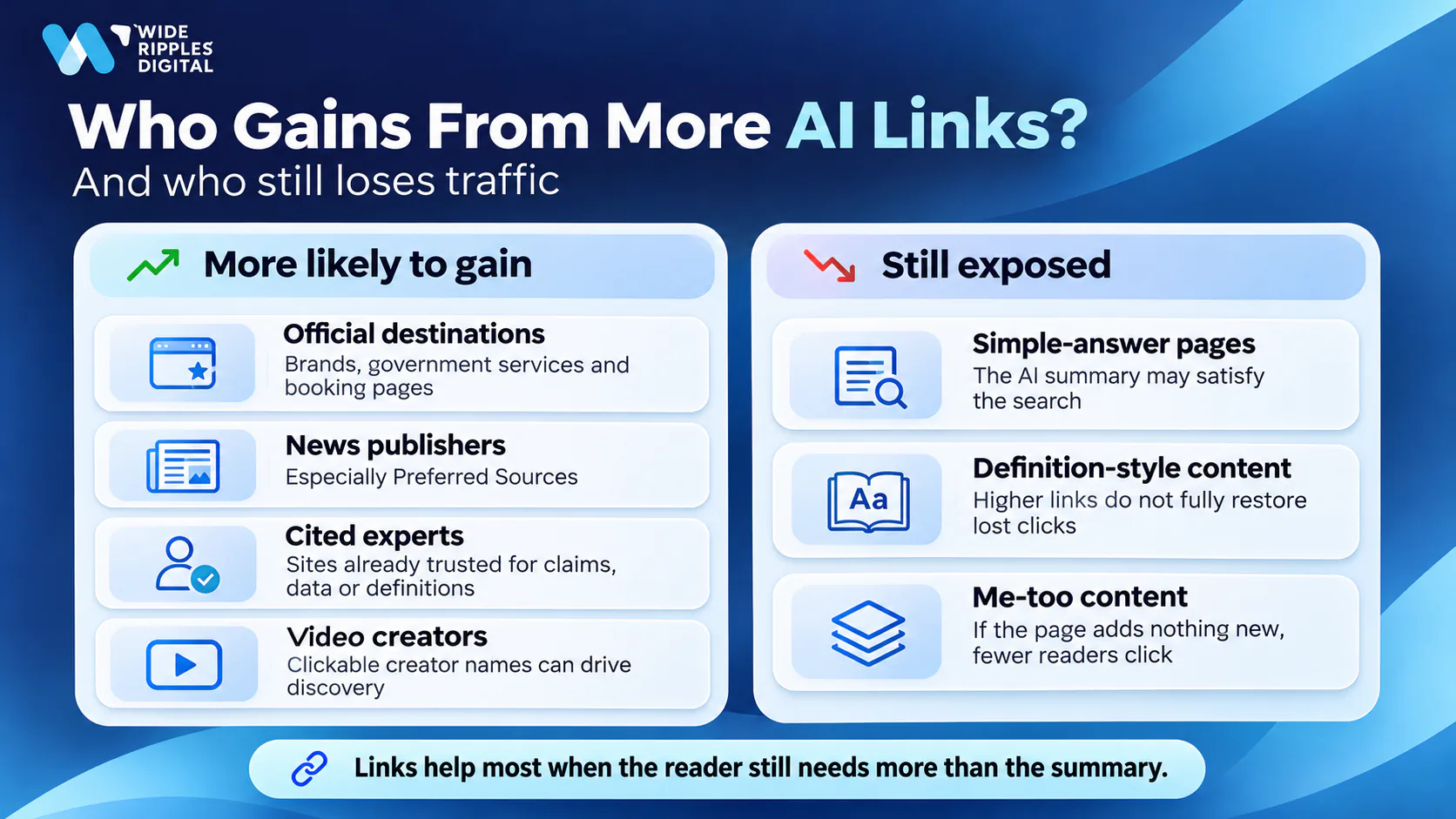
- Official destinations. Brands, government services and booking pages that are the single right answer to a task
- News publishers. Especially those readers have added as Preferred Sources
- Cited experts. Sites whose pages already earn inline citations for specific claims, data or definitions
- Video creators. Channels that gain a clickable name and a Search profile in AI Mode
What these sites share is a reason to click. A reader who wants to book, buy, read the full story or watch the video still has to leave the AI answer.
Who still loses AI Mode traffic
Pages that answer simple questions remain exposed. If your post explains what a term means, the AI answer covers it, and a higher link does little to change that.
Take a hypothetical example. Your guide to a tax deadline earned 4,000 clicks a month in 2024. An AI Overview now gives the date directly, and clicks fall to 1,600. A higher inline link might win back a few hundred clicks from readers who want detail, but not the original 4,000.
The lesson is simple. Links help readers who need more than the summary. Your content has to offer that "more", whether it is a calculator, a worked example, local detail or a service.
What you cannot measure yet
Search Console's generative AI performance report shows impressions in AI Overviews and AI Mode. It does not show clicks.
You cannot yet see whether the new inline links raise your click-through rate from AI answers. Clicks from AI features are counted in your standard Performance report, mixed with every other organic click. Google says more metrics are coming but has not given a date.
What the update means for Canadian businesses
Businesses can benefit when a search calls for one specific official page, such as a brand's own booking or support page. Google has not confirmed which local service searches will trigger the official websites test.
Take a hypothetical Mississauga dental clinic. A patient who searches for the clinic by name and asks to book is looking for one official destination, the kind of task Google describes. A generic search like "dentist near me" has many valid answers, so it does not fit that description.
Bilingual businesses should watch the news carousel rollout too. Google says carousels are reaching more languages. If you publish in French for Quebec readers, check whether your French pages appear in AI answers as well as your English ones.
How to earn more Google AI Mode links
Google has not published new ranking rules for the update. It says AI features need no special optimization or schema, and appearance is never guaranteed. The sites most likely to gain are the ones AI answers already trust and cite.
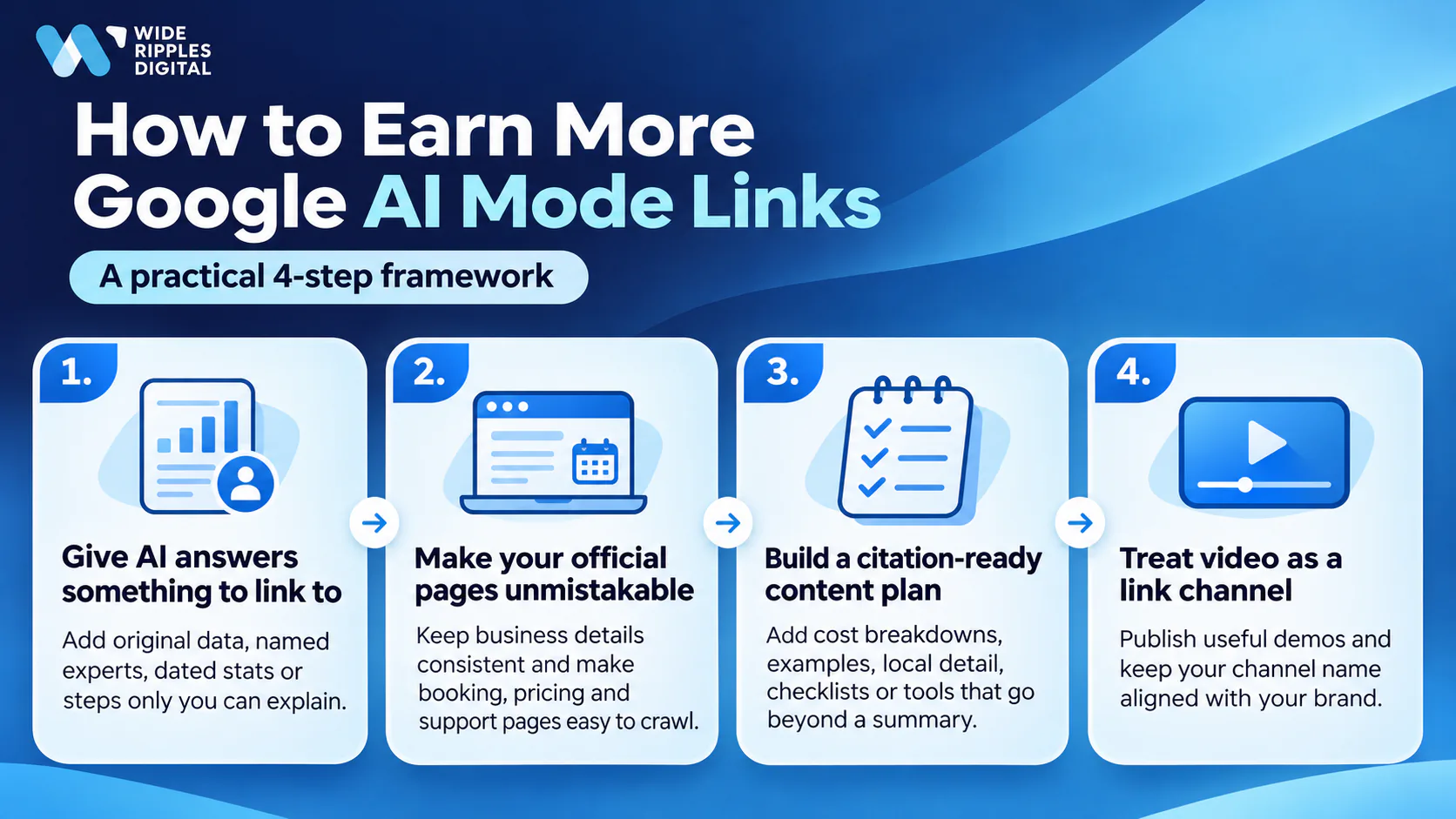
Give AI answers something to link to
Inline links sit on specific words or claims. Your page earns one when it is the clearest source for that claim.
Original data, a named expert, a dated statistic or a step only you can explain all give Google a reason to link. A page that repeats what 10 other sites say gives it none.
Format matters as much as substance. A direct answer under each heading, short paragraphs and tables make passages easy to quote. How to structure content for AI answers breaks down the headings, lists and proof that AI features pick up.
Make your official pages unmistakable
Google has not published criteria for the official websites test. Clear, consistent business details support Google's understanding of your business as an entity, so it can recognize your site as the official source for your brand, product or service.
Keep your business name, address and phone number consistent across your site, Google Business Profile and directories. Organization schema on your homepage is sound general practice, though Google says AI features need no special schema. Make sure key pages, such as booking, pricing and support, are easy to crawl and clearly labelled.
If a third-party site outranks you for your own brand tasks, fix that first. The official section points to official pages, so Google has to see your site as the official one first.
Build a citation-ready content plan
AI answers cite pages, not whole websites. Review your top pages one by one and ask what a reader would still need after reading an AI summary.
Add that missing layer to each page. It might be a cost breakdown, a Canadian example, a checklist or a free tool. How to optimise a website for AI citations covers the on-page changes that make a source easier to cite.
Treat video as a link channel
The creator name test turns video results in AI Mode into a path to your brand. A clickable name opens a Google Search profile that shows your wider work.
Search profiles are open to creators in Canada, India and the US who are 18 or older, have at least 10,000 followers or subscribers on one supported platform and follow Google's policies. If your business publishes how-to videos, demos or customer stories, check your eligibility and keep your channel name consistent with your brand name.
Video also answers questions text cannot. A two-minute demo of a product or service gives a reader a reason to click that an AI summary does not replace.
How Wide Ripples tracks AI Mode links for clients
We help Canadian businesses earn and measure visibility in AI answers. Our process runs in four stages:
- We pull AI impressions by page from Search Console's generative AI report and match them to organic clicks and GA4 conversions.
- We check which pages earn inline citations for priority queries, and which competitors appear instead.
- We add original data, direct answers, schema and official-page signals to the pages with the most to gain.
- We report monthly on AI impressions alongside organic clicks and website leads. We explain where Google's reporting limits stop us from tying clicks or leads to AI features specifically.
Our generative engine optimization work covers AI Mode, AI Overviews and AI platforms beyond Google.
What to do this month
Google will keep adjusting these features. You do not need to rebuild your site, but a few steps now put you in a stronger position:
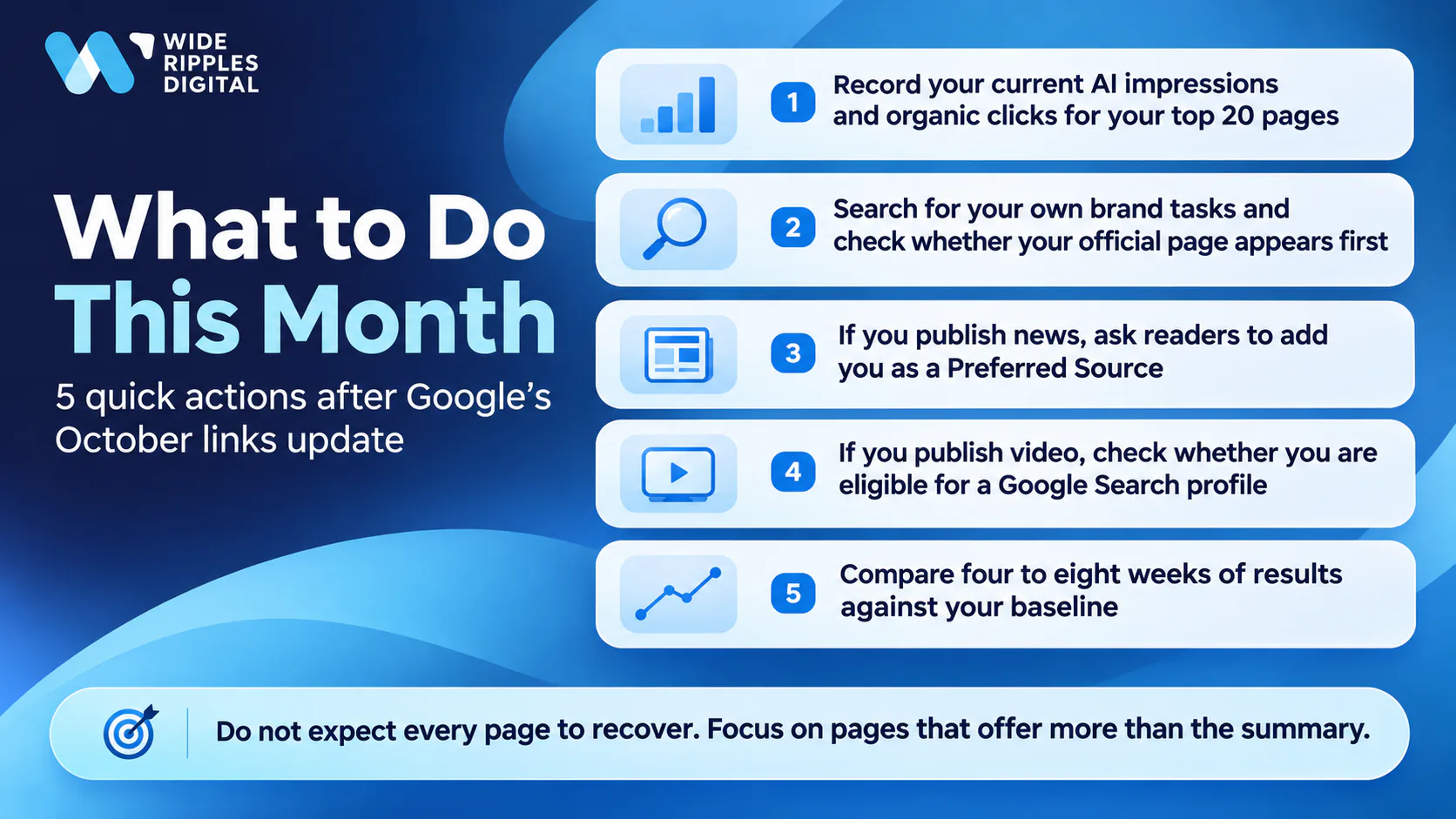
- Record your current AI impressions and organic clicks for your top 20 pages, as a baseline
- Search for your own brand tasks, such as "book" plus your business name, and check whether your official page appears first
- If you publish news, invite readers to add you as a Preferred Source
- If you publish video, check whether you are eligible for a Google Search profile
- Compare four to eight weeks of results against your baseline
Google's link changes reward websites that offer more than a summary can. Wide Ripples helps Canadian businesses turn AI visibility into clicks and leads.
Want to know where your site stands in AI Mode today? Call +1 416-668-6969 or book a free strategy call.
Google AI Mode links FAQs
Will the new links bring my traffic back to pre-AI levels?
Traffic recovery is uncertain. The links make it easier for interested readers to click, but readers who only wanted a quick fact still get it from the AI answer. Google has published no recovery data, so measure your own pages before you plan around a rebound.
Do these changes apply to searches in Canada?
Google did not name countries for most changes. News carousels are rolling out to more locations and languages globally. Check AI Mode and AI Overviews results for your own priority searches in Canada to see what has reached you.
Can I pay to appear in the official websites section?
Google has not described any paid option. The section is part of the AI response and is still a test. Clear, consistent business details on your own site support Google's understanding of your business, but appearance is not guaranteed.
How does a reader add my site as a Preferred Source?
Readers click the icon beside Top Stories when searching a news topic, or use Google's source preferences tool, where the feature is available. You cannot add yourself, but you can ask your audience to choose you, for example in a newsletter or on your news pages.
Will inline links send me lower-quality visitors?
The opposite is more likely. A reader who clicks after reading an AI summary already knows the basics and wants detail. Track engagement and conversions for those pages in GA4 to confirm the pattern on your site.
Should I stop writing informational content?
No, but change what it offers. Informational pages still earn AI impressions and brand exposure. Pair each one with something a summary cannot replace, such as data, tools, examples or a clear next step to your services.
How soon will I see a difference?
Google launched the inline link change on October 15, 2026, and other parts are still in testing. We suggest comparing four to eight weeks of clicks on your most-cited pages against your baseline before you draw conclusions.
Do links in AI Mode count as backlinks?
No. Links in AI Mode and AI Overviews are part of Google's search results, not links from another website. They can send you visitors, but they do not pass link authority the way a backlink from a respected site does.
Disclaimer: The information provided in this blog is for general informational purposes only. For professional assistance and advice, please contact experts.

Written by Umer Kureshi
Search and Performance Lead
Umer leads search and performance at Wide Ripples Digital and heads SEO and marketing at Bestax. His work covers technical SEO, content strategy, internal linking and local search, and he builds each plan around the gaps in a client’s niche rather than a copied playbook. On one campaign that approach took a site from 30 clicks a day to 12,953 in a single day.
Reviewed by Usman Shafique, Organic Growth Strategist
Last updated November 5, 2026 · Umer Kureshi on LinkedIn