How to Do Prompt-Based Keyword Research for AI Search Engines in 2026
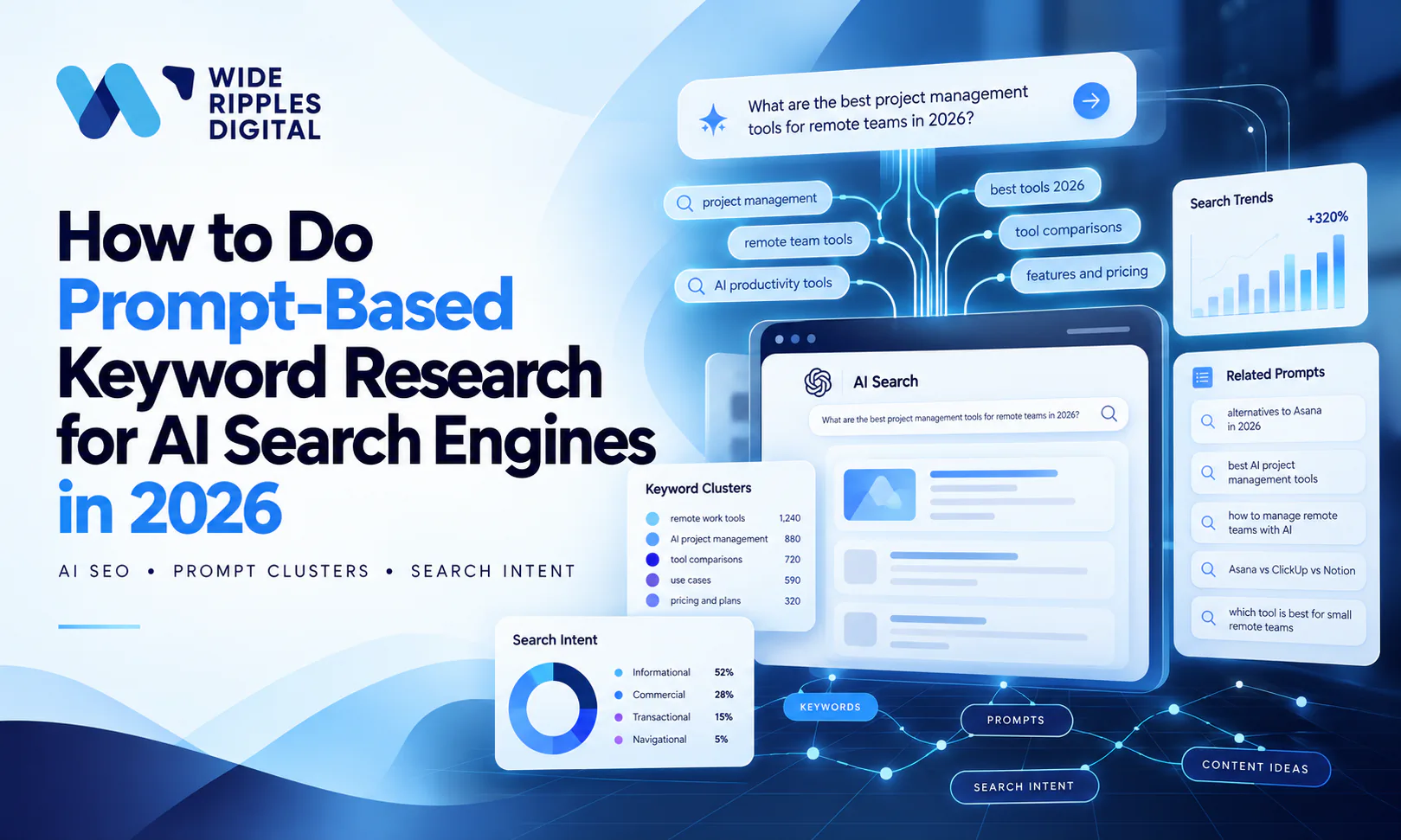
Prompt-based keyword research is the process of finding the real questions, decision moments, comparisons and follow-up prompts your audience types into AI search engines such as Google's AI Overviews and AI Mode, ChatGPT Search, Perplexity and Gemini. Instead of starting from a keyword tool and a volume column, you start from the customer's situation and map the whole conversation they are trying to have.
Keyword research used to be simple. You typed a seed keyword into a tool, checked the search volume, picked a few related terms and built a content plan around whatever looked popular. That is no longer enough. People now ask AI search engines full questions, add background about their business or budget, compare options in the same breath, and expect an answer that fits their situation. In plain terms, you stop thinking only like a keyword tool and start thinking like your customer.
What is prompt-based keyword research?
It means researching the way people talk to AI search engines, not only the way they type into a traditional search bar.
A traditional keyword might be:
local SEO services
A prompt-based search might be:
What local SEO services should a small business in Canada invest in if they want more Google Maps calls and website leads?
The second version is far more useful because it carries context: the audience, the location, the goal, the platform and the buying intent. From that one prompt you can plan content around local SEO, Google Maps visibility, service page strategy, lead generation, conversion tracking, Google Business Profile optimisation and reviews.
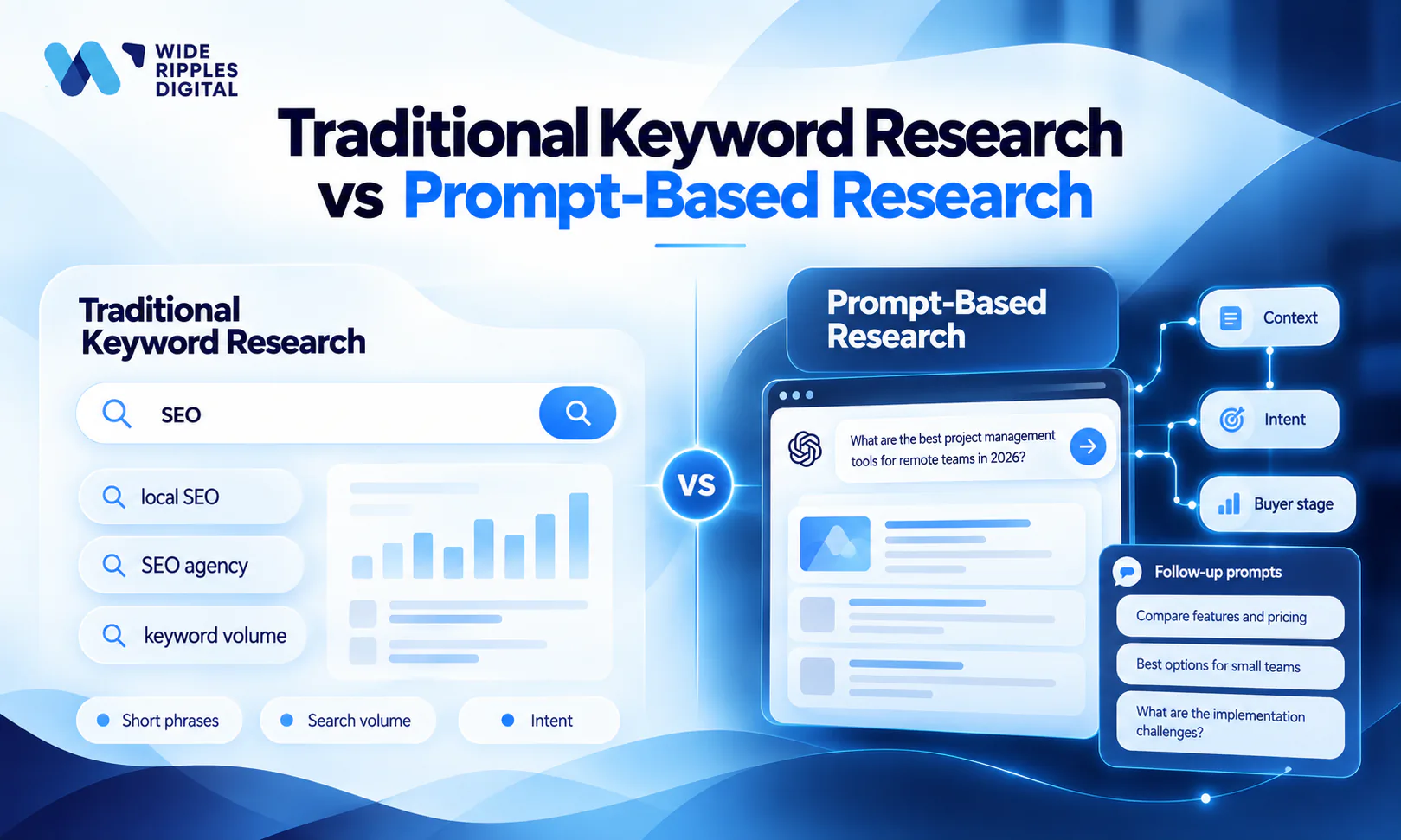
| Traditional keyword research | Prompt-based keyword research | |
|---|---|---|
| Starting point | A seed keyword | A real customer situation |
| Unit of research | Short phrases | Full questions and follow-ups |
| Main filter | Volume and difficulty | Intent, buyer stage and business fit |
| Output | A keyword list | Prompt clusters mapped to pages |
| Validation | Rankings | Rankings plus manual checks in AI answers |
Modern keyword research should still list keywords. It should also map the full conversation behind them. If you need the traditional foundation first, start with our guide on how to do keyword research for SEO, then use the prompt-based process below to extend it for AI search.
Why prompt-based keyword research matters in 2026
AI search engines are built to understand intent rather than match exact phrases. They try to work out what the person needs, what stage they are at, which sources can support the answer, and which pages are clear enough to summarise.
Google describes the mechanics in its guidance on AI features: both AI Overviews and AI Mode "may use a 'query fan-out' technique," issuing multiple related searches across subtopics and data sources "to develop a response." In other words, one question from the user becomes several searches behind the scenes. A page that covers the main question and its natural follow-ups gives Google more reasons to use it. That is exactly what prompt-based research is designed to find.
So the strongest page in 2026 is not the one that repeats a keyword most often. It is the one that answers the question better than the competition, explains the topic clearly, covers the obvious next questions and makes the next step easy. A page can rank for one keyword and still fail the broader question behind it, and AI answers make that gap easier to see.
A good prompt-based strategy helps you find:
- What your audience asks before they know the solution
- What they ask when comparing options
- Which objections stop them from buying
- What details they need before trusting a provider
- What follow-up questions they ask after reading the first answer
- What proof or example helps them move forward
If your current keyword strategy only looks at monthly search volume, you may be missing the questions that actually bring leads.
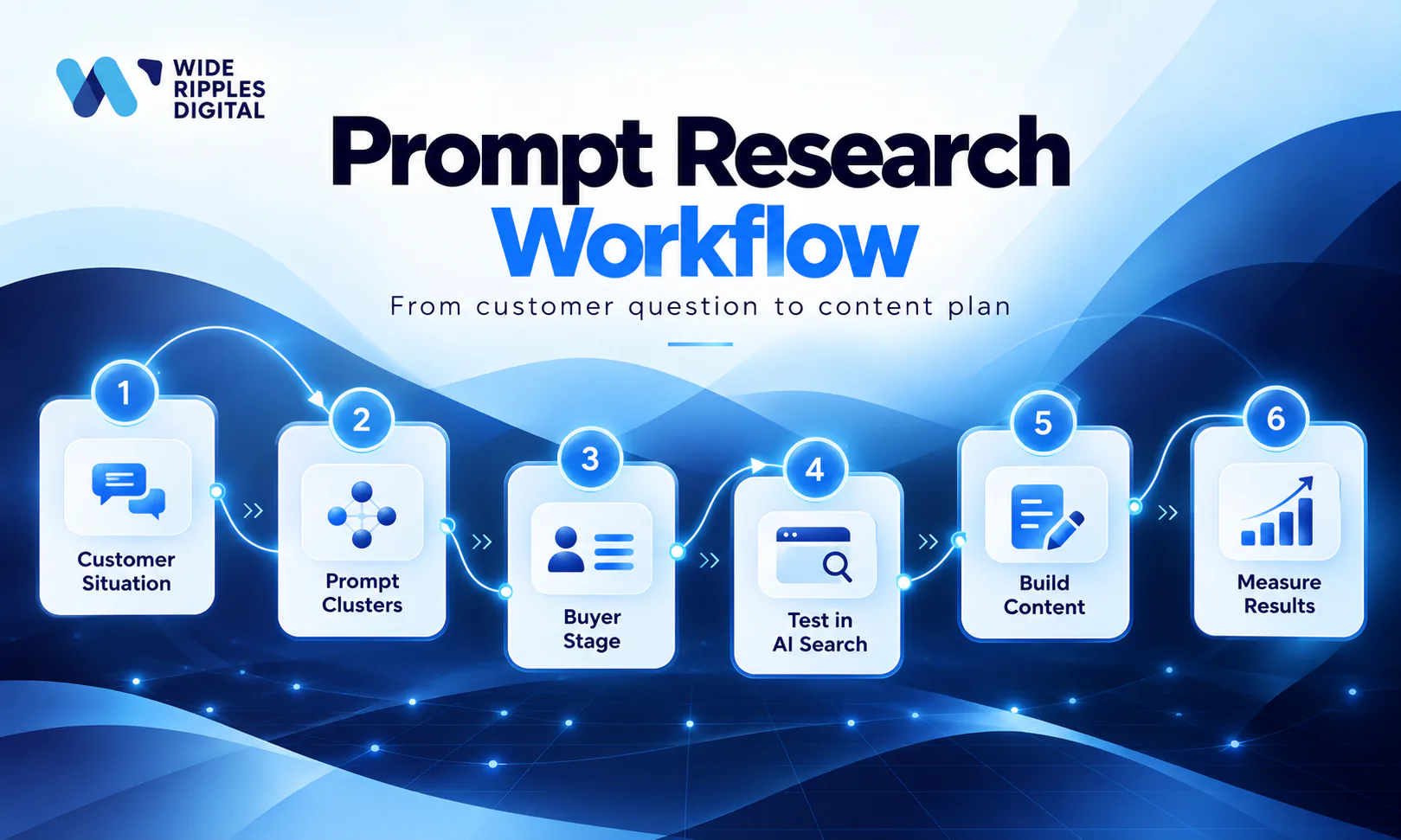
Step 1: Start with a real customer situation
The biggest mistake in keyword research is starting with a broad keyword before understanding the customer's actual problem. Instead of starting with "SEO agency," start with a situation like this:
I run a local service business and I am not showing on Google Maps.
That one situation turns into several AI search prompts:
- "Why is my business not showing on Google Maps?"
- "How can I rank higher in the Google local pack?"
- "What should I fix first on my Google Business Profile?"
- "Do reviews help my business show higher in local search?"
- "How long does local SEO take for a service business?"
This is much closer to how people use AI search. They explain the problem, ask for steps, compare options and want a recommendation that fits their type of business. The best sources for these situations are already inside your company: sales call notes, enquiry forms, support emails, onboarding questions and the objections your team hears every week.
If your business depends on local leads, connect this research directly to your local visibility plan. Our local SEO services show how Google Maps, service pages, website authority and lead generation fit together.
Step 2: Build prompt clusters instead of keyword lists
A keyword list gives you terms. A prompt cluster gives you a content strategy.
A prompt cluster is a group of related questions around one topic. If the topic is AI SEO, the cluster might include:
- "What is AI SEO and how is it different from traditional SEO?"
- "How do I make my website appear in AI search answers?"
- "Can blog content help my brand show up in ChatGPT or Perplexity?"
- "What type of pages do AI search engines prefer?"
- "Should I optimise for Google rankings or AI answers first?"
- "How do I measure visibility in AI search?"
- "What makes content easier for AI systems to extract and cite?"
That is more useful than targeting one phrase like "AI SEO services" because it shows the whole topic from every angle a buyer might come at it.
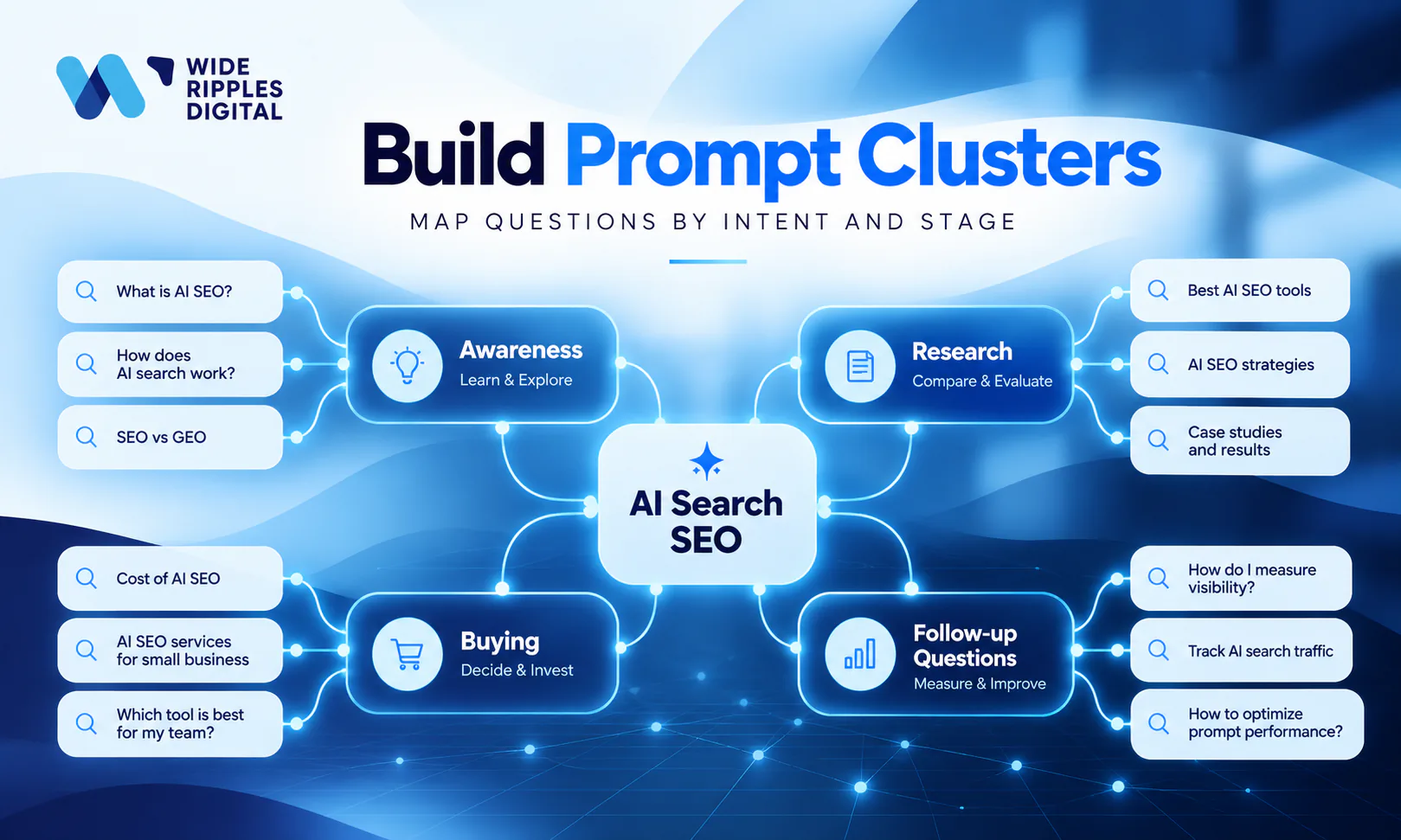
One article will not answer every prompt in depth, and it should not try. Over time, your website should cover the full cluster through service pages, blog posts, guides, FAQs, case studies and comparison pages, each linked to the others. If you want a page built specifically for this shift, our Generative Engine Optimization services focus on visibility in AI Overviews, answer engines and citation-based search.
Step 3: Sort questions by buyer stage
Not every question has the same value. Some come from beginners learning the topic, some from people comparing options, and some from buyers who are close to contacting a provider. Sort your prompts by stage.
Awareness stage:
- "What is AI search optimisation?"
- "Why is my organic traffic dropping?"
- "Why are people getting answers without clicking websites?"
Research stage:
- "How do AI search engines choose sources?"
- "What is the difference between SEO and GEO?"
- "How should I structure content for AI search?"
Buying stage:
- "Who offers AI SEO services in Canada?"
- "What should an AI search optimisation agency include?"
- "How much does SEO for AI search cost?"
- "What should I ask before hiring an SEO agency?"
This matters because your content should not treat every visitor the same. A beginner needs education. A buyer needs proof, a clear process, pricing context and a reason to trust you. That is where service pages and case studies earn their place. Our portfolio is built for that buying-stage reader: named clients, the work we did and the results, rather than vague claims.
Step 4: Use AI tools to find angles, not to replace strategy
AI tools are excellent for widening your thinking, but they should not be your only source. Give the tool a role and a situation:
Act like a small business owner in Canada who wants more leads from Google and AI search. What questions would you ask before hiring an SEO agency?
Then push with follow-ups:
- "What would you ask if you had a small budget?"
- "What would you ask if you were worried about fake SEO promises?"
- "What would you ask if your website already had blogs but no leads?"
- "What would you ask if you were comparing SEO, paid ads and content marketing?"
These prompts surface concerns that keyword tools often miss. The goal is not to copy the output. It is to understand the questions behind the search, check them against what real customers say, and then answer them with your own experience and examples. Google's autocomplete and People Also Ask boxes, Reddit threads and competitor FAQs are good cross-checks. For a deeper set of research prompts, see our guide to using Claude AI for SEO.
Step 5: Test prompts in real AI search engines
Once you have a list, test it by hand. Run your prompts in Google (AI Overviews and AI Mode), ChatGPT Search, Perplexity, Gemini or whichever tools your audience uses. Look at what gets mentioned, what gets ignored and which sources are cited.
Pay attention to:
- Which brands are mentioned
- Which pages are cited
- Which answers feel weak or generic
- Which questions remain unanswered
- Which content formats appear most often
- Which sources have strong definitions, examples and structure
- Which pages use clear headings and helpful FAQs
One caution: AI answers change between runs, accounts and locations. Run each important prompt more than once, use a fresh or logged-out session where you can, set the location you actually serve, and note the date. You are looking for patterns, not a single screenshot.
This is where you find content gaps. If every AI answer gives a basic definition but no practical checklist, write the checklist. If every result explains the topic but not how it applies to small businesses in Canada, add Canadian examples. If the answers are too technical, write a simpler guide that still sounds expert. That is how you create content useful enough to compete.
Step 6: Turn prompts into article sections
A strong AI search article is not one long block of general advice. It answers the main question first, then covers the related follow-ups in a clear structure. Instead of an article vaguely titled "AI Keyword Research," build the outline from the prompts:
- What is prompt-based keyword research?
- Why does it matter for AI search engines?
- How is it different from traditional keyword research?
- How do you find prompt-style search queries?
- How do you group prompts by intent?
- How do you test prompts in AI search engines?
- How do you turn prompts into content briefs?
- What mistakes should you avoid?
- How do you measure results?
That structure is easier for readers to scan, easier for search engines to understand and easier for AI systems to summarise. Our guide on structuring content for AI answers covers headings, lists and proof in more detail. If your team needs help turning research into pages that rank and convert, our SEO web copywriting services cover service pages, landing pages and blog content.
Step 7: Add experience that AI cannot easily copy
This is what separates average content from strong content. AI can summarise generic information very well, so if your article only says what every other article says, it is replaceable.
Add what only your team knows:
- What do clients usually misunderstand?
- What mistakes do you see again and again?
- What questions come up on sales calls?
- What patterns appear across campaigns?
- What does the data show after content is published?
- What would you do differently after handling many projects?
A basic article says: "Use long-tail keywords." A better one says something like this:
Do not treat every long-tail phrase as valuable. A long prompt can still be weak if it comes from someone with no buying intent. The better opportunity is often a specific question tied to a business problem, such as "why is my service page getting traffic but no leads?" That person is not just researching. They are trying to fix a revenue problem.
That kind of explanation is harder to copy because it comes from real strategic judgement.
Step 8: Build a prompt keyword sheet
To keep the research organised, build a spreadsheet with one row per prompt and these columns. Here is one filled-in row as an example:
| Column | Example |
|---|---|
| Main topic | AI search SEO |
| Customer situation | Business has blog traffic but few leads |
| Prompt-style query | "How do I optimise blog content for AI search and lead generation?" |
| Search intent | Problem solving |
| Buyer stage | Research moving to buying |
| Content format | Blog section plus a link to a service page |
| Answer gap | Most articles explain AI search but never connect it to conversions |
| Internal page to link | SEO services or GEO services |
| Proof needed | Campaign examples, a checklist, the content audit process |
| Priority | High |
The sheet turns a random list into a content system. It also drives your internal linking, because every prompt should point to the page that best answers the next step. Informational prompts link to guides, buying prompts link to service pages, and proof-seeking prompts link to case studies.
Step 9: Use internal links like a map, not decoration
Internal links are not only for SEO. They help readers reach the next useful page without going back to search. In prompt-based content, each link should answer the question the reader is most likely to ask next.
Use the "next step" column of your sheet to decide. A reader on an awareness article about AI search probably wants a definition or comparison next, so link to something like SEO vs GEO vs AIO. A reader on a research-stage page wants method, so link to a how-to or a service that explains the process, such as keyword research services. A buying-stage reader wants proof and a way to get in touch.
Keep it to the links that genuinely help. A paragraph with seven service links in a row reads like an advert and helps nobody. Descriptive anchor text matters too; our guide to anchor text explains how to write links that tell the reader and Google where they lead.
Step 10: Measure prompts, not just keywords
Traditional SEO tracking covers rankings, impressions, clicks and conversions. Those still matter, but prompt-based research needs a few extra checks:
- Which prompt clusters are bringing impressions
- Which pages are cited or mentioned in AI answers
- Which articles appear for question-style searches
- Which internal links are getting clicks
- Which content updates improve visibility
- Which pages lead to form submissions, calls or booked consultations
- Which topics generate leads rather than only traffic
Some of this needs a workaround. Google says traffic from AI Overviews and AI Mode is counted in Search Console's Performance report under the "Web" search type, so you will not see a separate AI line. Filter queries by question words (how, what, why, should, which) to see how your question-style searches are doing. ChatGPT Search usually tags its outbound links with utm_source=chatgpt.com, so those visits show in GA4 as chatgpt.com referrals, although some arrive with no referrer and land in Direct. For citation tracking across ChatGPT, Gemini and Perplexity, a re-run of your test prompts each month works for small sites, and the AI visibility tools we compared can automate it.
AI search may reduce clicks for simple answers, but strong content still builds trust, brand recall and high-intent visits. The aim is not to chase every AI mention. It is to earn attention from the right audience and move them toward action.
Common mistakes to avoid
Treating it as regular keyword research with longer phrases. Prompt-based research is not about longer keywords. It is about better intent.
Generating hundreds of prompts without checking them against real customers. A list of 500 AI-generated questions is useless if none of them connect to your services, your sales conversations or your audience's problems.
Writing generic answers. If your content could appear on any website, it will not make your brand stand out to readers or to AI systems choosing sources.
Forgetting internal links. A prompt-based article should never be a dead end. It should guide the reader to the next helpful page.
Ignoring conversion. Traffic from AI search and SEO only matters if it helps the business grow. Educate, but make the next step obvious.
Final thoughts
Prompt-based keyword research is how keyword strategy grows up for the AI search era. Instead of only asking "which keyword has volume?", you ask "what is the customer really trying to solve, what will they ask next, and which page should help them move forward?"
The businesses that win in 2026 will not be the ones that publish the most generic content. They will be the ones that understand real customer prompts, answer them clearly, add experience AI cannot easily copy, and connect every page to a useful next step.
Want a keyword and content plan built around the questions your customers actually ask? Book a free consultation with Wide Ripples and we will map your prompt clusters, show where AI answers leave gaps, and tell you which pages to build or fix first.
Frequently asked questions about prompt-based keyword research
What is prompt-based keyword research?
It is the process of finding the full, question-style searches people use in AI search engines. Instead of only researching short keywords, you research customer problems, comparisons, follow-up questions and buying intent, then map them to pages.
How is prompt-based keyword research different from normal keyword research?
Normal keyword research focuses on search volume, keyword difficulty and short phrases. Prompt-based research focuses on how people ask detailed questions in AI search tools, especially when they want explanations, comparisons, recommendations or next steps. It adds intent and buyer stage to the volume data rather than replacing it.
Why is prompt-based keyword research important in 2026?
More people use AI search engines and AI features in Google to get direct answers, and those searches usually carry more context. Google also says AI Overviews and AI Mode may run several related searches across subtopics to build one answer, so pages that cover a question and its follow-ups have more chances to be used.
Can prompt-based keyword research help with Google rankings?
Yes, it can support them. It leads to clearer, deeper and more useful pages, and a page that properly answers related questions has more chances to perform for long-tail searches, featured snippets, AI Overviews and regular organic results. It is not a ranking shortcut on its own.
How do I find prompts for AI keyword research?
Start with real customer situations: sales questions, support emails, enquiry forms and common objections. Then widen the list with AI tools, Google autocomplete, People Also Ask, forums such as Reddit, competitor gaps and manual tests inside AI search engines.
Should I use ChatGPT for keyword research?
Yes, for ideas and angles, but not as your only source. ChatGPT can generate customer questions, prompt variations, buyer concerns and outlines. Validate them with real search data, your own business experience and manual checks of the search results.
What is a prompt cluster?
A prompt cluster is a group of related, AI-style questions around one main topic. A cluster about local SEO might include questions about Google Maps rankings, reviews, service pages, citations, local content and conversion tracking.
How many prompts should one article answer?
One main prompt and several related follow-ups. You do not need to answer every possible question in one article. If the topic grows too large, create separate pages and connect them with internal links.
Do AI search engines care about keywords?
Yes, but not in the old way. Keywords still help search engines understand what a page is about, but AI systems also weigh meaning, structure, context, source quality and how clearly the page answers the question. Google says there are no special optimisations or AI text files needed to appear in AI Overviews or AI Mode; the usual SEO fundamentals apply.
How should I use internal links in AI search content?
Link to the page that answers the reader's most likely next question. Informational articles link to deeper guides, research-stage pages link to methods or services, and buying-stage pages link to case studies and contact options. Use descriptive anchor text and keep only the links that genuinely help.

Written by Umer Kureshi
Search and Performance Lead
Umer leads search and performance at Wide Ripples Digital and heads SEO and marketing at Bestax. His work covers technical SEO, content strategy, internal linking and local search, and he builds each plan around the gaps in a client’s niche rather than a copied playbook. On one campaign that approach took a site from 30 clicks a day to 12,953 in a single day.
Reviewed by Usman Shafique, Organic Growth Strategist
Last updated October 3, 2026 · Umer Kureshi on LinkedIn